


Bibi Andersson's only major award for her indelible work with Ingmar Bergman was at Cannes for Brink of Life
Andersson was just 27 when she acted in Brink of Life. Even at that young age, and even when the lines take a dramatic turn, you find this no-fuss, no-sentimentality quality.

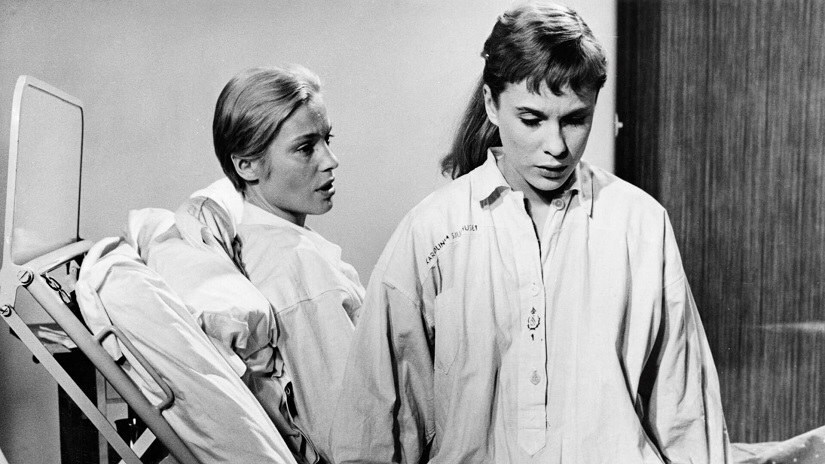
Ingrid Thulin (L) and Bibi Andersson in Brink of Life. Image via Twitter[/caption]Persona got Andersson a Best Actress award from the US-based National Society of Film Critics (they also gave her a Best Supporting Actress for Scenes from a Marriage) and a Guldbagge award (the Swedish equivalent of the Oscars). She won three more Guldbagge awards, though none were for Bergman’s films. But let’s look at the major awards, at least the ones we outsiders recognise as major. Andersson won the Silver Bear at Venice, for The Mistress (1962, Swedish), directed by Vilgot Sjöman. A year later, incidentally, Sjöman made the documentary, Ingmar Bergman Makes a Movie, in which the great filmmaker defined what makes a great actor: “An ideal actor is one who can turn on full concentration in a split second. And who can then, after each take, right after you say ‘cut’, turn it off, like switching off a light.”The only major award Bibi Andersson won for a Bergman movie was at Cannes. The film was Brink of Life (1958), and she shared Best Actress with not just her cast-mates (Eva Dahlbeck, Barbro Hiort af Ornäs, Ingrid Thulin) but also Tatiana Samoilova, who was recognised for The Cranes are Flying. So we’re talking one-fifth of a major award for one of the most legendary actress-director collaborations (and if I am not delving into Andersson’s non-Bergman films, it’s because I just haven’t seen enough of them). Given that awards are dependent on the tastes of the jury and a hundred other factors, I realise I am overreacting -- still, it seems like a minor crime. We are, after all, talking about an actress after whom a minor planet is named: 73767 Bibiandersson.Brink of Life -- which Bergman made after the twin successes of Wild Strawberries and The Seventh Seal in 1957 -- opens with Cissy (Ingrid Thulin), who’s two months pregnant and has been brought to the hospital because she’s begun to bleed. It’s a miscarriage, and after she’s taken to a ward, she tells the nurse, “This baby was not wanted. Its father did not want it. Its mother was not strong enough to love it on her own. That’s why it could not be born, and was just flushed away down the drain. Or put in a jar for scientific purposes.” The other women in the ward are Stina (Eva Dahlbeck) and Hjördis (Bibi Andersson), each with their own stories. Stina is past her due date. Hjördis is pregnant with the child of a man she’s neither married nor engaged to. Cissy is the archetypal Bergman sufferer. Stina is atypically cheerful, a living-breathing Disney cartoon -- Bergman doesn’t seem to know what to do with her, until she begins to suffer, too. It’s Hjördis who takes over the film and becomes its most fascinating character. It’s not that she doesn’t suffer. But she doesn’t come off like she’s nailed to a cross, like the others. It looks like she’s having a bad day at work and needs an Aspirin.

How Spider-Man actor Tom Holland has been on a sobriety journey of 4.5 years after being "addicted to alcohol"
Sitar virtuoso Rishab Sharma steals the spotlight with Rs 35.8 lakh Jacob & Co Ram Janmabhoomi watch at ‘Ramayana’ event: Here's what makes it rare
Amitabh Bachchan reveals being admitted to the ICU and undergoing surgery, calls recovery 'the most difficult phase of life'
Avengers Doomsday trailer out: What to expect from Marvel's ultimate crossover
Christopher Nolan banned the orchestra for 'The Odyssey': The sound of gongs, scrap metal and more