


Sridhar Vembu warns AI creates dependency among students instead of improving maths skills
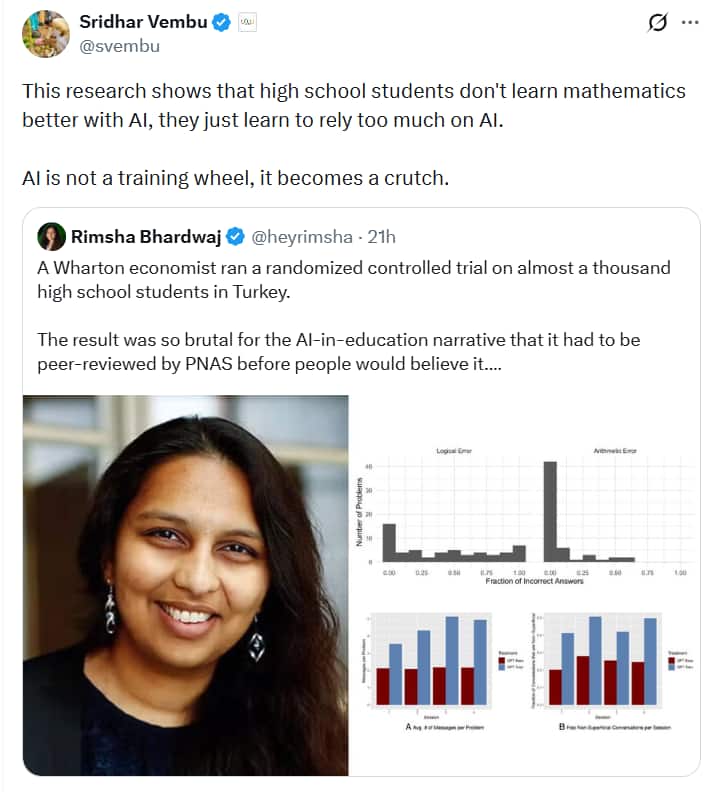
Zoho co-founder Sridhar Vambu recently claimed that AI in math is no good for the students. Pointing at a research, he says that high school children will learn to rely more on children rather than learning the skills. The research was done by a Wharton economist, who ran a randomized controlled trial on almost a thousand high school students in Turkey.

Just a few days ago, OpenAI claimed that its latest GPT model solved an 80-year-old math problem. The company was elated to describe it as among the biggest achievement in the field.
Now that AI can solve such complex mathematical problems, it is quite obvious that it can ace at high-school level queries. And this is exactly the part Zoho co-founder Sridhar Vembu wants to flag.
In the latest X post, Vembu stepped up clear the air on whether AI in mathematical education is helpful or not. He claims that while AI has achieved great success in the field, it will create a space of dependency among school kids. The crux of this claim is the research that found students who had been practicing math queries with GPT Base scored 17 per cent worse than the students who had practiced alone.
 More from Tech
Before we move on to what Vembu has to say and what does he mean by 'dependency', let's take a look at this research.
Practising math with AI may weaken problem-solving skills, study suggests
A Wharton economist conducted a large randomized controlled trial involving close to 1,000 secondary school students in Turkey to examine how AI tools affect mathematics learning. The experiment followed the same structured testing model commonly used in medical research. Students were divided into three separate groups and attended four 90-minute learning sessions.
The first group used GPT Base, a standard version of ChatGPT-4 that provided direct answers to questions. The second group worked with GPT Tutor, a modified version designed to guide students using hints and prompts instead of simply revealing solutions. The third group relied only on traditional learning methods, using textbooks and solving problems independently without AI assistance.
At first glance, the AI-supported groups appeared to perform significantly better during practice. Students using GPT Base completed 48 per cent more problems than those studying on their own, while the GPT Tutor group solved 127 per cent more. On the surface, the results seemed to reinforce the idea that AI could dramatically improve classroom learning and productivity.
However, the picture changed once students sat for an independent exam where AI tools were no longer available.
The students who had prepared using GPT Base ended up scoring 17 per cent lower than the group that practised without any AI support. Despite solving more problems during training sessions, they struggled when required to apply concepts independently. Meanwhile, students who had wrestled with questions on their own performed better in the final assessment.
Researchers later examined chat records from the practice sessions and found a clear pattern. Many students in the GPT Base group were relying on the AI to produce answers instead of actively working through mathematical reasoning themselves. Rather than building understanding step by step, they often moved quickly from one solution to the next while the AI handled most of the cognitive effort.
The study noted that, without clear limits or instructional guardrails, students tended to treat GPT-4 as a shortcut rather than a learning aid. As a result, their independent problem-solving abilities weakened over time.
One of the most striking findings came from the post-test surveys. Students who depended heavily on AI assistance were also among the most confident about their understanding of the subject, despite performing poorly in the exam. Researchers suggested that the tool created an illusion of mastery, making students feel they had learned concepts they had not actually internalised.
In effect, the AI system acted less like a tutor and more like a crutch: boosting confidence while quietly reducing genuine comprehension.
Vembu believes AI in education can create dependency and it feels right
Pointing at this research, Vembu said, "High school students don't learn mathematics better with AI, they just learn to rely too much on AI. AI is not a training wheel, it becomes a crutch."
Firstpost, previously, spoke to experts in the field to understand how AI is helpful in the mathematical research. And the comments were mostly positive.
The experts believe that AI is helping a great deal in mathematical research. Gurpreet Singh, former Isro scientist and now Math Lead at Newton School of Technology, said, “It accelerates exploration", pointing out that tasks which once took days can now be compressed into hours.
On the similar note, Siddhartha Gadgil, an IISc professor said AI is now a routine work for the researchers. “Using AI at work is now a routine task. During our research, if, for instance, you are stuck at a place, AI helps solve it much quicker than our manual checks. Its knowledge is so vast, that it is easier for the bit to highlight what is missing.”
However, another IISc professor Harish Seshadri cautions against overstating the shift. “Professional skills are still an important aspect here, even if AI is doing all of the job.,” he says. While AI can assist with steps, the conceptual grounding still rests with humans.
Hence it is quite clear that even if AI is helping researchers on the higher-level, students still need to get their basics right.
While the long-term impact of AI in classrooms remains uncertain, one thing is becoming increasingly clear: these tools are likely to become deeply embedded across education and every other industry. But AI systems still make mistakes, require human oversight and cannot replace foundational understanding. For students especially, the real challenge may not be accessing answers faster, but ensuring they still learn how to think through problems on their own.
Unnati is a tech journalist with almost half a decade of experience. She has a keen interest to cull out unique story angle. She reviews the latest consumer and lifestyle gadgets, along with covering pop culture and social media news. When away from the keyboard, you might find her reading a fiction, at the gym or drinking coffee.

OpenAI launches Presence to bring AI agents into customer support and enterprise workflows
Samsung Galaxy Fold 8 Ultra, Fold 8, Flip 8 launched: Here is how much it costs in India with discounts
Florida pastor sues OpenAI, says ChatGPT's medical advice delayed emergency treatment: Report
US accuses China's Moonshot AI of using Anthropic's Fable to build K3 model
Apple's biggest Mac refresh in years could bring 11 new models: Report