


Lava erupts from Taal volcano in Philippines, tens of thousands of people evacuate their villages
The last time the volcano’s eruption has a disastrous effect was in 1965, when more than 200 people were killed.

Red-hot lava spewed from a volcano near the Philippine capital of Manila on Monday as tens of thousands of people fled through heavy ash and frightening tremors, and authorities made plans to evacuate hundreds of thousands more for fear of a bigger eruption.
Clouds of ash from the Taal volcano reached Manila, 65 kilometres to the north, on Sunday, forcing the shutdown of the country’s main airport, with more than 500 flights cancelled. The airport partially reopened Monday after the ashfall eased.
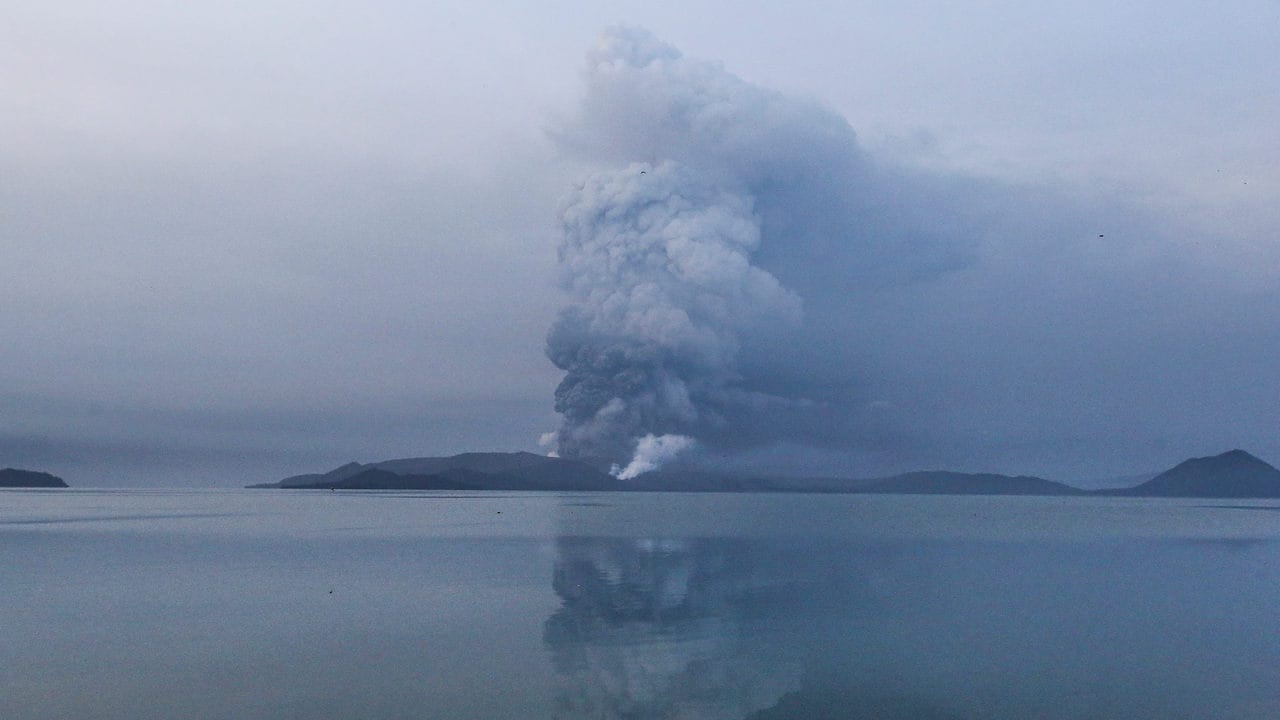
Taal volcano spews ash in view from Batangas, southern Philippines on Monday, Jan. 13, 2020. Red-hot lava gushed out of a volcano near the Philippine capital on Monday, as thousands of people fled the area through heavy ash. Experts warned that the eruption could get worse and plans were being made to evacuate hundreds of thousands. Image credit: AP Photo/Gerrard Carreon[/caption]The government’s disaster-response agency and other officials reported more than 30,000 villagers fled their homes in the hard-hit province of Batangas and nearby Cavite province. Officials expected the number to swell.
Some residents could not immediately flee their ash-blanketed villages because of a lack of transportation and poor visibility. Others refused to leave their homes and farms.
“We have a problem — our people are panicking due to the volcano because they want to save their livelihood, their pigs and herds of cows,” Mayor Wilson Maralit of the town of Balete told DZMM radio. “We’re trying to stop them from returning and warning that the volcano can explode again any time and hit them.”
 More from Science
Maralit, whose town lies along the shoreline of Taal Lake, which surrounds the erupting volcano, appealed for troops and more police to stop people from sneaking back to their villages.
On Monday, the ash and steam column reached a height of two kilometres, with lava fountains spurting less than half of that height before falling into the lake waters surrounding the main crater. Lava also spurted from another vent north of the main crater, said Renato Solidum, who heads the institute.
Frequent tremors and a buildup of pressure of the 311-meter volcano, one of the world’s smallest, however, indicated a major and much more dangerous eruption could still happen, he said.
The government volcano-monitoring agency raised the danger level around Taal three notches on Sunday to Level 4, indicating a hazardous eruption within hours to days as possible. Level 5, the highest, means such an eruption is underway.
The volcano’s last disastrous eruption happened in 1965, when more than 200 people were killed.
Irene de Claro, a mother of four, worried about her father, who stayed behind in their village in Agoncillo while the rest of the family fled.
Government work was suspended and schools closed in a wide swath of towns and cities, including Manila, because of the health risks from the ash.
Taal is regarded as the second-most restive of about two dozen active volcanoes in the Philippines, which lies along the Pacific “Ring of Fire,” a region prone to earthquakes and volcanic eruptions. A long-dormant volcano, Mount Pinatubo, blew its top north of Manila in 1991 in one of the biggest volcanic eruptions of the 20th century, killing hundreds of people.
About 20 typhoons and other major storms each year also batter the Philippines, making it one of the world’s most disaster-prone countries.

Careless Whispers: Scientists discover that plants can 'talk' to each other using smells
Life on Mars? European Space Agency’s Orbiter discovers ice water deposits at equator
Microsoft briefly overtakes Apple as the most valuable company, Apple back on top again
Even NASA is facing a tough time, starts layoffs following major budget cuts
ISRO, NASA's NISAR satellite to get ready by Jan-end, will monitor Earth's snow-covered regions