


Review: The new Nexus 7 is totally worth the higher price
If you were already eyeing last year's Nexus 7 model, then go ahead and pay $30 more for the latest.

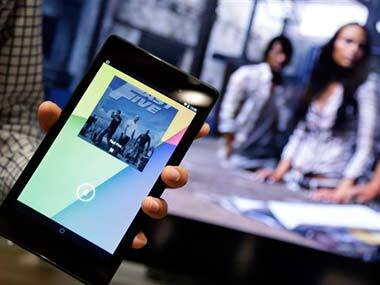
The new Nexus 7 in this file photo. AP[/caption]If you were already eyeing last year's Nexus 7 model, then go ahead and pay $30 more for the latest.Although screen dimensions are identical, the new Nexus 7 has a higher pixel density, at 323 pixels per inch compared with 216 on the old model. Trees and other objects in the movie Life of Pi look sharper, as do the movie title and credits on the screen.Sound is much better with speakers on the left and the right side of the tablet, held horizontally. Although they are technically back facing, the speakers are placed along a curved edge in such a way that sound seems to project outward and not away from you. On the old Nexus 7, I can't even tell where the speakers are.The new Nexus 7 also feels more comfortable in my hands. It's 17 percent thinner and 5 percent narrower when held like a portrait. The old model was a tad too wide to grip comfortably in the palm of my hands. The new device is also 15 percent lighter, at 10.2 ounces (290 grams). And the rubbery back feels smoother on the new tablet.The new Nexus ships with a camera app, something last year's model didn't really need because it had only a front-facing camera, for videoconferencing. With the new rear, 5-megapixel camera, you can take photos and video of what's in front of you. Expect to be ridiculed, though, if I see you doing that. Still, it's not as bad as blocking someone's view with a full-size tablet.As for the restricted profiles that come with Android 4.3, it's a good idea, though it still has kinks. When you set up a profile for your kid, you pick which apps to enable. Don't want your kid to be surfing the Web unrestricted? Then keep the Chrome browser disabled. Don't want him or her on Facebook? Keep that app disabled, too. The app store is also disabled, so Junior can't go on a download spree. If you do allow access to a particular app, though, then it's full access. There's no filtering to block porn and other questionable material, for instance.I found that some apps won't work with restricted profiles at all, including those for Gmail and other email accounts. If you want your kids to have access to email, then you have to give them full access or enable the browser to check email over the Web. You can't turn on just the email app.And although the new tablet is the first to ship with Android 4.3, it's available to download on other devices, including last year's Nexus 7.What the new tablet does offer is the promise of a longer battery life - up to 10 hours for Web surfing and nine hours for video streaming. Last year's model was rated at eight hours.There's no question the new model is better and worth the price increase. Choosing between the new Nexus 7 and the iPad Mini is tougher.If you already have an iPhone, the iPad Mini will be a nice complement. You won't have to buy music, video and apps twice, for instance. You might want to wait until this fall, though, to see whether Apple comes out with a new model.It's a tougher call if you have an Android phone.By volume, the two systems have a comparable number of apps. But I've found that many larger app developers have made versions only for the iPhone and the iPad. The American Museum of Natural History in New York has six that work on iPads but only one on Android devices. An app to watch full episodes of CBS television shows is for Apple and Windows devices only, not Android. Meanwhile, the iDonatedIt app for tracking tax deductions has more features for Apple devices, while features that are supposed to work on Android often don't.Android is good in that many apps designed for a phone's smaller screen are automatically adapted to take advantage of a tablet's larger screen. On the iPad, apps that aren't optimised for it are squeezed into a smaller window the size of an iPhone. Blow it up to full screen, and it looks distorted. But that's not as glaring on the Mini as it is on the full-size iPad. And having apps automatically change their layout isn't the same as designing them for the tablet from scratch, as is the case with the hundreds of thousands of apps optimised for the iPad.The Nexus 7's screen is much sharper than that on the iPad Mini, which has the non-HD display technology of the iPad 2 from 2011 - ancient in the world of mobile gadgets. The Nexus 7 is also a tad lighter, by 6 percent.That said, the iPad Mini has a larger screen, measuring 7.9 inches diagonally compared with 7 inches on the Nexus. And the iPad Mini has had a rear camera from the start. The iPad Mini also has Siri, a voice assistant that is feistier than Google Now on the Nexus. If you prefer Google Now for its ability to give you information you need to know without even asking, you can download it on the Mini. You can't get Siri on the Nexus.If you do get the Nexus 7, it supports wireless charging, so you can get rid of the messy wiring. The device comes only with a standard microUSB charger to plug in, so you'll have to buy a Qi-compatible wireless charger yourself.The $229 base model comes with 16 gigabytes of storage. For $40 more, or $269, you get twice the storage. Both will go on sale in the US next Tuesday. A 32-gigabyte model with 4G cellular capability will cost $349. By contrast, the iPad Mini starts at $329. A 32-gigabyte version with 4G costs $559.Even with the price increase, Google has Apple beaten on price. The Nexus 7 may lack the cachet and many of the apps that the iPad Mini has, but you'll be able to do a lot with it. I hope technology companies won't make price hikes a habit, but this one is made palatable by the device's richer display, sound and camera.About the Nexus 7:The updated Nexus 7 sports a sharper, 7-inch screen and better sound through dual speakers. It now has a rear, 5-megapixel camera to complement a 1.2-megapixel front-facing camera. It comes with an Android update that features the ability to create restricted accounts for kids.It also comes with a higher price tag. The base model with 16 gigabytes costs $229, or $30 more than last year's model. A 32-gigabyte model costs $269, or $20 more. A 32-gigabyte model with 4G cellular capability will cost $349, $50 more than before.The Wi-Fi-only models go on sale in the US on Tuesday, with other countries to come. Google says it will be available at its online Play store and the following retailers: Best Buy, GameStop, Walmart, Staples, Office Max, Office Depot, Amazon, Home Shopping Network, Radio Shack, J&R and B&H Photo. Google hasn't announced a release date for the cellular version.The device is made by AsusTek Computer, working from Google's design.Associated Press

Google burns cash for first time as AI spending pushes 2026 capex to $205 billion
Tesla sells more cars but makes less money: Why Musk’s AI pivot is squeezing profits
OpenAI launches Presence to bring AI agents into customer support and enterprise workflows
Samsung Galaxy Fold 8 Ultra, Fold 8, Flip 8 launched: Here is how much it costs in India with discounts
Florida pastor sues OpenAI, says ChatGPT's medical advice delayed emergency treatment: Report