


Microsoft Build 2026: Microsoft AI unveils next-gen In-house models and superintelligence lab plans
Microsoft AI unveiled seven new in-house models and announced plans for a superintelligence lab as it prepares for a massive scale-up in AI compute and capabilities

Microsoft has announced a major expansion of its AI ambitions with the launch of seven new in-house models developed by Microsoft AI, alongside plans to build a dedicated superintelligence lab. The company framed the move as part of a broader effort to push the frontier of AI development, as it anticipates an unprecedented surge in compute scale that could reshape work, business, and everyday life.
Microsoft AI announced a new family of in-house models built on a shared foundation and trained without distillation from other labs. The models use the same data discipline, infrastructure, and evaluation framework, and are designed to work together across Microsoft products. The company describes the approach as a “hill-climbing” system that continuously improves through compute scaling, better data, and tighter evaluation.
 More from Tech
Microsoft introduced a new family of in-house AI models under its MAI lineup, spanning reasoning, coding, multimodal, speech, and voice capabilities.
MAI-Thinkin-1, the company’s flagship reasoning model, is a medium-sized system that performs strongly within its weight class. Microsoft claims it delivers leading results on software engineering benchmarks and reaches human-preference parity with Sonnet 4.6. It is trained entirely from scratch using clean data, without any distillation.
MAI-Core-1 Flash is a 5-billion-parameter agentic coding model designed for inference-heavy workflows. It is deeply integrated into GitHub Copilot, Visual Studio Code, and the broader Microsoft stack.
MAI Image 2.5, including an ultra-efficient Flash variant, supports both text-to-image generation and image editing, with performance surpassing competing models in its category.
MAI Transcribe 1.5 is positioned as a state-of-the-art transcription model, offering high accuracy and up to five times faster performance than rivals. It also supports domain-specific terminology across 43 languages.
MAI Voice 2 delivers natural, high-quality speech generation across 15 languages and can adapt to a user’s voice from a short sample, while incorporating strong safety safeguards. A lower-cost, more efficient MAI Voice 2 Flash variant is also planned.
A major focus is Microsoft Frontier Tuning, a reinforcement learning approach that allows models to adapt directly to real-world workflows. Instead of relying only on general training data, the system learns from user-specific work traces—such as task steps, decisions, and actions inside organizations—through controlled reinforcement learning environments (RLEs). Microsoft positions this as a way for customers to effectively build their own models within their own data environments, while keeping full control and ownership of institutional knowledge.
Microsoft also emphasized a commitment to building models from scratch using clean, licensed data, its own training pipelines, and custom Maia 200 silicon, which is already delivering efficiency gains. The broader goal is long-term self-sufficiency and continuous model improvement through rigorous evaluation, small focused teams, and transparent reporting.
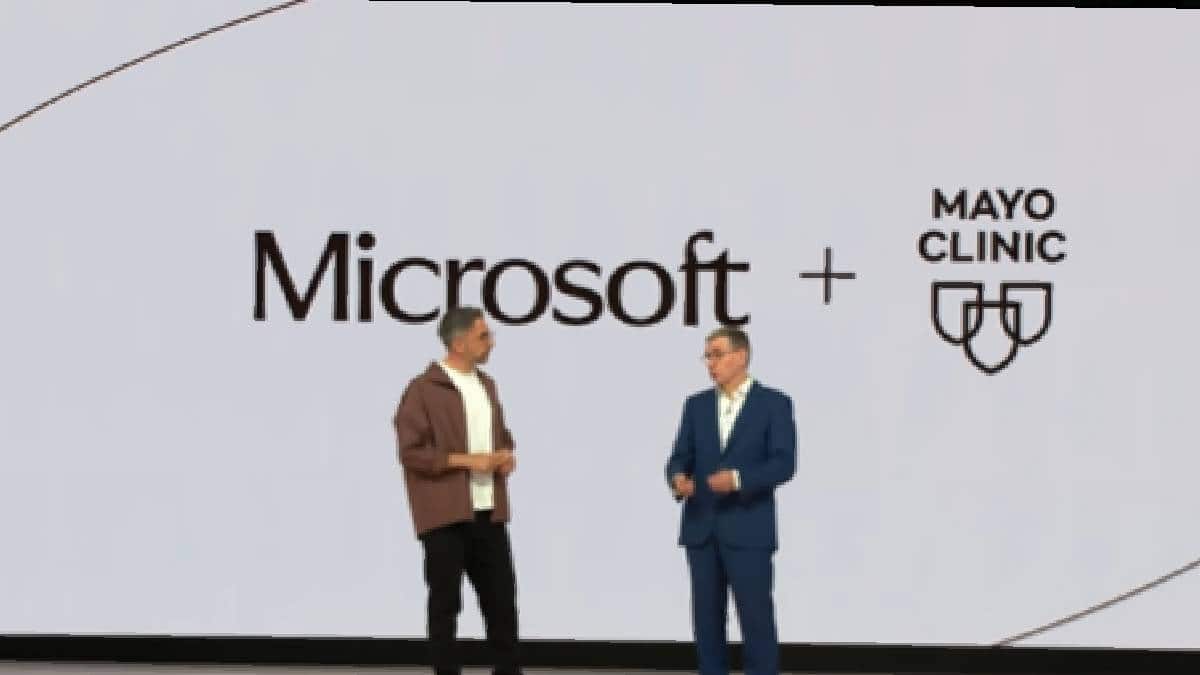
Frontier AI in healthcare: Microsoft and Mayo Clinic
Microsoft and the Mayo Clinic announced a collaboration to develop a frontier AI model for healthcare that combines Mayo Clinic’s clinical expertise and de-identified patient data with Microsoft’s AI systems. The model is designed for advanced clinical reasoning, with the goal of improving diagnosis accuracy and treatment planning.
It will first be deployed within Mayo Clinic’s own systems before being expanded via Azure Foundry to other healthcare organizations. The model will remain owned by Mayo Clinic, reflecting a focus on clinical governance, patient trust, and responsible use of sensitive medical data.

OpenAI launches Presence to bring AI agents into customer support and enterprise workflows
Samsung Galaxy Fold 8 Ultra, Fold 8, Flip 8 launched: Here is how much it costs in India with discounts
Florida pastor sues OpenAI, says ChatGPT's medical advice delayed emergency treatment: Report
US accuses China's Moonshot AI of using Anthropic's Fable to build K3 model
Apple's biggest Mac refresh in years could bring 11 new models: Report