


Microsoft Build 2026: Majorana 2 unveiled as next-generation Quantum chip
Microsoft Quantum unveiled Majorana 2, a major advance in topological quantum computing featuring far more stable qubits and progress toward scalable million-qubit systems

Microsoft Quantum has unveiled Majorana 2, a major advancement in its quantum computing roadmap following last year’s introduction of the Majorana 1 chip. Building on its earlier breakthrough based on a newly engineered state of matter, the company says Majorana 2 represents a significant step toward its long-term goal of a million-qubit system that could eventually fit on a single palm-sized chip.
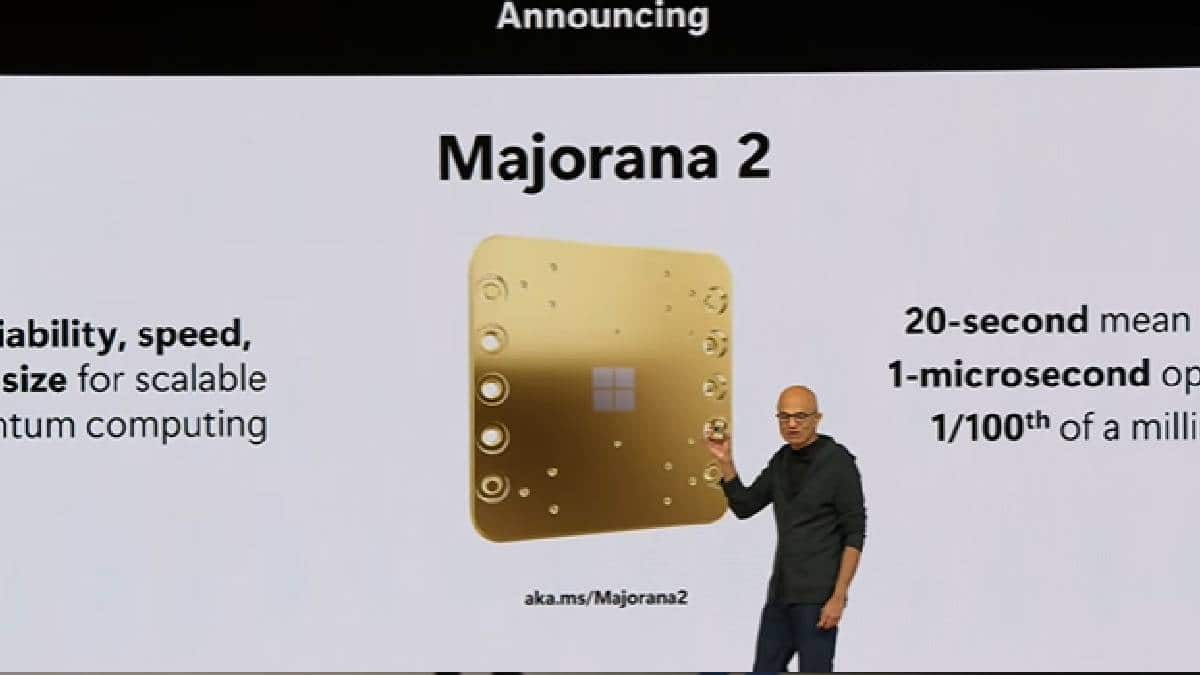
Microsoft highlights that its quantum team leveraged advances in AI to accelerate the refinement of topological qubits, helping overcome long-standing barriers that have limited practical quantum computing applications. As a result, the new system is designed to push closer to scalable, real-world quantum performance by addressing key challenges of size, speed, and reliability.
 More from Tech
The Majorana 2 qubits are reported to be around 1,000 times more reliable than the previous generation and can maintain their quantum state significantly longer. While most competing quantum systems measure qubit lifetimes in microseconds, Microsoft claims Majorana 2 achieves a mean lifetime of around 29 seconds, with some instances lasting up to a minute—marking a substantial leap in stability for quantum operations.
Microsoft’s quantum team has improved the Majorana 1 material stack to achieve a more stable topological phase, resulting in the development of Majorana 2. The new chip replaces aluminium-based superconductors with lead and updates the semiconductor active region to a combination of indium arsenide and indium arsenide antimonide. These material changes significantly enhance qubit performance by creating a larger topological gap, enabling more stable quantum states.
As a result, qubit lifetimes have improved dramatically—from between 1 and 12 milliseconds in the previous generation to over 20 seconds in Majorana 2, representing a more than 1,000x increase in stability. This marks a major leap in quantum reliability and performance.
DARPA has also advanced Microsoft to the final phase of its Quantum Benchmarking Initiative (QBI) under the US2QC program, which evaluates the feasibility of utility-scale quantum computing. The initiative involves collaboration with leading national laboratories and research institutions to rigorously assess quantum hardware, software, and applications. Microsoft’s selection follows DARPA’s evaluation of its architectural design and engineering approach for a fault-tolerant quantum system.
Roadmap Ahead
Looking ahead, Microsoft says it is accelerating its quantum roadmap, with plans now targeting a scalable, practical fault-tolerant quantum computer by 2029—cutting its earlier timeline in half and marking a significant milestone on the path toward transformative quantum computing.
Tags

OpenAI launches Presence to bring AI agents into customer support and enterprise workflows
Samsung Galaxy Fold 8 Ultra, Fold 8, Flip 8 launched: Here is how much it costs in India with discounts
Florida pastor sues OpenAI, says ChatGPT's medical advice delayed emergency treatment: Report
US accuses China's Moonshot AI of using Anthropic's Fable to build K3 model
Apple's biggest Mac refresh in years could bring 11 new models: Report