


1X unveils Neo's human-like robot hands that can feel touch and wash themselves | Watch
Humanoid robotics firm 1X has unveiled a major upgrade for its Neo robot, introducing dexterous hands that can sense touch, detect slipping objects and even be washed. The company says the new hardware brings Neo a step closer to handling everyday household chores with the finesse expected from human hands.

Household robots have long promised to cook meals, fold laundry and tidy up homes. The biggest challenge, however, has never been getting a robot from one room to another, it has been giving it hands capable of handling everyday objects without dropping, crushing or damaging them.
Norwegian robotics company 1X believes it has taken a significant step towards solving that problem.
The company has unveiled a new generation of hands for its Neo humanoid robot, packing in a combination of tactile sensing, tendon-driven movement and waterproof construction that aims to make the machine far more capable in real-world domestic environments. The update represents one of the most sophisticated robotic hand systems demonstrated for a consumer-focused humanoid robot to date.
 More from Tech
Designed for work inside homes rather than factories, Neo's latest hands promise a level of dexterity that closely resembles human movement, allowing the robot to manipulate delicate objects while also handling more demanding physical tasks.
Hands that can feel, adapt and even wash themselves
Unlike conventional robotic hands that simply execute commands, Neo's new hardware is designed to gather information while interacting with the world.
Most industrial robot hands rely on high gear ratios that prioritise strength but severely reduce their ability to detect physical contact. Once a robotic finger reaches its commanded position, the system receives little meaningful feedback about what it is touching or how much force is being applied.
Neo approaches the problem differently.
Its hands use tendon-driven mechanics with significantly lower gear ratios—roughly between 5:1 and 15:1—allowing every joint to function not only as a motor but also as a sensor. This creates what 1X describes as "force transparency", enabling the robot to measure contact forces while remaining backdrivable, meaning its fingers can naturally yield when pressure is applied instead of remaining rigid.
The fingertips are also equipped with high-resolution tactile sensors capable of detecting pressure, contact points and sideways forces that indicate when an object is beginning to slip.
That continuous stream of sensory information allows Neo to adjust its grip in real time rather than simply following pre-programmed movements.
Combined with 25 actuated degrees of freedom, the system gives the robot considerably more flexibility than traditional robotic grippers, making it better suited to handling fragile or unfamiliar household items.
Built for homes, with smarter capabilities still to come
The engineering extends beyond dexterity.
The new hands carry an IP68 rating, meaning they are sealed against dust and water and can be safely immersed. In practical terms, that allows Neo to wash its own hands after completing messy tasks—a feature rarely seen in humanoid robots.
Whether preparing food, cleaning kitchen surfaces or handling sticky ingredients, the washable design enables the robot to continue working without contaminating other household objects.
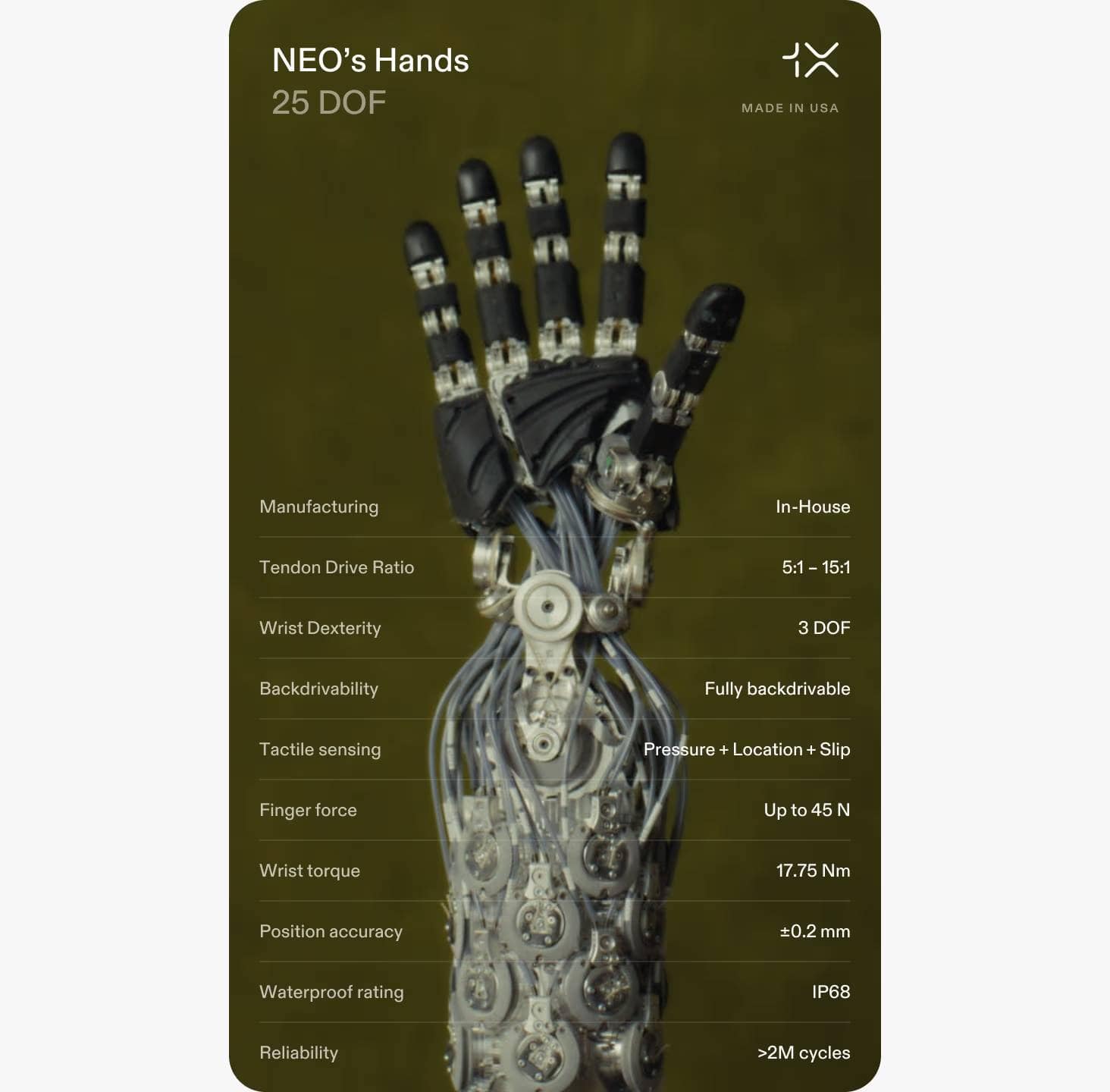
1X argues that while a humanoid's legs allow it to move through a home and its torso houses batteries and computing hardware, the hands ultimately determine how useful the robot becomes in everyday life. Tasks such as folding clothes, vacuuming, preparing meals or organising household items all depend on precise manipulation rather than mobility alone.
The company also believes the hardware is currently more capable than the artificial intelligence driving it.
That could prove advantageous in the long run. As Neo's AI improves through software and over-the-air updates, the robot may unlock new skills without requiring changes to its physical design.
The announcement also highlights the growing competition in humanoid robotics. Several startups are racing to build increasingly capable robotic hands, recognising that dexterity remains one of the biggest obstacles to creating useful general-purpose robots.
For now, 1X's latest reveal suggests the industry is edging closer to a future where humanoid robots are no longer confined to demonstrations in controlled environments. If Neo's hands perform as advertised, the vision of a robot that can prepare dinner, clean the kitchen and safely handle everyday household objects may no longer seem as distant as it once did.
Unnati is a tech journalist with almost half a decade of experience. She has a keen interest to cull out unique story angle. She reviews the latest consumer and lifestyle gadgets, along with covering pop culture and social media news. When away from the keyboard, you might find her reading a fiction, at the gym or drinking coffee.

OpenAI launches Presence to bring AI agents into customer support and enterprise workflows
Samsung Galaxy Fold 8 Ultra, Fold 8, Flip 8 launched: Here is how much it costs in India with discounts
Florida pastor sues OpenAI, says ChatGPT's medical advice delayed emergency treatment: Report
US accuses China's Moonshot AI of using Anthropic's Fable to build K3 model
Apple's biggest Mac refresh in years could bring 11 new models: Report