


Joint Euro-Japan spacecraft BepiColombo got its first view of Mercury, completed one of six flybys
The joint mission was launched in 2018 and it flew once past Earth and twice past Venus on its journey to the solar system’s smallest planet.

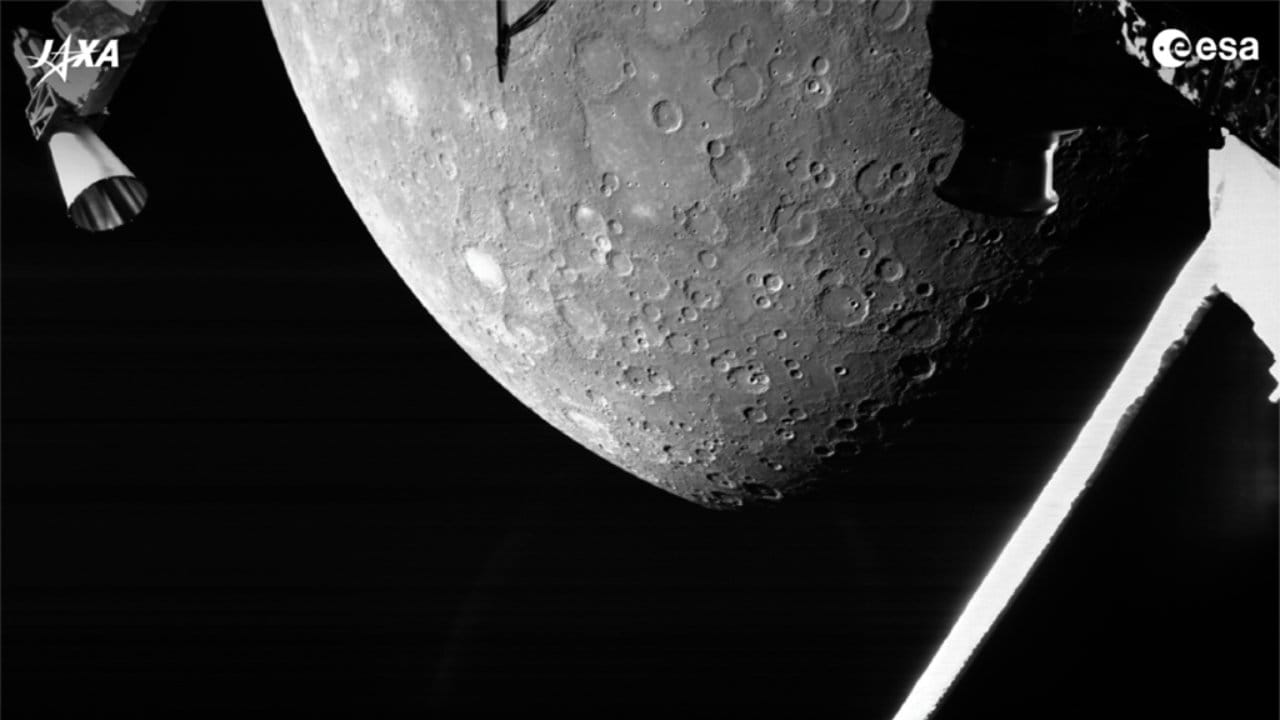
This image made available by the European Space Agency (ESA) shows planet Mercury taken by the joint European-Japanese BepiColombo spacecraft Mercury Transfer Module’s Monitoring Camera 2, Friday, Oct. 1, 2021. (ESA via AP)[/caption]The European Space Agency said the captured image shows the Northern Hemisphere and Mercury’s characteristic pock-marked features, among them the 166-kilometer-wide (103-mile-wide) Lermontov crater.The joint mission by the European agency and the Japan Aerospace Exploration Agency was launched in 2018, flying once past Earth and twice past Venus on its journey to the solar system’s smallest planet.Five further flybys are needed before BepiColombo is sufficiently slowed down to release ESA’s Mercury Planetary Orbiter and JAXA’s Mercury Magnetospheric Orbiter. The two probes will study Mercury’s core and processes on its surface, as well as its magnetic sphere.The mission is named after Italian scientist Giuseppe ‘Bepi’ Colombo, who is credited with helping develop the gravity assist maneuver that NASA’s Mariner 10 first used when it flew to Mercury in 1974.

'It's not over yet': PV Sindhu makes bold declaration following historic Japan Open title victory
The Luis de la Fuente effect: Spain’s secret weapon in their 2026 World Cup victory
Rodri beats Messi to win Golden Boot award; Check out full list of 2026 World Cup award winners
Messi breaks down after World Cup defeat, shares touching hug with Lamine Yamal
FIFA World Cup jackpot: What does Spain take home after beating Argentina?