


Weekly Defence Dispatch: India nears biggest military overhaul, a cornered Pakistan weighs its options and more
As India's theatre command reform nears Cabinet approval, a cornered Pakistan battles Balochistan insurgency, PoK unrest and a water row while deepening ties with Turkey. Firstpost tracks the week's key developments.

India Is Building the Military It Would Need to Fight China's
Delhi is done treating the China challenge as three separate problems for three separate services. What's taking shape now is a single command architecture and a fleet built to the same tonnage class as Beijing's, the clearest answer yet to the collusive two-front scenario.
Theatre commands clear their last hurdle
India's theatre command reform is nearing Cabinet Committee on Security clearance, after CDS General NS Raja Subramani sought Defence Ministry approval to begin the rollout. The plan creates three commands. A western command facing Pakistan under the Air Force, a northern command facing China under the Army, and a maritime command under the Navy. Each will be led by a four-star theatre commander with Army, Navy and Air Force assets under a single chain of command.
 More from India
The reform was first proposed by India's inaugural CDS, General Bipin Rawat, and has taken years to work through genuine questions about resource-sharing and command hierarchy between the three services. That is normal for any military trying to fuse structures that evolved separately for decades.
Operation Sindoor in 2025 gave the plan its clearest real-world test. It was the first operation run with meaningful tri-service coordination, and its operational lessons have reportedly gone straight into the final command design rather than sitting as a separate case study.
With all three services having already signed off institutionally, CCS approval is the last procedural step before what would be independent India's most significant military restructuring to date. More on the phased rollout here.
A fleet built to match Beijing's
The maritime command taking shape on paper will need ships to match, and the Navy has just put a number on it. Three warship programmes worth close to ₹1 lakh crore are moving from internal planning toward formal acquisition, four destroyers, six stealth frigates and six large combat ships, sixteen in all. Each class is sized to match a Chinese counterpart already at sea, ship for ship and roughly weight for weight, so the Navy isn't just growing bigger, it's growing to fight the specific fleet it may one day face.
India also can't build this fleet and keep it tied to home waters. The Indian Ocean is the corridor for most of the world's seaborne oil and trade, and Delhi has spent years positioning itself as the region's principal security provider, the reason it runs joint patrols, disaster response and anti-piracy missions from the Gulf to Southeast Asia. China's navy has been showing up more often in these waters too, through port visits, survey ships and submarine deployments. A fleet that can only patrol the coast can't back that claim to the Indian Ocean. A fleet built to match China's own front-line ships can.
Why it matters: The single-service model India has run since 1947 was built for an army that fights one war at a time on one front. That assumption no longer holds. Pakistan and China have deepened coordination on everything from military exercises to arms transfers, and a two-front contingency is now the planning baseline in Delhi, not a hypothetical. A structure where the Army, Navy and Air Force plan and fight separately, then try to sync up mid-crisis, adds exactly the kind of friction a fast-moving conflict punishes hardest. Operation Sindoor is the quiet argument for why this reform stopped being optional, tri-service coordination worked well enough under an improvised setup to prove the concept, but also well enough to expose how much faster it could run under a permanent, pre-integrated command.
China finished its own theatre command overhaul in 2016, restructuring seven military regions into five integrated commands built for fast, joint wars rather than slow, service-siloed ones. India moving on this now closes a structural gap that has existed between the two militaries for close to a decade, at a moment when the LAC and the wider Indo-Pacific are both live fronts.
India is getting itself ready for a front with China. A theatre command gives the military the structure to fight one war across services instead of three separate ones. A fleet built to hold its own against China's front-line ships gives the Navy the hardware to back India's claim as the Indian Ocean's principal security provider, not just at the coast, but for the length of it. Neither move happens in isolation. This is Delhi building toward the contingency it has spent the last decade calling its real planning baseline.
01
THREAT BOARD
Cornered at Home, Will Pak Resort to Adventurism Against India?
Pakistan's military is losing ground on nearly every front it controls. A recent article by Sushant Sareen at the ORF speculates that a Pakistani regime, battered by insurgency in Balochistan, protests in PoK and eroding domestic legitimacy, may find war with India more attractive than reform at home. Firstpost's Utpal Kumar has also argued here that a cornered military establishment may be pushed towards external confrontation, because a war with India gives the Pakistan Army a unifying cause to make its own failures look secondary.
Pakistan's military spokesman has said as much himself, warning that no one should expect "rationality or proportionality" in its response to rising militant violence, language aimed as much at India as at the insurgents. Pakistan is battling an insurgency it can't contain, a secession claim it can't dismiss, a rebellion in territory it claims to control, a water dispute it can't resolve, all against an economy offering no relief.
Balochistan's bloodiest stretch in years
Balochistan has had one of its bloodiest stretches in years. Coordinated attacks by the Balochistan Liberation Army and the Tehrik-e-Taliban Pakistan hit coast guard camps, army convoys, police posts and a checkpoint guarding the Mangi Dam through early July, killing dozens of security personnel. Highways in the province are effectively under militant control, with fighters setting up checkpoints at will, and some ministers are reportedly paying protection money just to move through safely. Islamabad's response, Operation Shaban, has produced a militant body count that climbs almost daily, past 120 within ten days, but the number comes entirely from state media citing security officials, with no independent verification of a single death. That fits an old pattern: Pakistan has spent decades folding Baloch political dissent and enforced disappearances into the same "counter-terror" framing it uses for genuine BLA and TTP attacks, and rights monitors have logged over 10,000 disappearances from the province since 2011.
A viral independence declaration Islamabad can't undo
The insurgency escalated further on July 13, when Baloch activist Mir Yar Baloch posted a viral declaration of independence for a "Republic of Balochistan," claiming control of roughly 85 percent of the province and appealing to the UN for recognition. No country has recognised it, and the BLA itself hasn't endorsed the declaration as a formal state proclamation. But it has put Balochistan in front of a global audience that barely knew the conflict existed, at the exact moment Pakistan's own military is visibly struggling to contain the province.
PoK protests and the water dispute add to the pressure
Balochistan isn't the only front burning. Pakistan-occupied Kashmir has its own uprising, weeks of protests led by the Joint Awami Action Committee over electricity subsidies, wheat prices and a security crackdown, with more than 30 dead around Rawalakot and Sudhnoti and over 4,000 Rangers deployed to stop a planned 40,000-strong march on Muzaffarabad. Army chief Asim Munir has separately warned that Pakistan will take "all necessary measures" over its water share under the Indus Waters Treaty, which India put in abeyance after Pahalgam, repeating that any move to restrict Pakistan's water would be treated as an act of war.
The through-line: Every one of these fronts, Balochistan, PoK, the water dispute, points the same direction: an army that cannot win at home looking for a win elsewhere. The usual Indian assumption is that a Pakistan fighting insurgents on multiple fronts can't afford to open a third with India. That logic may be backwards, that Rawalpindi's only real tool left is brute force, and a short war with India could look safer to its generals than admitting defeat at home. With India maintaining that Operation Sindoor is paused rather than concluded, the working assumption in Delhi has to be that the next provocation could come with little warning, and that it may be chosen precisely because Rawalpindi needs one.
Pakistan Deepens Defence Ties With Turkey as Army Chief Visits Ankara
Field Marshal Asim Munir was in Ankara this week for talks on deepening Pakistan's defence ties with Turkey, touching on joint production, technology transfer, and wider military exercises across land, air and sea. You can read more about the visit here.
The two countries already have a working defence relationship. Ankara has a growing defence-export business, especially in drones and naval platforms, and it fits neatly with what Pakistan already manufactures at home.Turkish drones and systems featured heavily in Pakistan's arsenal during India's preemptive strikes in May 2025, and India's air defences swatted all of it down without much trouble.
Turkey's Land Forces Commander had made a reciprocal trip to Pakistan earlier this year, and this visit builds on that groundwork. Analysts in both capitals are describing the push as one toward real interoperability, not just a photo-op. There is also speculation that Turkey could join the Pakistan-Saudi defence pact.
Why it matters: Pakistan is doing what it usually does after coming off worse in a fight, hunting for a foreign patron to paper over its own shortcomings instead of fixing them. Turkish drones didn't move the needle in May 2025, and tighter joint production with Ankara doesn't bridge all the gaps between the two militaries. It just makes Pakistan's supply chain a bit harder to squeeze. A steadier flow of Turkish unmanned systems and naval kit adds bulk to Pakistan's arsenal even if it doesn't add quality. India's own air defence and counter-drone work needs evolve to keep the advantage firmly in India's favour.
Army, Navy to induct amphibious combat boats for Sir Creek patrols
The Army and Navy are set to induct high-speed amphibious combat boats that can move across water, marshland and firm ground, to strengthen patrols in the Sir Creek sector and the Andaman and Nicobar Islands.
The Defence Ministry has issued an RFP for 11 rigid-hull amphibious boats, with at least 60 percent indigenously produced boats to be acquired. The target is to get the deliveries within two years, although no manufacturer has been picked yet. Most boats go to the Army for use in the Kutch, while the rest to the Navy. Each boat can carry 12 soldiers and a two-man crew.
Sir Creek is tricky terrain: Sir Creek is a 96-km tidal estuary, and the boundary here has stayed unresolved since Partition. India's claim follows the eastern bank of the creek. Pakistan claims the mid-channel. That gap decides who controls a stretch of maritime economic zone that is valuable for fishing and possible hydrocarbon reserves.
The ground itself doesn't hold still either, tides turn marsh into open water and back within hours, which strands regular patrol boats on mudflats and bogs down vehicles in the silt. Right now BSF outposts, patrol boats and the "Creek Crocodile" commandos cover this terrain, switching platforms depending on what the tide allows.
Defence Minister Rajnath Singh has also flagged the sector's rising stakes himself, warning last October that any Pakistani misadventure in Sir Creek would invite a response "so strong that it will change both history and geography,".
Why it matters: A boat that works regardless of tide closes a real capability gap in a sector that briefly triggered war in 1965. The Andaman leg of the order matters separately, that theatre is India's forward post for tracking China in the Indian Ocean, and faces the same land-water mobility problem across scattered islands. One platform, two fronts.
02
CHINA WATCH
Army Chief reviews Eastern Command preparedness
Army Chief General Dhiraj Seth carried out a two-day review of the Trishakti Corps under Eastern Command this week to check troop deployments, surveillance systems and the security situation along the China border. The visit took him to Bengdubi Military Station, at the northern mouth of the Siliguri Corridor, and on to Nagaland's 3 Corps (Spear Corps), for a separate briefing on operational readiness. This was his second major field visit since taking over as Army Chief.
Why Siliguri Corridor: The Siliguri Corridor, under 20 km wide at its narrowest, is the only land link between mainland India and the Northeast. It's commonly called the Chicken's Neck for a reason, cut this strip and the entire Northeast is isolated. The government has been reinforcing it in parallel, a planned underground rail line, highway stretches handed to national agencies for faster expansion, and over 120 acres given to BSF for surveillance. Hasimara Air Force Station in the corridor also houses one of India's two operational Rafale squadrons.
The Eastern theatre runs on a different tempo than the Western one, long stretches of infrastructure building and force calibration rather than active skirmishing. So periodic reviews are how the Army tracks what China is doing on its side of the LAC where road, rail and garrison construction has continued steadily since the 2020 stand-off. The Chief’s visit timing also lines up with the theatre command proposal nearing Cabinet approval. Eastern Command is expected to be folded into the new China-facing northern command, so ground-truthing troop postures and surveillance gaps now feeds directly into how that command is structured from day one.
Indian Army Rejects Claims of Chinese PLA Encroachment in Arunachal Pradesh
The Indian Army has dismissed recent reports alleging that Chinese PLA troops had encroached into Arunachal Pradesh and set up new camps there, calling the claims "incorrect and without any basis. The denial came days after an India-China Border Affairs meeting in Beijing, which External Affairs Ministry had described as constructive
India and China have spent the past year working through disengagement mechanisms and border dialogue meant to lower the temperature along the LAC, and a swirl of unverified encroachment reports threatens to undo that quietly, feeding public alarm.
Army Plans Zorawar Upgrade to Match Chinese Firepower in the Himalayas
The Army wants to raise the armour of the Zorawar light tank without pushing the tank's weight much past its current 25 tonnes. Zorawar was built light specifically to operate in high-altitude terrain like the Depsang Plains, where China's own Type-15 light tank sets the benchmark it will eventually be measured against. However, at present the Zorawar struggles to take on 25mm and 30mm rounds, which is why the Army is keen to upgrade it to NATO-equivalent standards. This is a chance for Indian materials science firms to start developing a domestic ceramic armour supply chain, which has applications well beyond just Zorawar.
Why China Won't Sell J-35 Jets to Pakistan Yet
Rumours that Pakistan is close to acquiring 40 Chinese J-35 stealth fighters have circulated since 2024. They resurfaced again this month. But these could just be Chinese whispers as per a report published on the site The Diplomat recently. The J-35 only debuted two years ago, and China hasn't even finished equipping its own carriers with it. Every jet coming off the line is going to the PLA Navy first, as Beijing races to match the US Navy's much larger carrier fleet.
Supplying frontline fighters to Pakistan may not be a priority at this moment. There's another bigger reason for a hold up. Handing a rogue state like Pakistan, the region's first fifth-generation fighter, would tip a balance on the India-Pakistan equation that China isn't ready to manage the fallout from.
Why it matters: As long as China holds off, India's AMCA programme isn't racing against an external deadline the way Pakistan would like to portray. Pakistan Air Force is still a long way away from suddenly fielding a stealth jet.
03
INDIA DEFENCE UPDATES
Isro Battles Scientist Exodus Even as Skyroot's Vikram-1 Marks Private Sector's Big Leap
There is consternation over 100 scientists resigning from the Isro in recent months, many from Gaganyaan and other flagship programmes. The Department of Space has responded with a July 14 memorandum tightening exit rules saying resignation requests from Group 'A' scientists on critical missions will no longer be cleared routinely.
Neither Isro nor the DoS has officially explained the resignations. But it is reported that India's growing private space industry is widely seen as a big draw, as startups and aerospace firms are actively hiring away experienced Isro hands with better pay and faster growth.
Former Isro officials have cautioned that tighter exit rules alone won't fix this problem. Deeper issues like career growth, leadership and work culture are at the heart of it. The stakes are higher for Gaganyaan specifically, since its human spaceflight mission depends on institutional knowledge built over years, and India's crewed launch is already running well behind its original 2022 target.
Vikram 1 launches: The same private space ecosystem pulling talent away from Isro delivered its own milestone this week. Skyroot Aerospace's Vikram-1 lifted off from Sriharikota on July 18. Its the first orbital-class rocket built entirely by a private Indian company to fly from Indian soil. The seven storey rocket, built in house with 3D printed engines, was designed to carry small satellites up to 350 kg to low earth orbit. It follows Skyroot's 2022 Vikram-S suborbital flight, India's first private rocket to reach space. You can read more about it here.
Why these developments matter: Together, these are really one story: India's space capability is shifting from a single state monopoly to a wider ecosystem with serious private players. Isro's talent loss is uncomfortable, but it's also the direct result of a private space industry becoming credible enough to compete for the same engineers, the same industry Vikram-1 just proved out.
04
PROCUREMENT AND INDUSTRY TRACKER
DRDO to Build Trisonic Wind Tunnel to Fast-Track Missile Development
Our sister network CNN-News18 exclusively reports that DRDO is moving to set up a trisonic wind tunnel facility in Hyderabad. DRDO has sought consultancy services for detailed engineering, design, drawings.
A wind tunnel is essentially a chamber that blasts air at high speed over a model to see how it behaves in real flight. The trisonic tunnel can do this at varying conditions (slow, sub-sonic and supersonic) all in the same facility. At present the three speed ranges are tested in separate wind tunnels run by DRDO, National Aerospace Laboratories and a few universities.
Why it matters: This will speed up missile design before DRDO spends money and time on an actual flight trial. Every missile programme India runs, from Agni to Akash, depends on testing queues at existing facilities. A dedicated trisonic tunnel makes that entire process possible in one facility and helps DRDO keep its own schedule.
Pralay missile may open to private manufacturing alongside ASTRA MK-2
India is considering extending private-sector manufacturing rights, first opened up for the ASTRA MK-2 air-to-air missile, to the Pralay tactical ballistic missile. Pralay is a 500-km-range system and forms part of India's developing Integrated Rocket Force. Firms like Bharat Forge, Tata Advanced Systems and Solar Industries are the likely contenders.
Why it matters: State-run missile production has historically been a bottleneck because manufacturing capacity at DRDO and production partners simply can't scale to match demand. Letting established private defence manufacturers build a proven design changes that math.
Russia Offers India AL-51F1 Engine Expertise for AMCA
Russia has offered to share engineering knowledge from its AL-51F1 engine, developed for the Su-57, to support India's AMCA fifth-generation fighter programme. It's a transfer of design lessons and development experience, not a finished engine. AMCA programme’s airframe design, stealth shaping and avionics have all moved forward under DRDO and HAL. But development of a reliable domestic engine is still years out.
Rolls-Royce and Safran are both already in talks with India on co-developing that engine. Moscow's offer is attractive, but the AL-51F1 is still maturing inside Russia's own fleet. DRDO's real call would be whether lessons from an unproven engine can get India to the finish line faster.
Coast Guard Completes Indigenous Waterjet Propulsion Test
Coast Guard has completed final testing on an indigenously built Marine Jet Power waterjets at a new testing facility in Goa. They will power 14 Fast Patrol Vessels under construction at Mazagon Docks. The facility puts India in a very small group, alongside the US and South Korea, with domestic capability to test and produce propulsion systems at this scale.
Waterjet propulsion has historically been one of the more stubborn import dependencies in Indian shipbuilding. The propulsion and steering systems that determine a vessel's manoeuvrability in coastal and riverine conditions have mostly come from abroad. Closing that gap helps the Coast Guard which carries out the bulk of India's anti-smuggling, anti-piracy and coastal surveillance work.
India’s Bets on Stratospheric Blimps Can Help Keep An Eye on LAC
India has formally invited private firms to build stratospheric airships that fly above 20 km and can loiter for months, powered by solar panels through the day and batteries at night. The Defence Acquisition Council has said the government will fund up to 70% of development costs.
An airship parked over a contested stretch of the LAC or the Indian Ocean can watch continuously and be redirected as the situation shifts, something satellites or drones cannot do well. The programme traces its urgency back to the 2017 Doklam stand-off, which exposed how thin India's real-time monitoring was in a genuine crisis.
SARAS MK-2 Flight Test Scheduled for FY 2027-28
India's homegrown 19-seater aircraft is set for its first flight test in FY 2027-28, with certification targeted for 2031. The Air Force has committed to 15 aircraft as launch customer and hinted at 30 more, and a parliamentary panel wants two per state, which could push the total order book to around 105 planes. HAL will build it in Kanpur, with Tata Advanced Systems and Larsen & Toubro among the private partners.
Why it matters: This aircraft class currently runs entirely on the ageing Dornier 228, with nothing modern to replace it. If SARAS MK-2 sticks to its 2031 date, DRDO and HAL programmes have a mixed record on timelines, it closes a real gap in regional air connectivity.
05
EXERCISES, DIPLOMACY, AND PARTNERSHIPS
NSA Doval Holds Bilateral Talks Ahead of BIMSTEC Security Summit
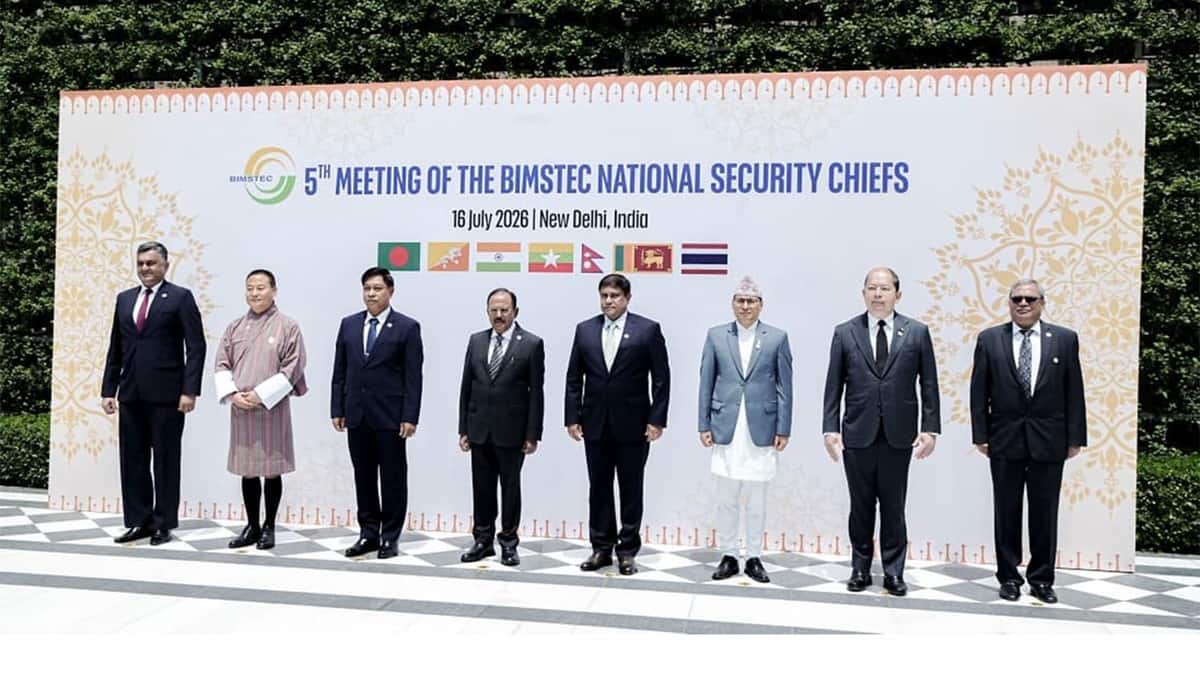
Ahead of the 5th BIMSTEC National Security Chiefs' meeting hosted in Delhi, NSA Ajit Doval has held a series of separate bilateral meetings with key counterparts from Sri Lanka, Thailand, Myanmar and Bangladesh. Doval used these meetings to push targeted, one-on-one outcomes rather than wait for a joint communique to do the work. With Sri Lanka, the conversation centred on maritime cooperation and securing India's southern sea lanes. With Thailand, an operational framework on intelligence sharing, law enforcement coordination and cybersecurity, explicitly tied to the India-Myanmar-Thailand Trilateral Highway was discussed. The concern is that the corridor could become a route for transnational crime. With Myanmar, both sides reviewed security cooperation along their shared border. With Bangladesh, the focus stayed on continuing defence ties.
Why it matters: Doval running four separate bilaterals in a single day, inside a multilateral summit, is itself a pattern worth noting: India increasingly uses these regional groupings as convenient cover to convene neighbours, then does the actual negotiating one country at a time, away from the summit's formal agenda.
Myanmar and Bangladesh are the two conversations with a live problem sitting underneath the routine language. Myanmar's civil war has pushed refugees and armed groups across the border into India's northeast for years, so that meeting was about managing an active spillover into Manipur and Mizoram.
Bangladesh is the harder case. Sheikh Hasina has been living in India since her government fell last year, and Dhaka's new administration has repeatedly pressed Delhi to extradite her. That alone keeps the relationship strained at the political level. Add to that issues regarding the porous shared border and a Bangladesh government whose foreign policy leanings India is still reading, and this bilateral carries more importance than the other three combined. Reports of Dhaka warming to Chinese port and infrastructure investment have only sharpened the urgency in Delhi. Sri Lanka and Thailand, by comparison, are steadier relationships where the goal is deepening what already works.
India, Japan hold 8th Defence Policy Dialogue in Tokyo
India and Japan held their 8th Defence Policy Dialogue in Tokyo this week, with Defence Secretary Rajesh Kumar Singh and Japanese Vice Minister Kano Koji reviewing the entire scope of defence ties including the military exchanges, maritime cooperation, joint exercises, and equipment and tech collaboration. Both sides have also confirmed a 2+2 ministerial meeting is likely later this year. The relationship has largely run on maritime cooperation so far, given both countries' shared stake in keeping sea lanes through the Indo-Pacific open and unchallenged by China.
India and Belgium Launch Strategic Dialogue
India and Belgium held their first Strategic Dialogue in Brussels. Foreign Minister S Jaishankar co-chaired it with Maxime Prevot, Belgium's Deputy PM and Foreign Minister. On the agenda were defence, semiconductors, supply chains, trade, clean energy and mobility. Belgium hosts many of the EU's institutions and NATO's headquarters, so a dedicated dialogue with Brussels functions differently than one with most EU member states. Its less about bilateral trade and more about having a direct channel into where EU and NATO policies actually gets made.
India Exports Akash Missiles to Tajikistan and Turkmenistan
India has sold its Akash air defence system to Tajikistan and Turkmenistan. Both countries hav been relying almost entirely on Russian equipment until now. Akash joins BrahMos, Pinaka and Astra as an established Indian export, with total defence exports crossing ₹38,000 crore last year. Akash's real combat use was seen during Operation Sindoor which has helped win new buyers.
Why it matters: This is India's first real foothold in Central Asia's defence market, a region next to Afghanistan and China's western border where Russia hasn't had competition. A missile with an actual combat record sells far more easily than one only tested on a range.
INS Sudarshini sails into Boston Harbour for Grand Parade of Sails
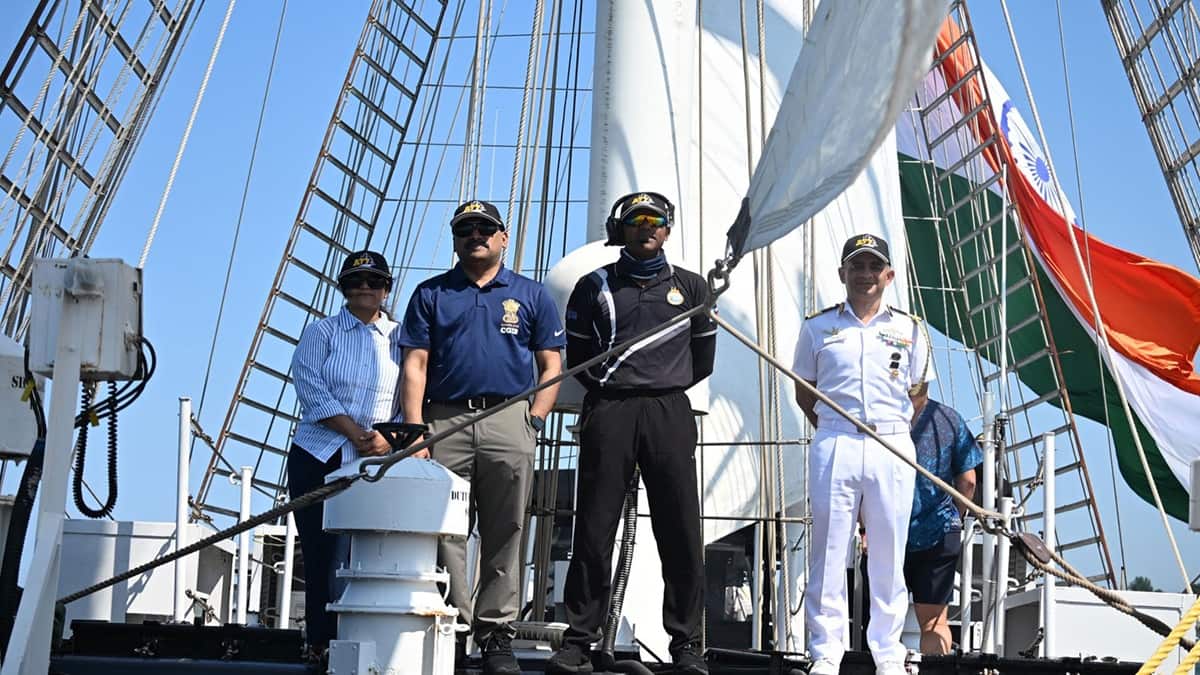
Indian Navy's sail training ship INS Sudarshini reached after taking part in New York's Sail4th 250 celebrations. It joined over 60 tall ships from 20-plus nations in the Grand Parade of Sails that opened Sail Boston 2026. The ship stayed open for public visits before embarking on her longer Lokayan 2026 voyage. It's a goodwill mission, sail training deployments carry no combat value, but they aren't random either. They're the Navy's lowest-cost, lowest-risk tool for sustaining presence in waters where India otherwise has no naval footprint.
Tags

J&K cop on Amarnath Yatra duty shot dead in Anantnag terror attack; TRF claims responsibility
Jaishankar meets Canada's Anita Anand, discusses bilateral cooperation and shared interests
Delhi, Bengaluru, Hyderabad... Neet paper leak protest spreads nationwide even as govt reaches out to CJP, Opposition
Why is India seeing 95% cloud cover despite a Super El Niño?
Jaishankar, Rubio review trade, defence, AI cooperation at Manila meeting