


Russia to join India-led International Big Cat Alliance: What is this global grouping to protect 7 big cats?
On Russian President Vladimir Putin’s second day in Delhi today (December 5), Moscow decided to adopt the framework agreement to join the International Big Cat Alliance (IBCA), spearheaded by India. This global grouping aims to protect and conserve seven big cats – the tiger, lion, leopard, snow leopard, cheetah, jaguar and puma. Here’s why such an alliance matters

Russia has decided to adopt the framework agreement to join the India-led International Big Cat Alliance (IBCA), a global initiative to protect the seven big cats. The development came during Russian President Vladimir Putin’s two-day state visit to India on December 4-5.
Prime Minister Narendra Modi had unveiled the alliance in April 2023, with the Central government establishing the IBCA through the National Tiger Conservation Authority, under the Ministry of Environment, Forest and Climate Change, last March. Russia will become the 19th member nation of the global alliance.
We take a closer look.
What is the International Big Cat Alliance?
The International Big Cat Alliance (IBCA) is an intergovernmental organisation, headquartered in Delhi. The alliance aims to protect and conserve seven big cats – the tiger, lion, leopard, snow leopard, cheetah, jaguar and puma.
India is home to five of these big cats, barring the jaguar and puma.
 More from Explainers
Six of the big cats are vulnerable or endangered on the International Union for Conservation of Nature list.
The IBCA aims “to facilitate collaboration and synergy among stakeholders, consolidating successful conservation practices and expertise and replicating them in range countries.”
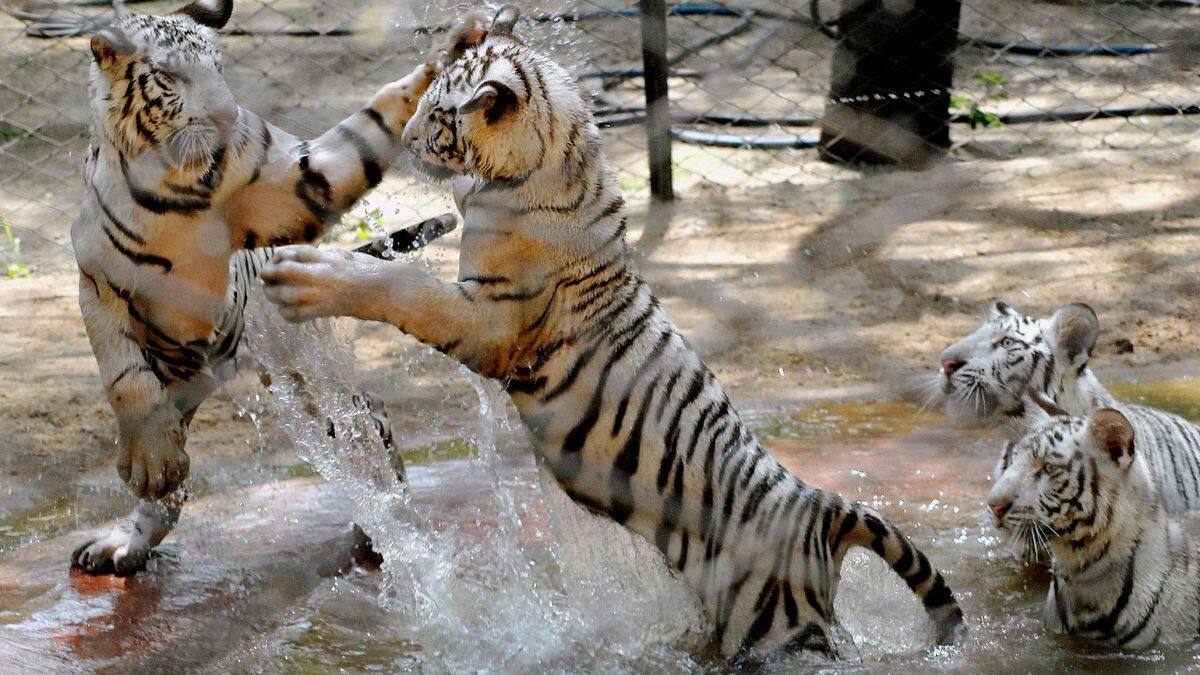
The IBCA wants to include “range” countries that are home to the seven big cats. There are a total of 95 such nations, including Canada, China, Congo, Brazil, Iran, Nepal, Ghana, Pakistan, Russia and the United States.
While Nepal has become a member of the alliance, Russia has now agreed to join.
The Indian government has allocated Rs 150 crore for the purpose from 2023-24 to 2027-28.
All United Nations member countries can become members of the IBCA after signing the framework agreement and issuing a Note Verbale, a method of formal diplomatic communication.
How IBCA came to be
PM Modi first proposed establishing an international alliance to combat poaching and illegal wildlife trade in 2019 while releasing India’s tiger census report on Global Tiger Day.
Emphasising the country’s commitment to animal protection and conservation, he spoke of the threat of a “decreasing and disturbed habitat” and illegal trade. He called for bringing together heads of government of tiger range countries in a group to “erase demand and firmly curb poaching and illegal trade in Asia.”
Modi announced the IBCA in 2023 in Mysuru, marking the 50th anniversary of Project Tiger, a wildlife conservation movement to protect the tigers in India.
The first assembly of the International Big Cat Alliance was held in New Delhi this June. Union Minister for Environment, Forests and Climate Change, Bhupender Yadav, was endorsed as the president of the global alliance by the nine countries present at the meeting – Bhutan, Cambodia, Eswatini, Guinea, India, Liberia, Suriname, Somalia and Kazakhstan.
Unlike the Global Tiger Forum, the IBCA plans to conserve the natural habitats of the lion, snow leopard, puma, jaguar and cheetah, as well as the tiger.
“IBCA aims for mutual cooperation among countries for mutual benefit in furthering the conservation agenda. IBCA would have a multipronged approach in broad basing and establishing linkages manifold in several areas and help in knowledge sharing, capacity building, networking, advocacy, finance and resources support, research and technical support, education and awareness," the Indian government said in a statement in 2024.
"With big cats as mascots for sustainable development and livelihood security, India and the big cat range countries can usher in major efforts on environmental resilience and climate change mitigation, while paving a future where natural ecosystems continue to thrive, and gain centrality in economic and development policies," it added.
Why IBCA is needed
Conserving the big cats is necessary as killing the apex predators disrupts the food chain.
As per IBCA's report, cited by Indian Express, these wild animals regulate prey populations, which helps to keep up the health of landscapes and prevents overgrazing that could result in ecological calamities like wildfires and disease.
Protecting big cats also ensures that their habitats, where many other species also live, remain safeguarded. Conserving these animals could help mitigate natural disasters, control pandemics, preserve soil, support climate adaptation and contribute to climate change mitigation by storing and sequestering carbon.
India's Project Tiger has shown how success can be achieved in conserving the big cats. The country has doubled its tiger population to more than 3,600, which makes up for 75 per cent of the world's tigers. From the tiger population falling to 1,800 by 1970 due to large-scale hunting and poaching, India now has the world's highest number of tigers.
According to a study published in Science, a leading peer-reviewed research journal, earlier this year, the South Asian country achieved the feat by preventing poaching and habitat loss of the big cats, securing prey, reducing human-wildlife conflict, and uplifting local communities.
With inputs from agencies

Military drones & police check-ups: How Sri Lanka is fighting against worst dengue outbreak in a decade
How Facebook job ad lured 2 Karnataka men into Myanmar cyber scam camp
Why is India seeing 95% cloud cover despite a Super El Niño?
What is CJP’s fourth demand to the government as protests in Delhi intensify?
The new geography of war: Why the Houthis can no longer be ignored