
Advertisement


Sections
Chandrayaan-3: What changes has ISRO made to Vikram lander to ensure success?
ISRO has left no stone unturned to ensure Chandrayaan-3's success. Learning from the mistakes that occurred during the previous failed Moon mission, the team of scientists have made significant changes to the engine and design of the Vikram lander. It has also been ‘stress tested’ extensively

We are just hours away from what will be a historic moment if Chandrayaan-3’s lander and rover successfully make a soft landing on the Moon’s south pole. And the Indian Space Research Organisation (ISRO) has left no stone unturned to ensure the success of this Moon mission.The ISRO team has learnt from their past mistakes – Chandrayaan-2 mission – in order to ensure that today’s landing, scheduled for 6.04 pm is a success and India comes out on top, becoming only the fourth nation behind the US, China and erstwhile Soviet Union to make a soft landing and only the first ever country to reach the south pole of the Moon.As we gear up for this momentous occasion, let’s take a closer look at what had gone wrong in Chandrayaan-2 and how ISRO has made changes to ensure that its successor, Chandrayaan-3, is triumphant in its mission.What went wrong with Vikram lander 2?Four years ago on 7 September, a billion Indians suffered heartbreak when Chandrayaan-2’s lander – Vikram – crashed on the Moon’s surface. ISRO lost contact with Vikram on the day of landing when it was barely 335 metres (0.335 km) from the surface of the Moon.Current ISRO chairman S Somnath has pointed out that there were three crucial mistakes that led to the crash of the lander and the ultimate failure of Chandrayaan-2. “The primary issue was we had five engines which were used to give the reduction of the velocity, which is called the retardation. These engines developed higher thrust than what was expected,” said Somnath to reporters. He explained that the extra thrust led to accumulation of errors, which, in turn, compromised the stability of the lander during the “camera coasting phase” for the soft landing.This led to further mistakes; “all the errors got accumulated, which was on the higher side than what we had expected. The craft had to make very fast turns. When it started to turn very fast, its ability to turn was limited by the software because we never expected such high rates to come,” Somanath added.The third problem was when Vikram, despite being close to the surface, increased its velocity as the landing site was quite far away. The ISRO chairman explained that this was partly due to the fact that the landing spot was a small patch of just 500 m x 500 m.Former ISRO chief K Sivan, who was in-charge during the Chandrayaan-2 mission, further added that the Vikram lander towards the end didn’t work well and had a hard landing. An India Today report had Sivan saying, “The dispersion level was more than what we had expected and designed for. Because of this high level, the guidance system malfunctioned. The system increased the thrust instead of reducing it. And to correct the errors, the control system required large manoeuvres. But, there was a limit in the system because of which it could not do what we wanted.”[caption id="attachment_13029842" align="alignnone" width="640"]![]() Students of Allahabad Central University make a sand sculpture wishing successful landing of Chandrayaan-3, at the Sangam in Prayagraj. PTI[/caption]What’s different with Vikram lander of Chandrayaan-3?Taking into account the mistakes made during the Chandrayaan-2 mission, ISRO went back to the drawing board and made changes to the Vikram lander for this Moon landing. Significant improvements have been made to the lander, in order to ensure success in the mission, ISRO has said.Firstly, Vikram has been given stronger legs, allowing it to withstand landing at greater velocities. ISRO chairman has stated that Vikram’s robust legs are now engineered to withstand a maximum impact of 3 metres per second, equivalent to around 10.8 kilometres per hour.Moreover, the velocity tolerance of Vikram has also been increased to 3m/second from 2m/second. This ensures that even at 3m/sec, the lander will not crash or break its legs. As one ISRO scientist told Times of India, “It is good that the tolerance will be for 3m/second, which means in case the best situation is not there, the lander will still do its job.”Vikram lander has also been equipped with four throttleable engines. For the unaware, athrottleable engine is one whose thrust can be varied.
Students of Allahabad Central University make a sand sculpture wishing successful landing of Chandrayaan-3, at the Sangam in Prayagraj. PTI[/caption]What’s different with Vikram lander of Chandrayaan-3?Taking into account the mistakes made during the Chandrayaan-2 mission, ISRO went back to the drawing board and made changes to the Vikram lander for this Moon landing. Significant improvements have been made to the lander, in order to ensure success in the mission, ISRO has said.Firstly, Vikram has been given stronger legs, allowing it to withstand landing at greater velocities. ISRO chairman has stated that Vikram’s robust legs are now engineered to withstand a maximum impact of 3 metres per second, equivalent to around 10.8 kilometres per hour.Moreover, the velocity tolerance of Vikram has also been increased to 3m/second from 2m/second. This ensures that even at 3m/sec, the lander will not crash or break its legs. As one ISRO scientist told Times of India, “It is good that the tolerance will be for 3m/second, which means in case the best situation is not there, the lander will still do its job.”Vikram lander has also been equipped with four throttleable engines. For the unaware, athrottleable engine is one whose thrust can be varied.
Want to know it all about Chandrayaan-3? Read all our explainersChandrayaan-3 costs lesser than big films: How India keeps its space missions frugalHow Tamil Nadu's soil has played a crucial role in ISRO's Moon missionChandrayaan-3: Why is soft-landing on the Moon so challenging?Reaching for the Moon: Meet the team behind India’s Chandrayaan-3Why is US watching Chandrayaan-3 launch closely?
Another change that ISRO has made to the lander for this mission is the addition of more fuel so that it can handle more disruptions.Furthermore, a new sensor has also been added. “We have added a new sensor called the laser doppler velocity metre, which will look at the lunar terrain. And through laser source sounding, we will be able to get components of three velocity vectors. We will be able to add this to the other instruments available, thereby creating redundancy in measurement," Somanath told TOI.Professor Radhakant Padhi, Aerospace Scientist, Indian Institute of Science has further explained that Chandrayaan-3’s Vikram has an “inbuilt salvage mode” which will help it land even if everything goes wrong. Speaking to NDTV, he said that he was confident that the lander will be successful. Chandrayaan-3 is designed for six sigma bounds, so it’s more robust. “Chandrayaan-3 has been stress tested, ISRO has taken care of all known unknowns,” Professor Padhi said.ISRO has also added two on-board computers on Vikram, which is one more than what was there during the previous mission.Addressing the issue of the small landing patch, ISRO has expanded it for Chandrayaan-3 from 500m x 500m to four km by 2.5 km.[caption id="attachment_13029882" align="alignnone" width="640"]![]() Indians cheer as they watch on screen the lift off of Indian Space Research Organisation (ISRO)'s Chandrayaan-3 in Mumbai. File image/AP[/caption]Why will Chandrayaan-3’s success be significant?ISRO is on the cusp of making history as everyone awaits with bated breath to see if India’s Chandrayaan-3 mission to the Moon’s south pole is successful at 6.04 pm.On Tuesday, India’s space agency also posted, “The mission is on schedule. Systems are undergoing regular checks. Smooth sailing is continuing.”If Vikram succeeds today, India will be the first and only country to soft-land on the Moon’s south pole and that too at a budget, which is far lesser than several Hollywood and Bollywood movies.It will also boost India’s private space-tech ecosystem. Venture capitalists are increasingly seeing India’s space-tech sector as a lucrative opportunity, given the scale of the market and the sector’s historic achievements in 2022. The year was marked by many firsts, including a private rocket launch and multiple other satellite launches.The successful launch of Chandrayaan-3 could bolster investor confidence and attract more private investment in space technology.The Chandrayaan-3 mission will also open up commercial opportunities for Indian companies and start-ups in the space sector. The success of the mission will add to India’s goodwill in the space league and serve as a technology demonstrator for future moon missions.With inputs from agencies
Indians cheer as they watch on screen the lift off of Indian Space Research Organisation (ISRO)'s Chandrayaan-3 in Mumbai. File image/AP[/caption]Why will Chandrayaan-3’s success be significant?ISRO is on the cusp of making history as everyone awaits with bated breath to see if India’s Chandrayaan-3 mission to the Moon’s south pole is successful at 6.04 pm.On Tuesday, India’s space agency also posted, “The mission is on schedule. Systems are undergoing regular checks. Smooth sailing is continuing.”If Vikram succeeds today, India will be the first and only country to soft-land on the Moon’s south pole and that too at a budget, which is far lesser than several Hollywood and Bollywood movies.It will also boost India’s private space-tech ecosystem. Venture capitalists are increasingly seeing India’s space-tech sector as a lucrative opportunity, given the scale of the market and the sector’s historic achievements in 2022. The year was marked by many firsts, including a private rocket launch and multiple other satellite launches.The successful launch of Chandrayaan-3 could bolster investor confidence and attract more private investment in space technology.The Chandrayaan-3 mission will also open up commercial opportunities for Indian companies and start-ups in the space sector. The success of the mission will add to India’s goodwill in the space league and serve as a technology demonstrator for future moon missions.With inputs from agencies
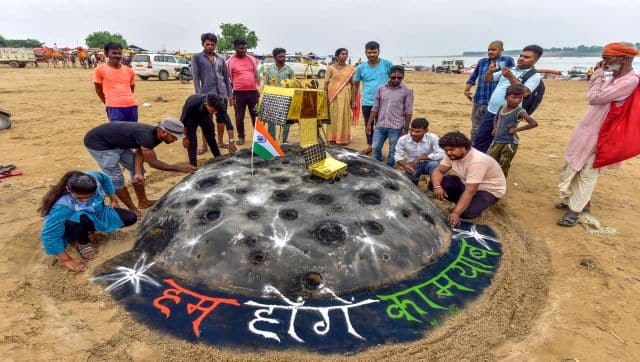 Students of Allahabad Central University make a sand sculpture wishing successful landing of Chandrayaan-3, at the Sangam in Prayagraj. PTI[/caption]What’s different with Vikram lander of Chandrayaan-3?Taking into account the mistakes made during the Chandrayaan-2 mission, ISRO went back to the drawing board and made changes to the Vikram lander for this Moon landing. Significant improvements have been made to the lander, in order to ensure success in the mission, ISRO has said.Firstly, Vikram has been given stronger legs, allowing it to withstand landing at greater velocities. ISRO chairman has stated that Vikram’s robust legs are now engineered to withstand a maximum impact of 3 metres per second, equivalent to around 10.8 kilometres per hour.Moreover, the velocity tolerance of Vikram has also been increased to 3m/second from 2m/second. This ensures that even at 3m/sec, the lander will not crash or break its legs. As one ISRO scientist told Times of India, “It is good that the tolerance will be for 3m/second, which means in case the best situation is not there, the lander will still do its job.”Vikram lander has also been equipped with four throttleable engines. For the unaware, athrottleable engine is one whose thrust can be varied.
Want to know it all about Chandrayaan-3? Read all our explainersChandrayaan-3 costs lesser than big films: How India keeps its space missions frugalHow Tamil Nadu's soil has played a crucial role in ISRO's Moon missionChandrayaan-3: Why is soft-landing on the Moon so challenging?Reaching for the Moon: Meet the team behind India’s Chandrayaan-3Why is US watching Chandrayaan-3 launch closely?
Another change that ISRO has made to the lander for this mission is the addition of more fuel so that it can handle more disruptions.Furthermore, a new sensor has also been added. “We have added a new sensor called the laser doppler velocity metre, which will look at the lunar terrain. And through laser source sounding, we will be able to get components of three velocity vectors. We will be able to add this to the other instruments available, thereby creating redundancy in measurement," Somanath told TOI.Professor Radhakant Padhi, Aerospace Scientist, Indian Institute of Science has further explained that Chandrayaan-3’s Vikram has an “inbuilt salvage mode” which will help it land even if everything goes wrong. Speaking to NDTV, he said that he was confident that the lander will be successful. Chandrayaan-3 is designed for six sigma bounds, so it’s more robust. “Chandrayaan-3 has been stress tested, ISRO has taken care of all known unknowns,” Professor Padhi said.ISRO has also added two on-board computers on Vikram, which is one more than what was there during the previous mission.Addressing the issue of the small landing patch, ISRO has expanded it for Chandrayaan-3 from 500m x 500m to four km by 2.5 km.[caption id="attachment_13029882" align="alignnone" width="640"]
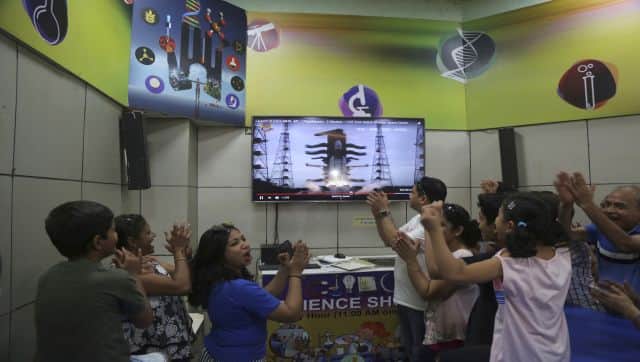 Indians cheer as they watch on screen the lift off of Indian Space Research Organisation (ISRO)'s Chandrayaan-3 in Mumbai. File image/AP[/caption]Why will Chandrayaan-3’s success be significant?ISRO is on the cusp of making history as everyone awaits with bated breath to see if India’s Chandrayaan-3 mission to the Moon’s south pole is successful at 6.04 pm.On Tuesday, India’s space agency also posted, “The mission is on schedule. Systems are undergoing regular checks. Smooth sailing is continuing.”If Vikram succeeds today, India will be the first and only country to soft-land on the Moon’s south pole and that too at a budget, which is far lesser than several Hollywood and Bollywood movies.It will also boost India’s private space-tech ecosystem. Venture capitalists are increasingly seeing India’s space-tech sector as a lucrative opportunity, given the scale of the market and the sector’s historic achievements in 2022. The year was marked by many firsts, including a private rocket launch and multiple other satellite launches.The successful launch of Chandrayaan-3 could bolster investor confidence and attract more private investment in space technology.The Chandrayaan-3 mission will also open up commercial opportunities for Indian companies and start-ups in the space sector. The success of the mission will add to India’s goodwill in the space league and serve as a technology demonstrator for future moon missions.With inputs from agencies
First Published:Aug 23, 2023, 13:06:15 IST
Advertisement
Advertisement

Cruise missiles, drones and more... The deadly arsenal of the Houthis
The Houthis have evolved into one of the world's most formidable non-state military forces, deploying anti-ship ballistic missiles, cruise missiles, drones and explosive boats to threaten Red Sea shipping. Their latest attacks on Saudi oil tankers have raised concerns over shipping through the Bab el-Mandeb Strait amid the Strait of Hormuz crisis
10 min read
Why India may not witness a medal rush at 2026 Commonwealth Games
A 125-strong Indian contingent is in Glasgow for the 2026 Commonwealth Games, starting today (July 23), chasing international glory. However, with a roster of sports such as badminton and wrestling being cut from the event, the country’s medal chances have been drastically reduced
4 min read
Delhi Police asks personnel to wear uniform: What the law says on cops in plainclothes during protests
The Delhi Police has instructed all its personnel to wear uniforms when they report for duty at Jantar Mantar for crowd control. This comes after outrage grew over videos of men in civilian clothes or without name tags hitting protesters in the Capital. Is it legal for the police to ditch uniforms during protests?
4 min read
Military drones & police check-ups: How Sri Lanka is fighting against worst dengue outbreak in a decade
Sri Lanka is fighting its most severe dengue outbreak in nearly a decade, with infections rising sharply across the nation. Military drones have been deployed to tackle the outbreak, which has claimed 56 lives. Health officials said the outbreak is being driven primarily by the DENV-2 variant of the virus
3 min read
How Facebook job ad lured 2 Karnataka men into Myanmar cyber scam camp
The Karnataka Cyber Command has rescued two youths from a scam compound in Myanmar operated by Chinese fraudsters. The duo from Karnataka were lured on the pretext of data-entry jobs. They were asked to work for 16 hours a day and were expected to sleep for six hours daily
4 min read
Advertisement
Advertisement