
Advertisement


Sections
Rooftops as an antidote to the lockdown: A photographer documents people's shared joys, closeness on terraces
On a rooftop, it is possible to convince yourself that not everything has changed since the pandemic: it’s still possible to spend time with family outdoors, to play the odd game of cricket, to meet friends and relatives.

On the terrace of one apartment building, a man holds up his baby, while a stranger looks on with delight. On another rooftop, a woman is unabashedly taking a selfie in the evening light, and a few feet away, a young boy kicks a ball around. On a third, a child sitting in a tub enjoys a bath, and on a fourth, a woman gives her partner a head massage.These visuals, captured by Madhu Gopal Rao, are part of a project titled ‘Rooftop’, which is being exhibited at the ongoing Indian Photo Festival. Far from being voyeuristic, the photographs evoke a sense of calm, community and normalcy – a reminder of what life looked like before the coronavirus pandemic upended all human existence.Rao, who is an award-winning photographer, says he didn’t have any preconceived thoughts or intentions about the project; that the photographs came together to form a story. A resident of Begumpet, Hyderabad, he didn’t even frequent the terrace of his apartment building before the nation-wide lockdown. But since he didn’t have much to do in the month of March, the photographer began visiting the space with his camera, which is when he observed people spending time there. Thus far he has shot 5,000 images over six months, and is eager to see the shape the project will take in the future.![Rooftops-1]() Previously, Rao associated rooftops with Makar Sankranti celebrations and kite flying, as well as summers during his years in a hostel, when students would sleep on the terrace. “In rural areas, rooftops are seen as a fixture of houses belonging to elite families, or those who are rich. It’s a status symbol. In urban areas, they serve as an extra space in more congested housing.
Previously, Rao associated rooftops with Makar Sankranti celebrations and kite flying, as well as summers during his years in a hostel, when students would sleep on the terrace. “In rural areas, rooftops are seen as a fixture of houses belonging to elite families, or those who are rich. It’s a status symbol. In urban areas, they serve as an extra space in more congested housing.![Rooftops-2]()
![Rooftops-3]() Despite the very social nature of rooftops and terraces (the visibility from other buildings, the fact that they are open to anyone), Rao has managed to capture moments of intimacy, such as couples huddled together. He says that people who lived in buildings close to his own began to recognise him and his everyday routine with the camera. Now, they wave at him and greet him too. “My presence has become so familiar that they have stopped noticing me beyond a point, which has given me the opportunity to capture more intimate moments,” he explains.Also read on Firstpost: Why the balcony is a socio-political tool for human communication — in isolation, celebration, rebellionIt’s almost as though little pockets of intimacy have spilled over outside the home, after being contained indoors for months on end. It also reminds me of the visual of women on terraces visible from my own balcony: girls, middle-aged women, friends, sisters and mothers, lost in their own thought, or very often, engaged in long phone calls – doing things they possibly cannot do at home, or prefer to do in a place where they are not immediately visible to others.
Despite the very social nature of rooftops and terraces (the visibility from other buildings, the fact that they are open to anyone), Rao has managed to capture moments of intimacy, such as couples huddled together. He says that people who lived in buildings close to his own began to recognise him and his everyday routine with the camera. Now, they wave at him and greet him too. “My presence has become so familiar that they have stopped noticing me beyond a point, which has given me the opportunity to capture more intimate moments,” he explains.Also read on Firstpost: Why the balcony is a socio-political tool for human communication — in isolation, celebration, rebellionIt’s almost as though little pockets of intimacy have spilled over outside the home, after being contained indoors for months on end. It also reminds me of the visual of women on terraces visible from my own balcony: girls, middle-aged women, friends, sisters and mothers, lost in their own thought, or very often, engaged in long phone calls – doing things they possibly cannot do at home, or prefer to do in a place where they are not immediately visible to others.![Rooftops-4]() “I think at the start of the lockdown, people didn’t know what to do. It was unexpected; living within four walls seemed impossible and stressful. The rooftop provided relief,” says Rao. He adds that terraces have a newfound significance in the lockdown, as a place that families looked forward to visiting and incorporating in their routines. "In this sense the lockdown has brought people together — people who wouldn't interact otherwise owing to a lack of time — and removed the walls that stood between people, both mental and physical," he explains.The photographer adds that the moments he has captured so far signify hope and perseverance to him. Apart from being an element of housing, he says the way people have used the space highlights how emotions and human experiences can endure, even in the most difficult times.More details about the exhibitions at the Indian Photo Festival can be found on its website.
“I think at the start of the lockdown, people didn’t know what to do. It was unexpected; living within four walls seemed impossible and stressful. The rooftop provided relief,” says Rao. He adds that terraces have a newfound significance in the lockdown, as a place that families looked forward to visiting and incorporating in their routines. "In this sense the lockdown has brought people together — people who wouldn't interact otherwise owing to a lack of time — and removed the walls that stood between people, both mental and physical," he explains.The photographer adds that the moments he has captured so far signify hope and perseverance to him. Apart from being an element of housing, he says the way people have used the space highlights how emotions and human experiences can endure, even in the most difficult times.More details about the exhibitions at the Indian Photo Festival can be found on its website.
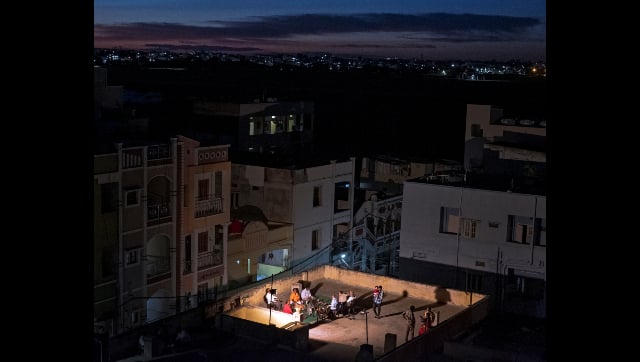 Previously, Rao associated rooftops with Makar Sankranti celebrations and kite flying, as well as summers during his years in a hostel, when students would sleep on the terrace. “In rural areas, rooftops are seen as a fixture of houses belonging to elite families, or those who are rich. It’s a status symbol. In urban areas, they serve as an extra space in more congested housing.
I see rooftops as being streets in the sky,” Rao says.At first glance, the viewer feels as though these rooftops are an extension of the subjects' homes, evidenced by the ease and comfort conveyed by their faces and bodies. It seems natural that during a pandemic, people would gravitate towards a place close enough to home, but different enough to be a refreshing change. But a closer examination reveals that this space is quite literally anything the subject wants it to be — a salon, a playground, or a place to find solitude and quiet.
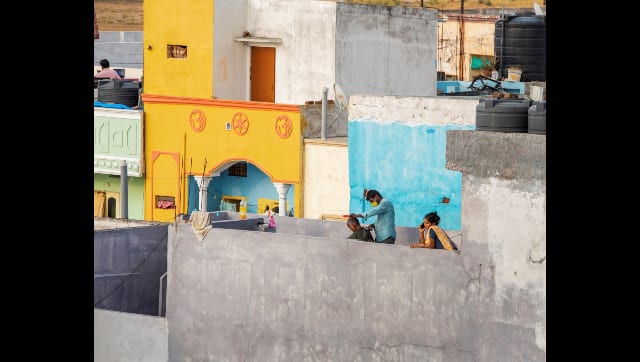
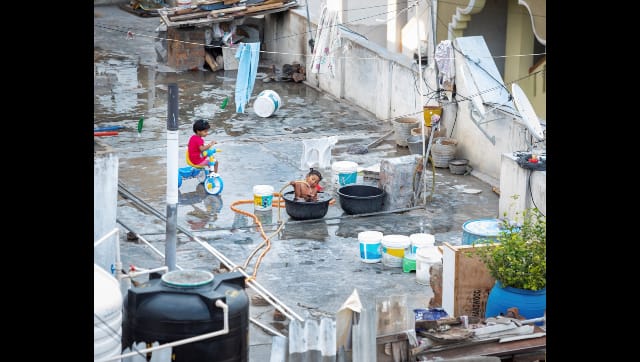 Despite the very social nature of rooftops and terraces (the visibility from other buildings, the fact that they are open to anyone), Rao has managed to capture moments of intimacy, such as couples huddled together. He says that people who lived in buildings close to his own began to recognise him and his everyday routine with the camera. Now, they wave at him and greet him too. “My presence has become so familiar that they have stopped noticing me beyond a point, which has given me the opportunity to capture more intimate moments,” he explains.Also read on Firstpost: Why the balcony is a socio-political tool for human communication — in isolation, celebration, rebellionIt’s almost as though little pockets of intimacy have spilled over outside the home, after being contained indoors for months on end. It also reminds me of the visual of women on terraces visible from my own balcony: girls, middle-aged women, friends, sisters and mothers, lost in their own thought, or very often, engaged in long phone calls – doing things they possibly cannot do at home, or prefer to do in a place where they are not immediately visible to others.
The rooftop affords privacy of an immediate sort, while also allowing one to feel like they’re still part of a town or city – an antidote to the isolation that accompanies being at home all the time.On a rooftop, it is possible to convince yourself that not everything has changed since the pandemic: it’s still possible to spend time with family outdoors, to play the odd game of cricket, to meet friends and relatives without masks (provided everyone stands a few feet apart). The scenes in Rao's photographs are an antithesis of the saddening, sometimes troubling, stories that have come out in the last year – of loneliness, a lack of belonging, or inability to connect.
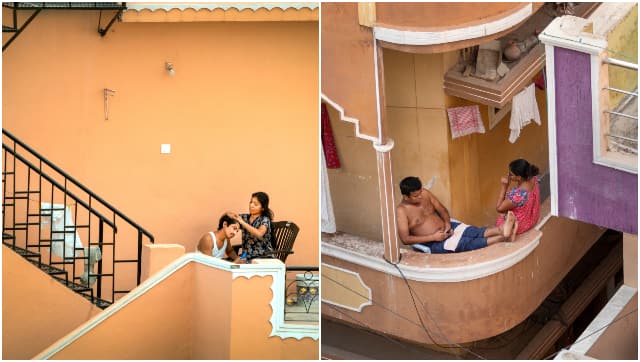 “I think at the start of the lockdown, people didn’t know what to do. It was unexpected; living within four walls seemed impossible and stressful. The rooftop provided relief,” says Rao. He adds that terraces have a newfound significance in the lockdown, as a place that families looked forward to visiting and incorporating in their routines. "In this sense the lockdown has brought people together — people who wouldn't interact otherwise owing to a lack of time — and removed the walls that stood between people, both mental and physical," he explains.The photographer adds that the moments he has captured so far signify hope and perseverance to him. Apart from being an element of housing, he says the way people have used the space highlights how emotions and human experiences can endure, even in the most difficult times.More details about the exhibitions at the Indian Photo Festival can be found on its website.
First Published:Nov 20, 2020, 09:22:27 IST
Advertisement
Advertisement

Midhaven on taking Indian Metal to Wacken this year: 'You’re sure to see a heavier, more nuanced performance'
Fresh off winning Wacken Metal Battle India and a 19-city Europe tour, Mumbai metal band Midhaven opens up about blending Indian classical traditions with sludge metal, representing India at Wacken Open Air, and the future of Indian heavy music in an exclusive interview with Firstpost.
5 min read
The woman in Lucian Freud's $39 million portrait was alive to watch herself become history
Decades after sitting for Lucian Freud, Sue Tilley reunited with one of the artist's most celebrated portraits as it headed to auction for $39 million, reflecting on fame, body image and becoming an unlikely muse
2 min read
Alexander McQueen is coming back to London Fashion Week, and its old shows explain why everyone's excited
McQueen will return to London Fashion Week for spring/summer 2027, its first time on the schedule since 2023, and the announcement has sent fashion writers straight back to the unsettling, theatrical shows that made its reputation in the first place.
3 min read
Why the Kiran Nadar Museum of Art is earning international recognition
With a new mega-campus, a former Louvre Abu Dhabi director at the helm, and growing international partnerships, the Kiran Nadar Museum of Art is emerging as a global force in the art world
2 min read
David Hockney dies at 88: The artist who put queer joy on canvas
From swimming pools and sunshine to portraits of lovers and friends, Hockney spent more than six decades showing that queer life could be ordinary, beautiful and full of colour.
2 min read
Advertisement
Advertisement