


More work needed on Iran nuke deal, say US officials
Two days of tough talks to limit Iran's nuclear program failed on Monday to make major headway toward a final deal —a foreboding sign for years of negotiations.

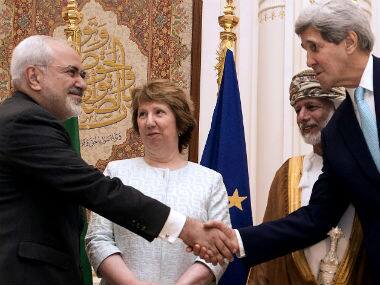
U.S. Secretary of State John Kerry, right, and Iranian Foreign Minister Mohammad Javad Zarif, shake hands during a meeting in Muscat, Oman. AP[/caption]"We are working hard," Kerry added. But the two sides are not yet there.One of the State Department officials said it's "self-evident" there's still work to be done before a compromise can be reached. The officials noted that Kerry extended his stay in Oman by several hours to continue the discussions. "I'm not indicating that progress was made in any way," the official said.Kerry headed out to Beijing, to join President Barack Obama and National Security Adviser Susan Rice at the annual Asia-Pacific Economic Cooperation summit Tuesday afternoon. The State Department officials said Kerry plans to brief Obama and Rice about the discussions in Oman. "A lot will be determined there, in terms of next steps for us," the second State Department official told reporters traveling with Kerry.Both officials spoke on condition of anonymity because they were not authorised to be identified while briefing reporters.Iranian negotiators remained in Muscat, the Omani capital, where lower-level meetings were expected to continue Tuesday with officials from Britain, China, France, Germany, Russia, the US and the EU. All teams will meet again 18 November in Vienna for a days-long, last-ditch attempt to clench an agreement.A potential agreement would ease Western sanctions against Iran's economy if Tehran agrees to limit its uranium enrichment to a level that would make it unable to build nuclear weapons. It would also have to provide international inspectors full access — with verifiable assurances that they are seeing the total picture— to its nuclear facilities.Iran wants sanctions lifted immediately after an agreement is struck, which may be impossible since Congress would have to agree to eliminate the US penalties against Tehran's oil and financial markets. It's more likely the sanctions would be eased, as Obama has the authority to do.The West also has demanded Iran limit its ability to enrich uranium, which in large amounts is used in nuclear weapons. Iran has maintained that its nuclear activities are purely peaceful, and necessary to fuel medical and energy demands.But for years, Iran hid some of its nuclear facilities and blocked inspector's access to others, raising widespread alarms about its intentions. The sanctions — imposed by the US, EU and the UN Security Council — aimed to punish Tehran for its covert nuclear program.Israel remains bitterly skeptical about Iran's intentions, and the negotiations have strained relations between the Obama administration and Washington's closest Mideast ally.Citing reports that a deal is close at hand, Israeli Prime Minister Benjamin Netanyahu on Monday announced he would ask the negotiators' top diplomats to resist any agreement that would allow Iran to become a nuclear power.Kerry spoke early Tuesday with Netanyahu, but the State Department officials refused to discuss why the Israeli prime minister believed a deal was imminent. The officials said Kerry also condemned comments posted this weekend on the managed Twitter account of Iranian Supreme Leader Ayatollah Ali Khamenei that called for Israel's destruction. His feed also tweeted various posts about the negotiations — including one detailing Iran's "red lines" of things it could not accept — while the Oman talks were ongoing.Associated Press

Air India to cut Delhi-Toronto flight time by 3 hours, resume non-stop services from August 1
US signs landmark nuclear deal with Saudi Arabia amid tensions in West Asia
Wildfires ravage parts of Italy, Spain and France, prompting thousands of evacuations
US set to sign Saudi nuclear deal; Rubio says pact won't fuel proliferation
India-US trade deal 'almost complete', says US after Jaishankar-Rubio talks in Manila