


Why India should be cautious in doing business with Pak
While it is understandable that one cannot shun one’s neighbours, can India continue to do business with Pakistan?

Prime Minister Manmohan Singh will be travelling to the United States later this month, where among other things, he would be attending the United Nations General Assembly and meet various world leaders on the sidelines. One of the Prime Minister's meetings may well be with his Pakistani counterpart Nawaz Sharif.The Pakistan government is trying hard for the Sharif-Singh meeting but the Indian government is playing hard ball and has so far refused to say whether Singh will be willing to meet Sharif in New York. The Ministry of External Affairs has already dropped enough indications that Pakistan has to come up with concrete deliverables before Singh meets Sharif and that the current atmosphere is not conducive to a summit meeting.[caption id="attachment_1082693" align="alignleft" width="380"]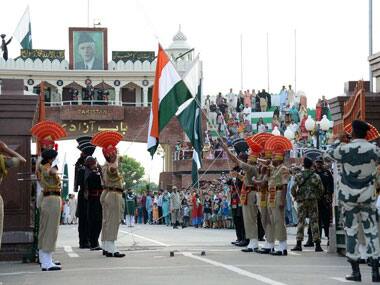 There has recently been a rash of articles in the media, both in Pakistan and India, and a general belief among the think tankers in India that there has been a change of attitude in Pakistan. AFP[/caption]While it is understandable that one cannot shun one’s neighbours, can India continue to do business with Pakistan? In other words, should India walk an extra mile for peace with an intransigent neighbour at a time when it is to have general elections in less than eight months?The LoC firing and the manner in which the entire Pakistan establishment, including the new Prime Minister Nawaz Sharif, has been denying and obfuscating the renewed flare-up shows how deep rooted Pakistan's hatred for India is and how naïve we are in never giving up hope on a turnaround in the neighbour’s attitude and behaviour.There has never been any doubt that attacks on the LoC has been unprovoked and calculated. It is a moot question whether the attack had the tacit or otherwise approval of the Pakistan Army or the Prime Minister. Does it really matter who ordered the killing of Indian soldiers? There is no doubt that the killings were carried out by Pakistanis, whether terrorists in uniform or uniformed terrorists.Why did the Pakistan army carry out the brazen attacks? There are a few reasons worth examining. First and foremost, is the fact that India continues to be enemy number one for Pakistan Army despite planted news articles which project differently. There has recently been a rash of articles in the media, both in Pakistan and India, and a general belief among the think tankers in India that there has been a change of attitude in Pakistan. These 'do-gooders' have been at pains to point out that the US has taken the place of India in terms of animosity. Many even argue that India ranks third among the adversaries, topped by the US and Tehrik-e-Taliban Pakistan.The LoC firing and subsequent events have clearly showed that such sentiments at best have been wishful thinking, and that too on the part of a select few Indians. For the Pakistan Army India remains the biggest enemy and if there is a change, as many suggest, it is only part of an elaborate charade.The second reason is that the Pakistan Army’s colossal failures on many fronts at home. While it claims to be the guardian of Pakistan, it has so far either remained mute or deliberately kept away from stopping the sectarian bloodletting happening all over Pakistan for the past few years. Sunni extremists have been wantonly killing Shias and Shia Hazaras, not to speak of minorities like Hindus and Christians, without any check from state agencies, including the army.The Pakistan army, which is quick to step in when its interests or image is affected, has been missing from the killing fields of Karachi and Quetta where hundreds of Shias — men, women and children — continue to fall to the cowardly attacks of Sunni extremist groups like Lashkar-e-Jhangvi (LJ). LJ has been a hands maiden of the Pakistan army for years, helping first to punish the Shias who once dared to challenge the supremacy of the military ruler Zia-ul Haq and then facilitate the rescue and regrouping of al Qaida and the Taliban after the US bombing of terrorist strongholds in October 2001.The army’s failure is equally stark in the economic sector. While the Generals and Brigadiers fattened themselves on the state exchequer, amassing fortunes and properties, the country and its people fell rapidly into despairing poverty and helplessness. Today the Generals are all multi-millionaires while millions remain impoverished and without any hope. The army could have stepped in to stem the economic slide, but did not. It is the biggest corporate and the biggest land lord. The army has enough resources to help the country tide out the economic and energy crises which it faces today.The army leadership instead has been rather busy hobnobbing with the Taliban and the Americans and finds all kinds of excuses to help in the killing of Osama bin Laden in Abbottabad. The army was not taken by surprise when the US Special Forces raided Abbottabad in May 2011 because it was in collusion with the Americans to violate the sovereignty of the country which it claims to protect.If there was any doubt, it was set at rest by the Abbottabad Commission report which found the Army blocking any investigation of the US raid by the local security agencies. Though the army, through its many agents of disinformation within the country and in foreign capitals, has managed to contain the damage, the slur on its shining image remains deeply embarrassing.The Army has also been unsuccessful in many other fronts and all of which leaves the leadership desperate to divert the attention from its failures. The most convenient is to up the ante on India. For some months, the army has been using its proxies like Hafiz Saeed to spew venom on India. Mouthpieces like Pakistan Today have been planting stories against India and warning the civilian leadership of the consequences of befriending the enemy country. After it failed to get enough traction on the hatred front, the army decided to launch the unprovoked attack on the LoC.There is another compelling reason for the Army chief, Ashfaq Kayani, to target India. He has never been a friend of India. When he took over charge in 2007, every one thought he will be the cat’s whiskers. He was the cigar chomping, golf swinging general. The Americans liked him. The Pakistanis had no choice. The army welcomed him after General Musharraf’s term. Everything was going good for him and people thought he would deliver on his promises. He trumpeted that he would restore the glory of the Pakistan Army, but what happened on his watch was completely different.Osama bin laden was killed in a US raid in the backyard of Pakistan Military Academy. Tehrik-e-Taliban Pakistan took the attack home, targeting with impunity GHQ, ISI offices, naval and air force complexes. The army could do nothing but stare at the destruction on the margins. No chief had to face such an ignominy. He is now leaving the chair in November and has nothing to show for his six long years of tenure. Desperate to retain some glory, Kayani is now raising the heat on India.This is a dangerous game he has indulged in the past and is acutely aware that he has nothing to lose in this game. India must be doubly cautious about what Kayani might do in the next two months before he gives up his uniform.The writer is a Firstpost columnist and a strategic analyst. He tweets @Kishkindha.
Consulting Editor, First Post. Strategic analyst. Political commentator. Twitter handle @Kishkindha.

Explorers discover wreckage of plane 72 years later. Will this help in finding MH370?
Chinese Defence Attache praise India’s rescue of 12 sailors off Kerala cost
'China ready to work with India,' says Wang Yi after talks with Jaishankar in Manila
Secret Service agent on JD Vance security detail put on leave over alleged leak of travel plans
China has dominated Myanmar’s rare earth mines — now India eyes deal to harness country’s critical minerals