


UK enters recession, central bank admits
Bank of England’s Monetary Policy Committee released minutes of its meetings, which most recently included a warning about the UK economy entering or possibly even already being in a recession. Read more.

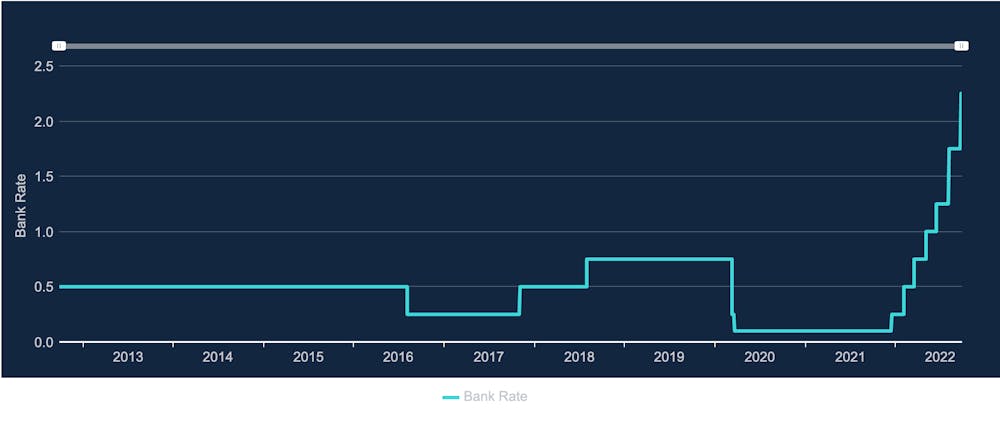
Although the definition of a recession varies between different countries and scholars, two consecutive quarters of decline in a country’s real gross domestic product (real GDP) is commonly used as a practical definition of a recession.So, the general consensus seems to be that GDP data pointing consistently to a reduction in economic activity should be interpreted as bad news because the economy is thought to be shrinking. This is normally associated with a decrease in consumer spending, a decline in business confidence and a consequent increase in unemployment.Certainly, any sign of a downturn typically sees banks and financial institutions tightening their lending criteria, making it difficult to obtain mortgages and business financing. This affects the housing market and small business activity.Further, since economies do not normally bounce back immediately from a recession, a period of prolonged depressed economic activity could lead to long-term unemployment, affecting people’s chances of future employment and earnings growth, especially younger generations and those from low-income households. This phenomenon is known as “employment scarring”.It’s not surprising, therefore, that the Bank of England is ringing the recession alarm bell even before it has full confirmation. But even with an agreement on a definition of sorts, measuring the state of the economy – that is, judging whether a country is in a recession or expansion – is not as straightforward as you might imagine.Firstly, the data or projections being released by the Bank of England, the ONS and more generally by other institutions around the world are “preliminary” – especially when first published for the relevant quarter. This means this data could be subject to subsequent revisions.For instance, in September 2022 (the final month of the third quarter) available data may indicate the economy has shrunk in the third quarter. However, as more information about Q3 performance is gathered, by October or November 2022 this negative growth sign might revert to zero growth or even positive.This is called “real-time data uncertainty” and it is one of the challenges policymakers face when making decisions “in real time”. In other words, central banks make decisions based on an evolving and often “noisy” understanding of the state of the economy.Secondly, as US Treasury secretary Janet Yellen also commented recently, negative growth associated with otherwise strong labour market conditions and spending, should not necessarily imply bad news for the economy. What she means here is that GDP should not be the only indicator on which an economic assessment is based – a broad range of indicators can often provide a different picture.
The outlook for UK growth
So, what is the Bank of England’s current assessment of the state of the UK economy? The minutes from its most recent meeting say: “The expected slowing in underlying growth in 2022 Q3 was consistent with weakness documented in the latest business surveys.”These business surveys indicate close to zero near-term growth, while an important indicator of expected business activity (called the composite purchasing managers’ index output expectations series) fell between June and August 2022.The Bank also said weak growth in manufacturing output (due to supply chain disruptions) and weak demand is adversely affecting the economy. Meanwhile, business investment intentions have been reported as weakening, with firms citing uncertainty about demand and the broader economic outlook, as well as rising costs, as the main drivers of a decline in investments.So the Bank of England is painting a picture using a multitude of indicators to show a shrinking economy. In this context, the Bank has said it will closely monitor upcoming data, as well as the evolution of Kwarteng’s growth plan policies set out on September 23. It will hope the latter can give a non-trivial boost to a seemingly deteriorating economy. Luciano Rispoli, Senior Lecturer in Economics, University of SurreyThis article is republished from The Conversation under a Creative Commons license. Read the original article.Read all the Latest News, Trending News, Cricket News, Bollywood News, India News and Entertainment News here. Follow us on Facebook, Twitter and Instagram.

US set to sign Saudi nuclear deal; Rubio says pact won't fuel proliferation
India-US trade deal 'almost complete', says US after Jaishankar-Rubio talks in Manila
Marco Rubio says he 'would expect India to be concerned' over Trump's pharma tariffs
Trump renews China election interference claims, but files point to Russia's larger role
'See me after class!': UK education secretary Lucy Powell mocked by Tories over grammar gaffe