


Stephen Hawking's ashes to be buried near graves of Isaac Newton, Charles Darwin at Westminster Abbey
Stephen Hawking's ashes will be buried near the graves of fellow British scientists Isaac Newton and Charles Darwin at Westminster Abbey, it was announced on Tuesday

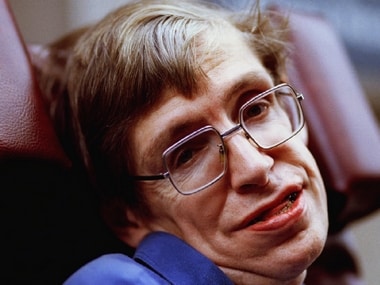
File image of Professor Stephen Hawking. Reuters[/caption]Hawking died aged 76 on 14 March after a cosmic career in which his mental genius transcended his physical disability.Propelled to stardom by his 1988 book A Brief History of Time, an unlikely worldwide bestseller, Hawking's genius and wit won over fans from far beyond the rarefied world of astrophysics.As a scientist, he earned comparisons with Newton and Albert Einstein.Family, friends and colleagues will be invited to the private funeral service, which takes place at 2 pm (1300 GMT). A private reception will be held afterwards at Trinity College.Hawking was famously an atheist, something his children Lucy, Robert and Tim touched on, as they thanked people for their "wonderful tributes" and messages of condolence."Our father lived and worked in Cambridge for over 50 years. He was an integral and highly recognisable part of the university and the city," they said."For this reason, we have decided to hold his funeral in the city that he loved so much and which loved him."Our father's life and work meant many things to many people, both religious and non-religious. So, the service will be both inclusive and traditional, reflecting the breadth and diversity of his life."Mystery of the universeHawking died peacefully at his Cambridge home. His health had been deteriorating since the New Year.Several thousand people have signed a book of condolence at Gonville and Caius, while many more from around the world have sent messages in an online version.Hawking defied predictions that he would only live for a few years after developing a form of motor neurone disease in his early 20s.The illness gradually robbed him of mobility, leaving him confined to a wheelchair, almost completely paralysed and unable to speak except through his trademark voice synthesiser.He became one of the world's most well-regarded scientists and entered the pantheon of science titans.John Hall, Dean of Westminster, said: "It is entirely fitting that the remains of Professor Stephen Hawking are to be buried in the abbey, near those of distinguished fellow scientists.
"We believe it to be vital that science and religion work together to seek to answer the great questions of the mystery of life and of the universe."Newton was buried in the abbey in 1727 and Darwin alongside him in 1882. Other famous scientists are buried nearby, the most recent being atomic physicists Ernest Rutherford in 1937 and Joseph John Thomson in 1940."We believe it to be vital that science and religion work together to seek to answer the great questions of the mystery of life and of the universe," said Hall.Several kings and queens are buried in the abbey, along with eight British prime ministers.The last significant ashes to be buried at the abbey were those of the actor Laurence Olivier in 1989.

Globe at a glance: From Houthis striking Saudi tankers in Red Sea to wildfires in Europe
Houthis claim responsibility for attack on two Saudi oil tankers in Red Sea as a new chokepoint emerges
Air India to cut Delhi-Toronto flight time by 3 hours, resume non-stop services from August 1
US signs landmark nuclear deal with Saudi Arabia amid tensions in West Asia
Wildfires ravage parts of Italy, Spain and France, prompting thousands of evacuations