


SpaceX calls off launch of NASA's deep space observatory due to technical error
SpaceX called off Sunday's planned launch of a deep-space observatory — and a revolutionary rocket-landing attempt — after a critical radar-tracking system failed.

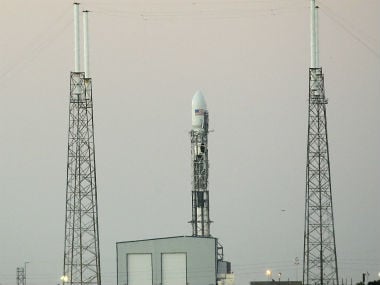
A Falcon 9 SpaceX rocket stands on launch complex 40 moments after an evening launch attempt was scrubbed at the Cape Canaveral Air Force Station in Cape Canaveral. AP[/caption]Gore arrived at Cape Canaveral well in advance of the sunset liftoff, eager to see his brainchild finally soar. He told reporters an hour before the planned launch time that he was grateful to the scientists and others who kept his dream alive. The measurements will help measure global warming, he noted, and the steady stream of pictures of Earth may help mobilize the public to put pressure on the world's government leaders "to take action to save the future of human civilization.""The constant ability to see the Earth whole, fully sunlit, every single day ... can add to our way of thinking about our relationship to the Earth," said Gore. He was accompanied by Sen. Bill Nelson of Florida, who flew on the space shuttle as a congressman in 1986.The $340 million mission is meant to provide a heads-up on intense solar activity that can disrupt communications, power and air travel. That's why the spacecraft is to be stationed 1 million miles (1.6 million kilometers) from Earth and 92 million miles (148 million kilometers) from the sun, the so-called Lagrange point where the gravity fields are neutralized.NOAA's director of the Space Weather Prediction Center in Boulder, Colorado, Tom Berger, likened it to a "tsunami buoy."The observatory originally was called Triana, after the sailor who first spotted land on Christopher Columbus' historic voyage. Now it's dubbed DSCOVR, short for Deep Space Climate Observatory.Gore's presence added to the excitement at the launch site.Also contributing to the buzz, though, was the experimental landing planned by SpaceX. Musk wants to eventually reuse his rockets to cut down costs and speed up flights.It will be the second such landing test for SpaceX. Last month's effort ended in flames.SpaceX loaded more hydraulic fluid into the first-stage booster this time for the guidance fins; the fluid ran out too soon on Jan. 10, and the booster landed hard and tumbled over. But the path of the unmanned Falcon 9 rocket this time will see the booster descending faster than before, making it harder to nail the vertical landing.SpaceX officials repeatedly stressed that the landing test is a secondary objective, and that the main job is to make sure the observatory gets a good ride to space."Launching our 1st deep space mission today," Musk wrote via Twitter. He noted that the observatory will end up "4X further than moon.""Rocket reentry will be much tougher this time around due to deep space mission," he added. "Almost 2X force and 4X heat. Plenty of hydraulic fluid tho."The modified barge that will serve as the landing zone nearly 400 miles (640 kilometers) off the Florida coast is almost as big as a football field, but that's small against the backdrop of the Atlantic. The 14-story booster will descend from an altitude of about 80 miles (130 kilometers), with touchdown expected nine to 10 minutes after liftoff.Last month's effort resulted in minor damage to the platform.SpaceX not only patched everything up, but added a name to the platform, painted in large white letters on deck: "Just Read the Instructions." That's the name of a ship from the Culture science fiction series written by the late Scottish author Iain M. Banks.Musk, a Banks fan, already has his company delivering cargo to the International Space Station for NASA and working on a capsule to fly American astronauts there.Associated Press

Explorers discover wreckage of plane 72 years later. Will this help in finding MH370?
Chinese Defence Attache praise India’s rescue of 12 sailors off Kerala cost
'China ready to work with India,' says Wang Yi after talks with Jaishankar in Manila
Secret Service agent on JD Vance security detail put on leave over alleged leak of travel plans
China has dominated Myanmar’s rare earth mines — now India eyes deal to harness country’s critical minerals