


Plague of mice in Australia: After bountiful rains last year, rodents overrun farms, shops and bedrooms
For what has been half a year but felt to many like an eternity, the rodents have chewed a swath through southern Queensland, New South Wales and northern Victoria

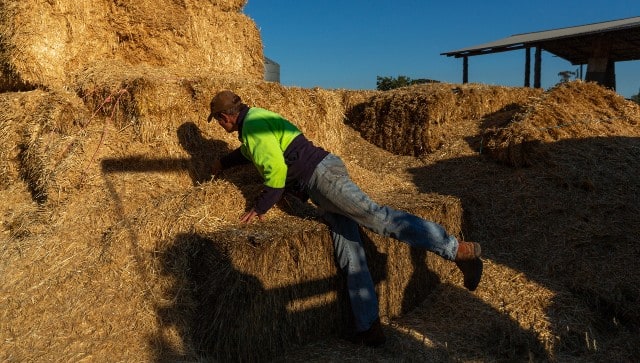
Jeff Fragar checks hay damaged by mice on his farm in Tottenham, Australia. Image courtesy: The New York Times[/caption]Australia suffers a mouse plague every decade or so. The current one came after bountiful rains last year that left farmers’ silos overflowing with grain. They stocked up on feed for their animals, and all that grain gave the mice a perfect source of food.Changes to farming practices have also been a factor. Crop farmers used to burn stubble to clear the land. Over the past 15 years, they’ve started sowing new crops directly onto the old stalks, for environmental reasons. That has had the unintended consequence of creating more sources of food and shelter for mice.These natural and human-made causes, along with the fast breeding cycles of mice — they can have six to 10 offspring every three weeks or so — have allowed their numbers to quickly explode into the millions.At the same time, government help has been slow to arrive. The New South Wales government recently announced a support package that includes rebates on mouse bait and the lifting of a ban on the use of the poison bromadiolone, which the state agricultural minister, Adam Marshall, said would be the equivalent of “napalming” the mice.In the tiny town of Tottenham, near the Fragars’ farm, residents say this mouse plague is the longest they have lived through.The coming Southern Hemisphere winter has slowed the mice down. Robert Brodin, who owns a store called Tottenham Rural Trading, said he had been catching 30 or 40 mice in his store each morning but now caught only 15 or 20.But he’s not confident it will end anytime soon. “They used to say once they start eating each other, it’ll be over, but they’ve been eating each other since December, and it’s not stopping,” he said.Steve Henry, whom the Australian government has labeled the country’s top mice plague expert, said it was easier to predict the beginning of an outbreak than the conclusion of one.The scene he painted for the eventual denouement was one of vermin apocalypse. The tail end of a mouse plague, Henry said, arrives when “there’s too many mice in the system; they’re all interacting with each other and disease spreads quickly. At the same time, they’re running out of food, so they’re turning on the sick and weak, and they’re attacking and eating their babies.”He warned that if the mice survive the winter in large numbers, their populations would explode again in the spring and cause even more damage.Until it’s all over, the plague will continue to take a psychological toll in remote areas, where people are largely self-reliant and often face setbacks with the mindset that you take it on the chin and get on with it.Jo Randall, who lives about 75 miles south of the Fragars, said she had been brought to tears one morning as she contemplated the extra work the mice were creating on top of an already laborious farm and home life.The Randalls consider themselves lucky because they’ve been able to keep the mice out of their fields, through baiting and burning of the land.But they live in an old house, full of tiny cracks and holes for rodent intruders to slip through. Even in the morning cold, she has to open the windows to alleviate the odour.Signs of mice are all around: Randall’s phone case has been chewed ragged at the edges, the family’s stereo system has been destroyed, and there are scores of tiny teeth marks in the handle of a pair of scissors on the counter.She thought the last straw would be if the mice ever got into her bed. But when it actually happened — when she found droppings in her good sheets at 10.30 pm after an exhausting day — she just sighed, stripped the sheets and made the bed again.“You’ve just got to resign to the fact that you’re not going to win the battle, you’re not going to get rid of them,” she said. “So you just do the best as you can and just wait for it to be over.”Yan Zhuang c.2021 The New York Times Company

Globe at a glance: From Houthis striking Saudi tankers in Red Sea to wildfires in Europe
Houthis claim responsibility for attack on two Saudi oil tankers in Red Sea as a new chokepoint emerges
Air India to cut Delhi-Toronto flight time by 3 hours, resume non-stop services from August 1
US signs landmark nuclear deal with Saudi Arabia amid tensions in West Asia
Wildfires ravage parts of Italy, Spain and France, prompting thousands of evacuations