
Advertisement


Sections
Pakistan Election 2018: Suicide bomber strikes outside polling station in Quetta, kills 31, injures 40
Around 25 people have been killed and 40 injured in a blast in Quetta in Balochistan on the day of the voting for the Pakistan general elections.

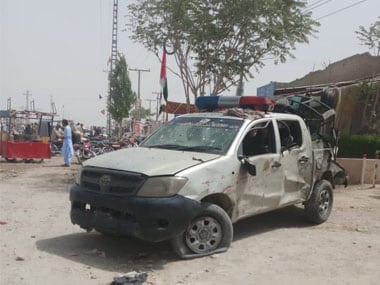
Around 31 people have been killed and 40 others have been injured in a blast outside a crowded polling station in Pakistan's southwestern city of Quetta on Wednesday, as voting for Pakistan general elections was underway.The attack in Quetta, the provincial capital of Baluchistan, also wounded 35 (40 according to some sources) people and several were reported to be in critical condition, raising concerns the death toll could rise further, according to hospital official Jaffar Kakar, a doctor.The police confirmed it was a suicide blast and security forces established a cordon around the site of the attack. The attack was part of a larger pattern of attacks targeting security forces vehicles and not the electoral process.The area was crowded as people were making their way to vote at Tameer-e-Nau Model School nearby, reported Dawn. Polling has come to a halt at the polling station after the blast.A witness who was waiting to cast his ballot, Abdul Haleem, said he saw a motorcycle drive into the crowd of voters just seconds before the explosion. Haleem's uncle was killed in the blast."There was a deafening bang followed by a thick cloud of smoke and dust and so much crying from the wounded people," he told The Associated Press.[caption id="" align="alignleft" width="380"]![At least 25 people, including police officials, have been killed in a blast in Quetta. Courtesy: Firstpost/Imran Mukhtar]() At least 25 people, including police officials, have been killed in a blast in Quetta. Courtesy: Firstpost/Imran Mukhtar[/caption]Baluchistan also saw the worst violence during election campaigning earlier this month, when a suicide bomber blew himself up at a political rally, killing 149 people, including the candidate Siraj Raisani. Another 400 were wounded. Voting in that constituency has been suspended.The Islamic State group claimed responsibility for that attack, though Baluchistan has seen relentless attacks, both by the province's secessionists and Sunni militants who have killed hundreds of Shiites living there. In recent years, the IS affiliate in the region has emerged as a major force behind violence, often using local Sunni radicals from the outlawed Lashkar-e-Jhangvi to carry out its attacks.Citing security concerns, Pakistan's election commission announced that internet and cellphone services in several Baluchistan districts have been suspended. Election commission secretary Babar Yaqub told reporters that threats against polling stations, staff and even candidates have been received.Militants on Tuesday lobbed grenades and opened fire at a military convoy escorting election staffers and voting material in Baluchistan's district of Turbat, killing four troops.At the request of the election commission, Pakistan's military deployed 350,000 troops countrywide at polling stations.Also on Wednesday, police said a shooting between supporters of two opposing political parties killed one person and wounded two in a village near the northwestern city of Swabi. Later, more clashes between rival political parties killed another person and wounded 15 across the country.Early voting was heavy at some polling stations in Islamabad, the capital, and also in the Punjab provincial capital, with several political party leaders standing in line to cast their ballots.
At least 25 people, including police officials, have been killed in a blast in Quetta. Courtesy: Firstpost/Imran Mukhtar[/caption]Baluchistan also saw the worst violence during election campaigning earlier this month, when a suicide bomber blew himself up at a political rally, killing 149 people, including the candidate Siraj Raisani. Another 400 were wounded. Voting in that constituency has been suspended.The Islamic State group claimed responsibility for that attack, though Baluchistan has seen relentless attacks, both by the province's secessionists and Sunni militants who have killed hundreds of Shiites living there. In recent years, the IS affiliate in the region has emerged as a major force behind violence, often using local Sunni radicals from the outlawed Lashkar-e-Jhangvi to carry out its attacks.Citing security concerns, Pakistan's election commission announced that internet and cellphone services in several Baluchistan districts have been suspended. Election commission secretary Babar Yaqub told reporters that threats against polling stations, staff and even candidates have been received.Militants on Tuesday lobbed grenades and opened fire at a military convoy escorting election staffers and voting material in Baluchistan's district of Turbat, killing four troops.At the request of the election commission, Pakistan's military deployed 350,000 troops countrywide at polling stations.Also on Wednesday, police said a shooting between supporters of two opposing political parties killed one person and wounded two in a village near the northwestern city of Swabi. Later, more clashes between rival political parties killed another person and wounded 15 across the country.Early voting was heavy at some polling stations in Islamabad, the capital, and also in the Punjab provincial capital, with several political party leaders standing in line to cast their ballots.![Pakistan General Election 2018]() Local television reported scattered incidences of police arresting people with pre-marked ballots.Rights groups have warned that a rancorous election campaign and widespread allegations of manipulation imperil the wobbly transition to democratic rule and raise the specter of bitter challenges of fraud after the elections.The unprecedented participation in these elections of radical religious groups, including those banned for terror links but resurrected and renamed, has also raised concerns — especially for minorities and women — ahead of the voting.Pakistan Tehreek-e-Insaaf (PTI) leader Chaudhry Mohammad Sarwar condemned the incident on Twitter. "I strongly condemn the terrorist attack on 2018 election "voters" in Quetta today which has taken many precious lives & left numerous injured. Gift must check these continuous terrorist attacks in Balochistan. Terrorists will never succeed!" he tweeted soon after the attack.Jibran Nasir, an independent candidate from Pakistan's financial hub of Karachi, said he received death threats and even had a fatwa, or religious edict, issued against him after he refused to condemn Ahmadis, reviled by mainstream Muslims as heretics because they believe the messiah promised in Islam arrived over a century ago. Pakistan in 1974 declared Ahmadis non-Muslims."I am speaking for the millions of Pakistanis who are too afraid to confront religious bigotry," Nasir said, adding that no arrests have been made of those who threatened him.The leading contenders in Wednesday's polling are former cricket star Imran Khan and his right-of-center Pakistan Tehreek-e-Insaf Party, and the right-of-center Pakistan Muslim League, the party of disgraced Prime Minister Nawaz Sharif, who is in jail serving 10 years on corruption charges. His younger brother Shahbaz Sharif took control of the party.Khan's supporters showered his vehicle with rose petals as he arrived to vote at a polling station near his home suburb in. Islamabad. After voting, he appealed on Pakistanis to come out and vote in huge numbers "to save future generations."The third-largest party in the running is the left-leaning Pakistan People's Party, headed by Bilawal Bhutto, the son of late Prime Minister Benazir Bhutto, assassinated by the Pakistani Taliban, whom she had vowed to eradicate.[caption id="attachment_4817751" align="alignnone" width="850"]
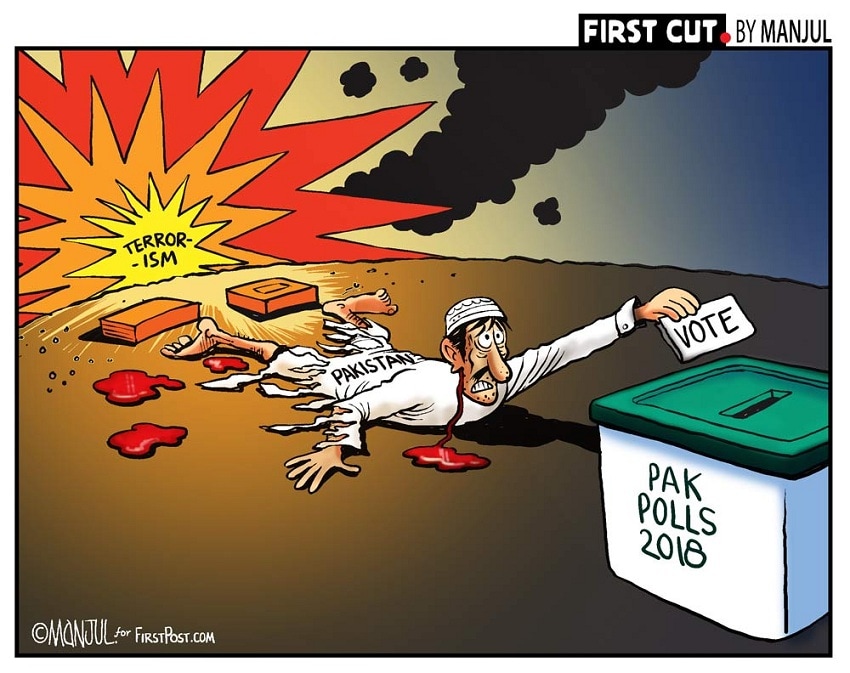
Local television reported scattered incidences of police arresting people with pre-marked ballots.Rights groups have warned that a rancorous election campaign and widespread allegations of manipulation imperil the wobbly transition to democratic rule and raise the specter of bitter challenges of fraud after the elections.The unprecedented participation in these elections of radical religious groups, including those banned for terror links but resurrected and renamed, has also raised concerns — especially for minorities and women — ahead of the voting.Pakistan Tehreek-e-Insaaf (PTI) leader Chaudhry Mohammad Sarwar condemned the incident on Twitter. "I strongly condemn the terrorist attack on 2018 election "voters" in Quetta today which has taken many precious lives & left numerous injured. Gift must check these continuous terrorist attacks in Balochistan. Terrorists will never succeed!" he tweeted soon after the attack.Jibran Nasir, an independent candidate from Pakistan's financial hub of Karachi, said he received death threats and even had a fatwa, or religious edict, issued against him after he refused to condemn Ahmadis, reviled by mainstream Muslims as heretics because they believe the messiah promised in Islam arrived over a century ago. Pakistan in 1974 declared Ahmadis non-Muslims."I am speaking for the millions of Pakistanis who are too afraid to confront religious bigotry," Nasir said, adding that no arrests have been made of those who threatened him.The leading contenders in Wednesday's polling are former cricket star Imran Khan and his right-of-center Pakistan Tehreek-e-Insaf Party, and the right-of-center Pakistan Muslim League, the party of disgraced Prime Minister Nawaz Sharif, who is in jail serving 10 years on corruption charges. His younger brother Shahbaz Sharif took control of the party.Khan's supporters showered his vehicle with rose petals as he arrived to vote at a polling station near his home suburb in. Islamabad. After voting, he appealed on Pakistanis to come out and vote in huge numbers "to save future generations."The third-largest party in the running is the left-leaning Pakistan People's Party, headed by Bilawal Bhutto, the son of late Prime Minister Benazir Bhutto, assassinated by the Pakistani Taliban, whom she had vowed to eradicate.[caption id="attachment_4817751" align="alignnone" width="850"]![Toon by Manjul.]() Toon by Manjul.[/caption]Election officials say more than 11,000 candidates are vying for 270 seats in Pakistan's law-making Lower House of Parliament and 577 seats in four provincial assemblies.The 85,307 polling stations opened at 8 a.m. and will continue for 10 hours, an hour longer than in the 2013 polls. Voting for two parliamentary seats and six seats in provincial assemblies has been postponed due to attacks on candidates or disqualifications. First results are expected early Thursday.There are more than 105 million eligible voters in Pakistan, 59 million men and 46 million women.Pakistan's election commission reminded candidates their elections will be nullified if the female voter turnout does not reach 10 percent. The requirement was imposed after the 2013 elections, when several areas banned voting by women, mostly in Pakistan's religiously conservative northwest. Some candidates were elected without a single woman marking a ballot.The commission issued its reminder Tuesday after veteran rights activist Tahira Abdullah said local jirgas, or councils, of elders from 60 areas of the country, representing 16 different constituencies, had signed agreements banning women from voting despite the new ruling. While some areas have refused to relent, others were allowing women to cast ballots.In Pakistan's deeply tribal and religiously conservative North Waziristan, where Taliban insurgents have found safe havens, women voted for the first time on Wednesday, said Mohamad Ayaz Khan, a government administrator."We made history today," said Khan. "It is the first time that women have come out of their homes to cast their vote."Voting is segregated throughout Pakistan with even single polling stations divided between men and women, including separate election officials.Results will trickle in after polling ends, with the outcome expected early Thursday, according to election officials.International and domestic election observers will monitor the voting. The European Union Election Observation Mission has 120 monitors at polling stations in major centers across Pakistan, with the exception of Baluchistan.Under Pakistani law, separate seats are reserved for women and for non-Muslim minorities, which comprise 4 percent of the population.With inputs from agencies
Toon by Manjul.[/caption]Election officials say more than 11,000 candidates are vying for 270 seats in Pakistan's law-making Lower House of Parliament and 577 seats in four provincial assemblies.The 85,307 polling stations opened at 8 a.m. and will continue for 10 hours, an hour longer than in the 2013 polls. Voting for two parliamentary seats and six seats in provincial assemblies has been postponed due to attacks on candidates or disqualifications. First results are expected early Thursday.There are more than 105 million eligible voters in Pakistan, 59 million men and 46 million women.Pakistan's election commission reminded candidates their elections will be nullified if the female voter turnout does not reach 10 percent. The requirement was imposed after the 2013 elections, when several areas banned voting by women, mostly in Pakistan's religiously conservative northwest. Some candidates were elected without a single woman marking a ballot.The commission issued its reminder Tuesday after veteran rights activist Tahira Abdullah said local jirgas, or councils, of elders from 60 areas of the country, representing 16 different constituencies, had signed agreements banning women from voting despite the new ruling. While some areas have refused to relent, others were allowing women to cast ballots.In Pakistan's deeply tribal and religiously conservative North Waziristan, where Taliban insurgents have found safe havens, women voted for the first time on Wednesday, said Mohamad Ayaz Khan, a government administrator."We made history today," said Khan. "It is the first time that women have come out of their homes to cast their vote."Voting is segregated throughout Pakistan with even single polling stations divided between men and women, including separate election officials.Results will trickle in after polling ends, with the outcome expected early Thursday, according to election officials.International and domestic election observers will monitor the voting. The European Union Election Observation Mission has 120 monitors at polling stations in major centers across Pakistan, with the exception of Baluchistan.Under Pakistani law, separate seats are reserved for women and for non-Muslim minorities, which comprise 4 percent of the population.With inputs from agencies
 At least 25 people, including police officials, have been killed in a blast in Quetta. Courtesy: Firstpost/Imran Mukhtar[/caption]Baluchistan also saw the worst violence during election campaigning earlier this month, when a suicide bomber blew himself up at a political rally, killing 149 people, including the candidate Siraj Raisani. Another 400 were wounded. Voting in that constituency has been suspended.The Islamic State group claimed responsibility for that attack, though Baluchistan has seen relentless attacks, both by the province's secessionists and Sunni militants who have killed hundreds of Shiites living there. In recent years, the IS affiliate in the region has emerged as a major force behind violence, often using local Sunni radicals from the outlawed Lashkar-e-Jhangvi to carry out its attacks.Citing security concerns, Pakistan's election commission announced that internet and cellphone services in several Baluchistan districts have been suspended. Election commission secretary Babar Yaqub told reporters that threats against polling stations, staff and even candidates have been received.Militants on Tuesday lobbed grenades and opened fire at a military convoy escorting election staffers and voting material in Baluchistan's district of Turbat, killing four troops.At the request of the election commission, Pakistan's military deployed 350,000 troops countrywide at polling stations.Also on Wednesday, police said a shooting between supporters of two opposing political parties killed one person and wounded two in a village near the northwestern city of Swabi. Later, more clashes between rival political parties killed another person and wounded 15 across the country.Early voting was heavy at some polling stations in Islamabad, the capital, and also in the Punjab provincial capital, with several political party leaders standing in line to cast their ballots.
 Local television reported scattered incidences of police arresting people with pre-marked ballots.Rights groups have warned that a rancorous election campaign and widespread allegations of manipulation imperil the wobbly transition to democratic rule and raise the specter of bitter challenges of fraud after the elections.The unprecedented participation in these elections of radical religious groups, including those banned for terror links but resurrected and renamed, has also raised concerns — especially for minorities and women — ahead of the voting.Pakistan Tehreek-e-Insaaf (PTI) leader Chaudhry Mohammad Sarwar condemned the incident on Twitter. "I strongly condemn the terrorist attack on 2018 election "voters" in Quetta today which has taken many precious lives & left numerous injured. Gift must check these continuous terrorist attacks in Balochistan. Terrorists will never succeed!" he tweeted soon after the attack.Jibran Nasir, an independent candidate from Pakistan's financial hub of Karachi, said he received death threats and even had a fatwa, or religious edict, issued against him after he refused to condemn Ahmadis, reviled by mainstream Muslims as heretics because they believe the messiah promised in Islam arrived over a century ago. Pakistan in 1974 declared Ahmadis non-Muslims."I am speaking for the millions of Pakistanis who are too afraid to confront religious bigotry," Nasir said, adding that no arrests have been made of those who threatened him.The leading contenders in Wednesday's polling are former cricket star Imran Khan and his right-of-center Pakistan Tehreek-e-Insaf Party, and the right-of-center Pakistan Muslim League, the party of disgraced Prime Minister Nawaz Sharif, who is in jail serving 10 years on corruption charges. His younger brother Shahbaz Sharif took control of the party.Khan's supporters showered his vehicle with rose petals as he arrived to vote at a polling station near his home suburb in. Islamabad. After voting, he appealed on Pakistanis to come out and vote in huge numbers "to save future generations."The third-largest party in the running is the left-leaning Pakistan People's Party, headed by Bilawal Bhutto, the son of late Prime Minister Benazir Bhutto, assassinated by the Pakistani Taliban, whom she had vowed to eradicate.[caption id="attachment_4817751" align="alignnone" width="850"]
 Toon by Manjul.[/caption]Election officials say more than 11,000 candidates are vying for 270 seats in Pakistan's law-making Lower House of Parliament and 577 seats in four provincial assemblies.The 85,307 polling stations opened at 8 a.m. and will continue for 10 hours, an hour longer than in the 2013 polls. Voting for two parliamentary seats and six seats in provincial assemblies has been postponed due to attacks on candidates or disqualifications. First results are expected early Thursday.There are more than 105 million eligible voters in Pakistan, 59 million men and 46 million women.Pakistan's election commission reminded candidates their elections will be nullified if the female voter turnout does not reach 10 percent. The requirement was imposed after the 2013 elections, when several areas banned voting by women, mostly in Pakistan's religiously conservative northwest. Some candidates were elected without a single woman marking a ballot.The commission issued its reminder Tuesday after veteran rights activist Tahira Abdullah said local jirgas, or councils, of elders from 60 areas of the country, representing 16 different constituencies, had signed agreements banning women from voting despite the new ruling. While some areas have refused to relent, others were allowing women to cast ballots.In Pakistan's deeply tribal and religiously conservative North Waziristan, where Taliban insurgents have found safe havens, women voted for the first time on Wednesday, said Mohamad Ayaz Khan, a government administrator."We made history today," said Khan. "It is the first time that women have come out of their homes to cast their vote."Voting is segregated throughout Pakistan with even single polling stations divided between men and women, including separate election officials.Results will trickle in after polling ends, with the outcome expected early Thursday, according to election officials.International and domestic election observers will monitor the voting. The European Union Election Observation Mission has 120 monitors at polling stations in major centers across Pakistan, with the exception of Baluchistan.Under Pakistani law, separate seats are reserved for women and for non-Muslim minorities, which comprise 4 percent of the population.With inputs from agencies
First Published:Jul 25, 2018, 16:30:57 IST
Advertisement
Advertisement

Globe at a glance: From Houthis striking Saudi tankers in Red Sea to wildfires in Europe
Your window to world news: As Yemen's Houthi rebels claimed to have struck two Saudi oil tankers in the Red Sea on Wednesday, the United States has announced a landmark deal with Saudi Arabia that would establish a civilian nuclear program in the Gulf country
2 min read
Houthis claim responsibility for attack on two Saudi oil tankers in Red Sea as a new chokepoint emerges
Yemen's Iran-backed militant group Houthis have claimed responsibility for the attack on two Saudi oil tankers in the Red Sea, opening a new chokepoint in the ongoing conflict in West Asia.
2 min read
Air India to cut Delhi-Toronto flight time by 3 hours, resume non-stop services from August 1
Air India will resume non-stop Delhi-Toronto flights from August 1, cutting travel time by nearly three hours and deploying its new Boeing 787-9 Dreamliner on the route
2 min read
US signs landmark nuclear deal with Saudi Arabia amid tensions in West Asia
Amid the growing tensions in West Asia, the United States signed a landmark nuclear deal with Saudi Arabia that could potentially allow the kingdom to have enriched uranium.
2 min read
Wildfires ravage parts of Italy, Spain and France, prompting thousands of evacuations
Wildfires raged on Wednesday in Sicily, southwestern France and central Spain, sparking thousands of evacuations and claiming the life of an Italian firefighter.
2 min read
Advertisement
Advertisement