


Nobel Physics Prize winners: All you need to know about mugs, donuts and quantum computing
The Nobel Physics prize was the second of the awards to be given away, on Tuesday, to a Birtish trio — scientists David Thouless, Duncan Haldane and Michael Kosterlitz for revealing the secrets of exotic matter.

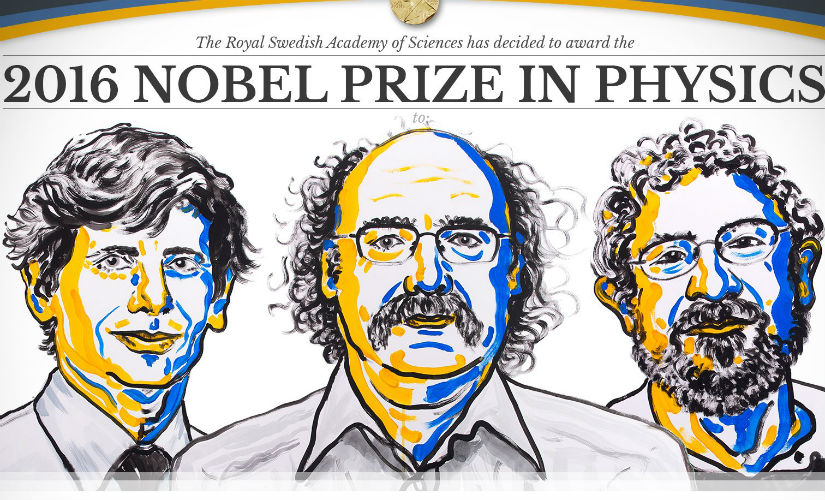
Scientists David Thouless, Duncan Haldane and Michael Kosterlitz declared winners of Nobel Physics prize. Image courtesy: @NobelPrize/Twitter[/caption]Today, topology has burgeoned into a wide range of physics sub-fields promising a host of practical applications ranging from supercomputing to superconductors.The key virtue of topological materials is that they "remain robust regardless of the deforming forces being applied to them," said David Carpentier, a physicist at France's CNRS research institute. By shaping materials into "topological states," scientists hope one day to transport energy or information farther and fastest than possible today. It is hoped that new materials emerging from this research will use much less electricity. But they pose a high risk of overheating, which is where topological insulators with an inherent stability would come in very handy.The jury said their pioneering work "has boosted frontline research in condensed matter physics, not least because of the hope that topological materials could be used in new generations of electronics and superconductors, or in future quantum computers." It holds exceptional promise for quantum computing and tiny quantum devices as topological states can transport energy and information without overheating, unlike traditional quantum mechanics. Quantum computers, still on the drawing board, promise superfast processing speeds using the properties of subatomic particles that exist in more than one state at once.Kosterlitz, speaking to reporters in Helsinki where he was working, joked: "I've been waiting for my desk-top quantum computer for years and it's showing no signs of appearing...At the risk of making a bad mistake, I would say that this quantum computation stuff is a long way from being practical."Haldane said his prizewinning discovery had been serendipitous. "Most of the big discoveries are done that way: you stumble on it and you have the luck to recognise you have something very interesting," he told reporters at the Nobel press conference via videolink. "It's so surprising that it takes a while to grip, but when you see it you realise why no one had seen it before.""The next step will be to create these objects in the lab and try to manipulate them, performing very simple operations," Nathan Goldman of the Free University of Brussels said."Two years ago, I would have said it would take at least two decades to see something on the supermarket shelf" resulting from topology research, Asorey said."Today, I would say one decade, maybe less."

Explorers discover wreckage of plane 72 years later. Will this help in finding MH370?
Chinese Defence Attache praise India’s rescue of 12 sailors off Kerala cost
'China ready to work with India,' says Wang Yi after talks with Jaishankar in Manila
Secret Service agent on JD Vance security detail put on leave over alleged leak of travel plans
China has dominated Myanmar’s rare earth mines — now India eyes deal to harness country’s critical minerals