


Motor Vehicle Agreement: Bhutan govt planning to save BBIN bill from being scrapped
The Bhutan government is preparing to move a motion to withdraw the controversial Motor Vehicle Agreement involving Bangladesh, Bhutan, India and Nepal (BBIN) during the joint sitting of the parliament next month, in order to save it from being scrapped in Parliament, a media report said.

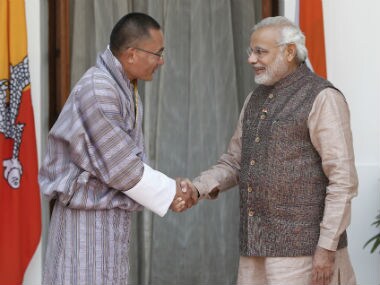
File photo of Prime Minister Narendra Modi with Bhutan PM Tshering Tobgay. Reuters[/caption]Prime Minister Tshering Tobgay earlier told Kuensel that due process would be followed if the agreement is withdrawn.However, the government's effort to withdraw the agreement that is already with the joint committee is likely to be met with resistance as the Legislative Rules of Procedure (LROP) 2011 do not have provisions for withdrawal of a disputed bill, the daily reported.If the bill fails to obtain the endorsement of the joint sitting, it will be declared a dead bill and no bill of the same substance will be deliberated in the same year.However, members of Parliament from the ruling party who are in the joint parliamentary committee are persuading the opposition and council members to agree on the withdrawal of the agreement during the joint sitting. The 12-member joint parliamentary committee was formed to resolve the differences and propose recommendations to the Parliament.Should the withdrawal option not come through, the agreement will go to vote, in which case it is likely to be rejected. The chairman of the joint committee, Ritu Raj Chhetri, said the best option for the committee would be to propose a withdrawal. "It looks like it will be tough to get support from the opposition and most council members," he said.The council believes that ratifying the agreement, which aims to facilitate seamless cross-border movement of both cargo and passenger vehicles, will overwhelm Bhutan, the smallest country in the grouping. The opposition also argues that it will affect the livelihoods of Bhutanese transport operators.The government argues that Bhutan's interests will be protected while enacting protocols, which will be the by-law of the agreement. An opposition member said it could support the agreement if such assurances were incorporated in the protocols and presented along with the agreement in the Parliament.The government has repeatedly stated that the agreement does not open the floodgates for foreign vehicles. However, the Council remains unconvinced because of the principle of reciprocity the agreement upholds.The government believes that implementation of the motor vehicle agreement, which is the first of any between the four countries, will open gates for cooperation in other areas. The government identified the agreement as the precursor to cooperation in other fields including connectivity, energy, trade and ICT, Kuensel reported.The transport ministers of the four countries signed the agreement in June 2015 in Thimphu.Unable to ratify the Bangladesh, Bhutan, India, Nepal (BBIN) motor vehicles agreement, Bhutan has asked the three other members to go ahead without it, leaving them in a fix, the Kathmandu Post reportedBhutan has communicated its decision to the Nepali Embassy in Delhi.

Globe at a glance: From Houthis striking Saudi tankers in Red Sea to wildfires in Europe
Houthis claim responsibility for attack on two Saudi oil tankers in Red Sea as a new chokepoint emerges
Air India to cut Delhi-Toronto flight time by 3 hours, resume non-stop services from August 1
US signs landmark nuclear deal with Saudi Arabia amid tensions in West Asia
Wildfires ravage parts of Italy, Spain and France, prompting thousands of evacuations