
Advertisement


Sections
Maldives unrest: PM Narendra Modi's visit to island nation under shadow
Prime Minister Narendra Modi's proposed visit to Maldives on 15 March is under shadow due to the ongoing political situation in the island nation following the arrest of former President Mohamed Nasheed last week.

Prime Minister Narendra Modi's proposed visit to Maldives on 15 March is under shadow due to the ongoing political situation in the island nation following the arrest of former President Mohamed Nasheed last week.[caption id="attachment_2133939" align="alignleft" width="380"]![Prime Minister Narendra Modi with Maldives President Abdulla Yameen. PIB]() Prime Minister Narendra Modi with Maldives President Abdulla Yameen. PIB[/caption]With Maldives witnessing mass rallies and protests against the detention of Nasheed on terror charges, it is understood that a clear decision on whether Modi should visit the Indian Ocean island, which was initially part of the Prime Minister's four-nation visit, has not been taken.Meanwhile, officials have already announced the dates for Modi's visit to Sri Lanka, Mauritius and Seychelles —the three other countries.Maintaining that a final decision will only be taken after the return of the advance team from Maldives, the officials said, "usually for any multi-nation visit, the dates are announced together but in this case dates for only three countries have been announced. Therefore, it is very clear that Maldives' trip is under shadow and is not clearly decided upon."Nasheed, 47, the country's first democratically elected leader, was arrested on Sunday on terror charges for ordering the arrest of a senior judge in 2012. His arrest has triggered mass rallies and protests across Maldives.In an earlier article, Firstpost consulting editor Rajeev Sharma had written that the Maldivian crisis also brings the Modi government face to face with harsh diplomatic realities arguing that Modi should immediately cancel his trip.
Prime Minister Narendra Modi with Maldives President Abdulla Yameen. PIB[/caption]With Maldives witnessing mass rallies and protests against the detention of Nasheed on terror charges, it is understood that a clear decision on whether Modi should visit the Indian Ocean island, which was initially part of the Prime Minister's four-nation visit, has not been taken.Meanwhile, officials have already announced the dates for Modi's visit to Sri Lanka, Mauritius and Seychelles —the three other countries.Maintaining that a final decision will only be taken after the return of the advance team from Maldives, the officials said, "usually for any multi-nation visit, the dates are announced together but in this case dates for only three countries have been announced. Therefore, it is very clear that Maldives' trip is under shadow and is not clearly decided upon."Nasheed, 47, the country's first democratically elected leader, was arrested on Sunday on terror charges for ordering the arrest of a senior judge in 2012. His arrest has triggered mass rallies and protests across Maldives.In an earlier article, Firstpost consulting editor Rajeev Sharma had written that the Maldivian crisis also brings the Modi government face to face with harsh diplomatic realities arguing that Modi should immediately cancel his trip.
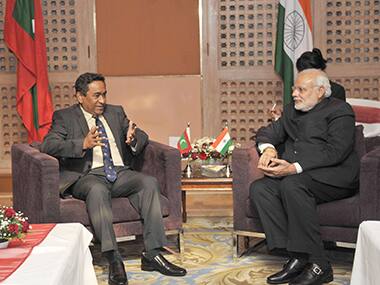 Prime Minister Narendra Modi with Maldives President Abdulla Yameen. PIB[/caption]With Maldives witnessing mass rallies and protests against the detention of Nasheed on terror charges, it is understood that a clear decision on whether Modi should visit the Indian Ocean island, which was initially part of the Prime Minister's four-nation visit, has not been taken.Meanwhile, officials have already announced the dates for Modi's visit to Sri Lanka, Mauritius and Seychelles —the three other countries.Maintaining that a final decision will only be taken after the return of the advance team from Maldives, the officials said, "usually for any multi-nation visit, the dates are announced together but in this case dates for only three countries have been announced. Therefore, it is very clear that Maldives' trip is under shadow and is not clearly decided upon."Nasheed, 47, the country's first democratically elected leader, was arrested on Sunday on terror charges for ordering the arrest of a senior judge in 2012. His arrest has triggered mass rallies and protests across Maldives.In an earlier article, Firstpost consulting editor Rajeev Sharma had written that the Maldivian crisis also brings the Modi government face to face with harsh diplomatic realities arguing that Modi should immediately cancel his trip.
The tone and tenor of the ongoing trial of Nasheed is clear from the fact that the Human Rights Commission of the Maldives claimed on 26 February that independent doctors were not given the chance to examine whether Nasheed faced any injuries when he was dragged to court on 23 February. The Ministry of External Affairs may well rush senior diplomats to Male to defuse the crisis but the writing is quite clear on the wall: that the Abdulla Yameen government is not prepared to budge from the position it has taken with regard to Nasheed’s arrest. Under the circumstances, it won’t be advisable for PM Modi to travel to Maldives.Maldives, a small-sized but strategically important neighbour, triggers a serious diplomatic challenge for the BJP government considering that the party had hauled the then UPA government led by Manmohan Singh over coal when the Maldivian political crisis had first erupted three years ago.The Manmohan Singh government was accused of letting an 'Indian government' die its political death, slowly but surely. The UPA government had projected an image that it did not want to interfere in the domestic politics of a foreign country – though the strategic imperatives from the Indian point of view were to the contrary. In the process, India lost an important friend and ceded Maldives’ strategic space to rivals like China.With inputs from PTI
First Published:Mar 03, 2015, 21:02:23 IST
Advertisement
Advertisement

Explorers discover wreckage of plane 72 years later. Will this help in finding MH370?
On April 11, 1952, a Pan Am Flight 526A, crashed into the Atlantic Ocean, killing 52 of the 69 people on board. After decades of effort, explorers have found the wreck of the plane at the bottom of the seabed near Puerto Rico. The discovery offers new hope to families who lost loved ones in the Malaysia Airlines Flight 370 crash in 2014
5 min read
Chinese Defence Attache praise India’s rescue of 12 sailors off Kerala cost
Rear Admiral You Jian, the Defence Attache at the Embassy of China in India, has praised India for rescuing 12 Chinese crew members off the coast of Kerala last year.
1 min read
'China ready to work with India,' says Wang Yi after talks with Jaishankar in Manila
China's Foreign Minister Wang Yi said that Beijing and New Delhi should 'consolidate positive momentum' in bilateral ties during his talks with his Indian counterpart Dr S. Jaishankar.
1 min read
Secret Service agent on JD Vance security detail put on leave over alleged leak of travel plans
A US Secret Service agent assigned to Vice President JD Vance's security detail has been placed on administrative leave after being suspected of leaking sensitive information about the vice president's travel plans to the media
2 min read
China has dominated Myanmar’s rare earth mines — now India eyes deal to harness country’s critical minerals
India is deepening rare earth cooperation with Myanmar as New Delhi seeks alternative sources of critical minerals dominated by China, including dysprosium and terbium used in EVs, defence systems and clean energy technologies
6 min read
Advertisement
Advertisement