


IPCC sounds alarm on climate change: Without US co-operation, the battle for reducing emissions can't be won
The report says that action must be taken to ensure that human civilisation becomes a zero-emission project by mid-century.

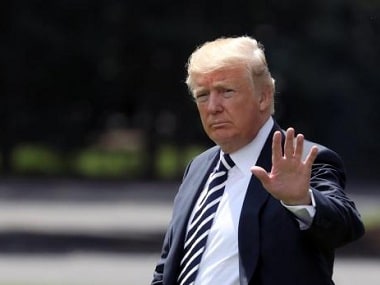
File photo of US president Donald Trump. Reuters[/caption]The global community must ensure that the goal of finalising the Paris agreement’s implementation guidelines at the annual UN Climate Change Conference this December in Katowice, Poland, is met. This is all very well, except for one small matter. Under the leadership of President Donald Trump, the United States, historically the largest emitter of greenhouse gases and currently the second largest after China, contributing 15 percent of global emissions going by 2014 data, has pulled out of the Paris agreement. Without its compliance, meeting the 1.5ºC target will be all but impossible.When Trump rescinded former president Barack Obama’s decision of accession to the deal, the global community was aghast, but it could do precious little to convince the mercurial occupant of the White House. Many groups in the US, including those with corporate interests, have pledged to independently pursue the commitments under the Paris agreements. Even the fossil fuel industry, the most inveterate of climate change deniers, has embraced change.But that might not be enough. In December 2017, for instance, the Trump administration opened part of the Arctic National Wildlife Refuge to oil development and in January, it announced a new, five-year draft plan for offshore drilling leases. These decisions will not only endanger the fragile ecosystem of the area but will also spur a drilling war which, according to US interior secretary Ryan Zinke, is part of ‘a new path for energy dominance in America’. This new path can have only one outcome: more emissions of greenhouse gases. On the other hand, the fact that China, which in 2014 contributed almost 30 percent of greenhouse-gas emissions is emphatically on board, is a positive development.The Trump administration’s Alaska policy focuses attention yet again on of the big casualties of climate change: the polar glaciers, which are melting at a furious pace. That is not just a concern in itself, because of what is happening to one kind of ecosystem, but also because it is contributing to the rise in sea levels, which especially threatens island nations and riverine, deltaic regions. Think northern India.Let us be clear about one thing though. The Paris agreement was a climbdown from the basic structure of the global architecture of plans to counter climate change laid down in the Kyoto Protocol, which was adopted in 1997 and came into effect in 2015. It was ratified by all major countries other than the US. Canada pulled out of it in 2012, citing the specious excuse that the US was not a party.The Kyoto Protocol looked at the problem of emissions from a historical perspective, which is to say that it recognised that the already industrialized countries had contributed an overwhelming portion of the stock of GHGs in the atmosphere: over the period 1800-1998, it has been estimated, countries from North America and Europe that were part of the Organisation for Economic Co-operation and Development had contributed 46.30 percent, while the Soviet Union’s share was 12.50 percent. That works out to a total of almost 60 percent.The Kyoto Protocol, thus, enunciated the principle of ‘common but differentiated’ responsibilities according to which one set of countries, mainly the developed West and the Warsaw Pact countries, had to take on obligatory and binding emission-reduction targets, while developing countries were to meet targets set by themselves keeping in mind their development needs. They were given what was called an ‘emission space’. The developed world was, additionally, given the responsibility of providing funds and technologies to help the developing world pursue ‘cleaner’ development strategies. Kyoto Protocol targets were not met, primarily because the countries that had apparently been driving the battle against climate change, those of Western Europe, reneged on their commitments.In any case, the basic architecture of the Kyoto Protocol, and the principle of ‘common but differentiated’ responsibilities, was junked by the Paris agreement, with the express purpose of bringing the US on board. That objective was secured, when Obama signed up. This fundamental change was a debatable move, but, for the moment, let us accept it was necessary given the urgency of action and the fact that it is the developing world, precisely, that will be worst affected by climate change.With Trump’s decision to withdraw from the pact, the justification for the change in the basic architecture of the global regulatory framework has disappeared. Still, it can be argued, given the new IPCC report, that all countries have to put their shoulders to the wheel to get it rolling in the right direction. The question, however, is, despite the pieties of the IPCC, will it be possible to achieve even near zero-emission world without the US’s participation? Common sense suggests that it won’t.

Globe at a glance: From Houthis striking Saudi tankers in Red Sea to wildfires in Europe
Houthis claim responsibility for attack on two Saudi oil tankers in Red Sea as a new chokepoint emerges
Air India to cut Delhi-Toronto flight time by 3 hours, resume non-stop services from August 1
US signs landmark nuclear deal with Saudi Arabia amid tensions in West Asia
Wildfires ravage parts of Italy, Spain and France, prompting thousands of evacuations