


India downplaying Agni-V's potential: Chinese expert
Du Wenlong, a researcher at China's PLA Academy of Military Sciences, said the Agni-V "actually has the potential to reach targets 8,000 kilometers away". India, on the other hand, said that it can accurately hit targets more than 5,000 km away.

Beijing: Chinese experts feel that there is to more India's successful long-range nuclear-capable missile Agni-V than what New Delhi is saying. A Chinese researcher said the missile "actually has the potential to reach targets 8,000 kilometers away".Du Wenlong, a researcher at China's PLA Academy of Military Sciences, told the Global Times that the Agni-V "actually has the potential to reach targets 8,000 kilometers away".[caption id="attachment_282182" align="alignleft" width="380" caption="Chinese experts feel that there is to more India's successful long-range nuclear-capable missile Agni-V than what New Delhi is saying. PTI"]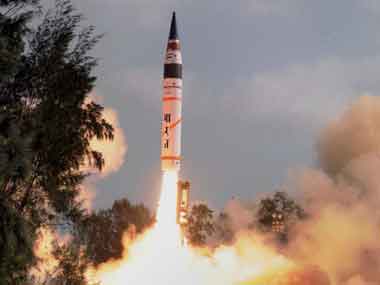 [/caption]Du added that "the Indian government had deliberately downplayed the missile's capability in order to avoid causing concern to other countries".India Thursday test-fired the Agni-V missile that it said can accurately hit targets more than 5,000 km away. With this launch, India entered an exclusive club of nations that have this capability.Zhang Zhaozhong, a professor with the People's Liberation Army National Defence University, told the Global Times that according to China's standard, an ICBM should have a range of at least 8,000 km."The Agni-V's range could be further enhanced to become an Inter-Continental Ballistic Missile," he said.IANS

Wildfires ravage parts of Italy, Spain and France, prompting thousands of evacuations
US set to sign Saudi nuclear deal; Rubio says pact won't fuel proliferation
India-US trade deal 'almost complete', says US after Jaishankar-Rubio talks in Manila
Marco Rubio says he 'would expect India to be concerned' over Trump's pharma tariffs
Trump renews China election interference claims, but files point to Russia's larger role