


India 'complaining' of US spying won't help: It should protect itself instead
We need to ask ourselves: what are spy agencies like NSA supposed to do apart from spying?

Why is one not surprised to learn that the USA’s National Security Agency (NSA) received clearance from its Foreign Intelligence Surveillance Court to spy on the BJP, among others? Or that as many as 193 foreign governments or foreign entities were on the spy agency’s radar?The Indian government can work up a lather over this intrusion, summon the US envoy and give him (or her) an earful, and register its impotent protests – all for public consumption. But we need to ask ourselves: what are spy agencies supposed to do apart from spying? Every nation has to spy on its enemies, and if the US thinks a lot of its enemies lurk in India, it will do so, never mind our sensibilities. It does not require an Edward Snowden to tell us that this is what Uncle Sam has been up to.It is time we stopped being crybabies and do what we have to do. If we want to protect the privacy of our citizens and our political parties, we should develop cyber counter-capabilities to prevent snooping by the US or – for that matter – more hostile or aggressive powers like Pakistan and China. Summoning envoys and expressing moral outrage is for media headlines. They don’t matter.[caption id="attachment_1599393" align="alignleft" width="380"]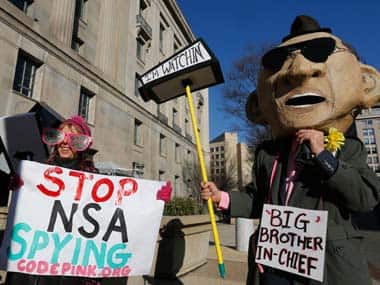 Reuters[/caption]The world can be divided into two types: those who can, do, those who can’t, cry. Do we want to be in the former category or the latter?But many other points need to be made in the context of this spygate affair.For one, the BJP should be preening that Uncle Sam thought it worthy of being spied on. You are someone to reckon with only if someone thinks you are worth spying on. The USA did not think spying on Britain, New Zealand, Australia, and Canada was worth the effort. It takes these allies for granted. It is best if your frenemy does not take you for granted.The second point is this: how much respect can you have for a spy agency that taps into the BJP and still could not tell President Obama that Narendra Modi was the one to watch – and that it made no sense to antagonise a future Prime Minister of India with a silly visa ban that had largely evangelists rooting for it? These evangelists don’t even vote for the Democratic Party. The IQs of the guys doing the BJP surveillance must be reckoned to be lower than that of backward rabbits if they told their boss to ignore Narendra Modi.The third point is this: one would have thought the USA needed to know more about what was going on in the ruling parties rather than opposition ones. In 2010, when the surveillance clearance was sought by the NSA from the Foreign Intelligence Surveillance Court, the Congress had won a big victory just a year ago, and as far as one could see, it was going to be there for four more years, with the possibility of another win in 2014 on the back of populist policies. Why wasn’t the Congress spied on? Or did the NSA think the Congress was not worth spying on? Did it believe, as we heard in another context, that “Congress to ab apni dukaan hai”?The fourth point is simple: our own Intelligence Bureau spies on opposition parties on behalf of the party in power. If this is not objectionable, why raise a ruckus only about the USA's spying?Clearly, the only lessons to be learnt from this Snowden leak, published in the Washington Post, are the following – all inter-related.#1: Nations have to follow their interests. India must follow suit. Protests will get us nowhere. We have to see if we can do the same to the US, and spy on them the same way they spy on us. In fact, if we can nail, name or nab one of their cyber-spies and bring them to justice here, the US will learn to respect us. We have to give it to them as good as we got.#2: The US is still a frenemy – like China. Pakistan is clearly an enemy nation as of now. We have to be prepared not only to counter spying by the US – which at least has the decency to get some kind of court approval for its dirty work - but also by those who need no such justification. How do we now China isn’t doing the same and passing on the info to its pal in Pakistan? A large investment in intelligence gathering, both electronic and human intelligence, has to be central to the future defence of Indian interests.#3: The future of conflict is cyber conflict - where countries will try to cripple the war-making and economic capabilities of their rivals rather then send tanks and armies to fight. No one wants to fight conventional wars anymore – they are simply too expensive and too messy, and counter-productive. All countries know that wars are as disruptive to their own economies as they are to that of their enemies. Hence war-making has moved towards crippling or slowing down the rival. This is now a vital area for strategic thinking for India.#4: As far as political parties are concerned, it is tough to insulate them from spying. They are simply too large to escape it. At best, top leaders can take precautions to prevent spying. Even domestically, political parties like the BJP have been subject to stings and other forms of spying. They have to either tighten up internal discipline or learn to enjoy the attention.But, as I said before, we can’t afford to be crybabies. We have to protect ourselves quietly.
R Jagannathan is the Editor-in-Chief of Firstpost.

Explorers discover wreckage of plane 72 years later. Will this help in finding MH370?
Chinese Defence Attache praise India’s rescue of 12 sailors off Kerala cost
'China ready to work with India,' says Wang Yi after talks with Jaishankar in Manila
Secret Service agent on JD Vance security detail put on leave over alleged leak of travel plans
China has dominated Myanmar’s rare earth mines — now India eyes deal to harness country’s critical minerals