
Advertisement


Sections
Gaza war: How bias affects coverage of Israel-Palestine conflict
The recent flare up in Gaza which went from a searching for three kidnapped Israeli teens to a full fledged invasion, has seen no halt in the bloodshed as the death toll hit 583.

Ayman Mohyeldin, NBC's correspondent on Gaza was kicking around a football on a beach in Gaza with a bunch of children who had chosen the sunny afternoon to get away from the refugee camps where they had been housed. Also on the beach was a hotel where foreign correspondents and journalists covering the Gaza conflict were staying. Mohyeldin finished playing with the children and walked away, only to have to tweet this: ![A Palestinian man carries the body of a boy killed by Israeli shells on a beach in Gaza City. Reuters image]() A Palestinian man carries the body of a boy killed by Israeli shells on a beach in Gaza City. Reuters image[/caption]"But his [Netanyahu] complaint is in itself a concession. The story of the conflict between Israel and Palestine looks a little bit different this time around. Social media have helped allow us to see more deeply inside war zones — in this case, inside Gaza — and allowed viewers much fuller access to the terror that grips a population under military attack," writes Benjamin Wallace-Wells for the New York Magazine. Even Mohyeldin, NBC's only Egyptian-American correspondent, made no attempt to hide that there existed a tug-of-war between him and the network over how the crisis should be covered. Putting NBC on the spot, he tweeted after being reinstated that he was grateful that the network was committed to covering the "Palestinian side of the story".
A Palestinian man carries the body of a boy killed by Israeli shells on a beach in Gaza City. Reuters image[/caption]"But his [Netanyahu] complaint is in itself a concession. The story of the conflict between Israel and Palestine looks a little bit different this time around. Social media have helped allow us to see more deeply inside war zones — in this case, inside Gaza — and allowed viewers much fuller access to the terror that grips a population under military attack," writes Benjamin Wallace-Wells for the New York Magazine. Even Mohyeldin, NBC's only Egyptian-American correspondent, made no attempt to hide that there existed a tug-of-war between him and the network over how the crisis should be covered. Putting NBC on the spot, he tweeted after being reinstated that he was grateful that the network was committed to covering the "Palestinian side of the story".
4 Palestinian kids killed in a single Israeli airstrike. Minutes before they were killed by our hotel, I was kicking a ball with them #gaza
— Ayman Mohyeldin (@AymanM) July 16, 2014 Days later NBC had pulled Mohyeldin from Gaza, in a widely-protested move seen as the network's way of ensuring that the coverage isn't seen as too sympathetic towards the Palestinians. But, social media was already on the case, as the hashtag #LetAymanReport trended on Twitter and outraged gripped all those who had seen Israel's atrocities in Gaza. With no explanation about the entire incident, NBC reinstated Mohyeldin, the award-winning former Al Jazeera journalist who returned to Gaza. Mohyeldin's arbitrary removal from air and subsequent reinstatement has brought the spotlight back on conflict journalists and how war zones are covered amid political slants and resulting censorship. Recently, the BBC defended it's coverage of Gaza after protesters gathered outside it's London office along with an online petition signed by 45,000 people and called the broadcaster's reportage devoid of context. The Guardian reported:"The petition, signed by Noam Chomsky, John Pilger, Ken Loach, Brian Eno and Jeremy Hardy, accused the corporation of pro-Israeli bias and said it would “like to remind the BBC that Gaza is under Israeli occupation and siege [and] that Israel is bombing a refugee population”.The problem, as the Guardian report says, something BBC journalists themselves admitted -- they are unable to convey the Palestinian perspective. “Many times senior journalists at the BBC have told me they simply cannot get the Palestinian viewpoint across, the perspective they can’t say – which is the Palestinian view – is that Israel is a brutal apartheid state," the report in Guardian says quoting Greg Philo, professor at Glasgow University and co-author of Bad News from Israel. But as the conflict plays out in the media in form of a public relations war, Israel, as a New York Magazine reports says, has already lost the plot -- something Prime Minister Benjamin Netanyahu knows well. Netanyahu recently complained to journalists that Hamas had been using "telegenically dead Palestinians for their cause". [caption id="attachment_1622421" align="alignleft" width="380"]
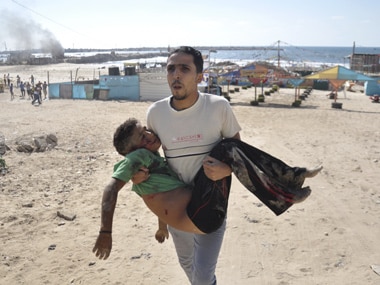 A Palestinian man carries the body of a boy killed by Israeli shells on a beach in Gaza City. Reuters image[/caption]"But his [Netanyahu] complaint is in itself a concession. The story of the conflict between Israel and Palestine looks a little bit different this time around. Social media have helped allow us to see more deeply inside war zones — in this case, inside Gaza — and allowed viewers much fuller access to the terror that grips a population under military attack," writes Benjamin Wallace-Wells for the New York Magazine. Even Mohyeldin, NBC's only Egyptian-American correspondent, made no attempt to hide that there existed a tug-of-war between him and the network over how the crisis should be covered. Putting NBC on the spot, he tweeted after being reinstated that he was grateful that the network was committed to covering the "Palestinian side of the story".
Thanks for all the support. Im returning to #Gaza to report. Proud of NBC's continued commitment to cover the #Palestinian side of the story — Ayman Mohyeldin (@AymanM) July 18, 2014
The discussion of bias becomes especially important in light of the recent comments by US secretary of state John Kerry who was caught on tape criticising Israel.Kerry was heard talking about Israeli soldiers killed in Gaza to a State Department official identified as Jonathan Finer just before appearing on the "Fox News Sunday" political talk show."I hope they don't think that's an invitation to go do more," Kerry is heard saying. "That better be the warning to them."This is followed by a frustrated Kerry saying, "It's a hell of a pinpoint operation, it's a hell of a pinpoint operation," in apparent frustration over the civilian toll in the Israeli operation. "We've got to get over there," Kerry is heard saying on the Sunday recording. "I think, Jon, we ought to go tonight. I think it's crazy to be sitting around. Let's go."And yet, on air, particularly on a conservative website like Fox, Kerry sang a different tune. When confronted over the remarks by Fox host Chris Wallace, Kerry only reiterated Israel's right to self-defense."You have people who've come out of tunnels. You have a right to go in and take out those tunnels. We completely support that. And we support Israel's right to defend itself against rockets that are continuing to come in," he said.In the recent flare up which went from searching for three kidnapped Israeli teens to a full fledged invasion, has seen no halt in the bloodshed as the death toll hit 583 on Tuesday, 15 days since Israel launched its operation. Another 3,640 people have been wounded as the violence spirals into the bloodiest one in recent years.To many however, it isn't a PR war. Recently, an Al Jazeera journalist broke down on air while reporting from Gaza, and had to walk off camera as his voice broke mid-sentence, highlighting the devastation felt by all those who witnessed the heartbreaking violence.With inputs from AFPFirst Published:Jul 23, 2014, 15:15:17 IST
Advertisement
Advertisement

Explorers discover wreckage of plane 72 years later. Will this help in finding MH370?
On April 11, 1952, a Pan Am Flight 526A, crashed into the Atlantic Ocean, killing 52 of the 69 people on board. After decades of effort, explorers have found the wreck of the plane at the bottom of the seabed near Puerto Rico. The discovery offers new hope to families who lost loved ones in the Malaysia Airlines Flight 370 crash in 2014
5 min read
Chinese Defence Attache praise India’s rescue of 12 sailors off Kerala cost
Rear Admiral You Jian, the Defence Attache at the Embassy of China in India, has praised India for rescuing 12 Chinese crew members off the coast of Kerala last year.
1 min read
'China ready to work with India,' says Wang Yi after talks with Jaishankar in Manila
China's Foreign Minister Wang Yi said that Beijing and New Delhi should 'consolidate positive momentum' in bilateral ties during his talks with his Indian counterpart Dr S. Jaishankar.
1 min read
Secret Service agent on JD Vance security detail put on leave over alleged leak of travel plans
A US Secret Service agent assigned to Vice President JD Vance's security detail has been placed on administrative leave after being suspected of leaking sensitive information about the vice president's travel plans to the media
2 min read
China has dominated Myanmar’s rare earth mines — now India eyes deal to harness country’s critical minerals
India is deepening rare earth cooperation with Myanmar as New Delhi seeks alternative sources of critical minerals dominated by China, including dysprosium and terbium used in EVs, defence systems and clean energy technologies
6 min read
Advertisement
Advertisement