
Advertisement


Sections
Explained: How end of Roe v Wade will affect birth control, abortion pills and IVF treatments in the US
The Supreme Court's decision overturning the right to abortion nearly 50 years ago will have far-reaching implications for reproductive health care across the United States

The United States of America is witnessing massive protests, with chants of ‘my body, my rights’ ringing loud across the country, after the Supreme Court overturned the historic Roe v Wade decision, eliminating federally protected abortion rights.On Friday, the US Supreme Court overturned the landmark ruling, unthinkable just a few years ago, which is likely to lead to abortion bans in roughly half the states.Justice Samuel Alito, in the final opinion issued, wrote that Roe and Planned Parenthood v Casey, the 1992 decision that reaffirmed the right to abortion, were wrong had and to be overturned.“We therefore hold that the Constitution does not confer a right to abortion. Roe and Casey must be overruled, and the authority to regulate abortion must be returned to the people and their elected representatives,” Alito wrote, in an opinion that was very similar to the leaked draft.Reacting to the ruling, Gloria Steinem, the nation’s most visible feminist and advocate for women’s rights, said succinctly, “Obviously, without the right of women and men to make decisions about our own bodies, there is no democracy.”The US SC’s decision has not only snatched away abortion rights of women, but also put a cloud of doubt on other areas of reproductive medicine as well, including fertility treatments like in vitro fertilisation.Abortion pills in post-Roe worldShortly after the Roe v Wade decision was made, fears increased that states could ban abortion pills, with some states noticing an uptick in the sale of abortion pills.As of today, there are 13 states in the US have trigger laws going into effect that will ban all or nearly all abortions, including medication abortions. For the unaware, a medical abortion is when a patient takes a drug called mifepristone, also known as RU-486, followed by a second drug called misoprostol, to end a pregnancy rather than having a surgical procedure.In 2020, more than half of all US abortions were medication abortions — up from 39 per cent in 2017, according to the Guttmacher Institute, an abortion rights research and advocacy organisation.However, with Roe v Wade being overturned, at least 26 states will pass new abortion laws. Such state laws have so far not distinguished between surgical and medication abortion, so they are expected to ban medication abortion entirely. Some will ban abortions almost completely, while others outlaw abortion at six weeks or 15 weeks.Another fear is that abortion bans will force many clinics to close, ending that route to obtaining abortion pills.However, implementing such a ban on medication abortion will be difficult to track and implement. Those seeking abortions despite bans in their states might, for example, travel to another state to get the pills where they are legal, use an address in another state then have the package forwarded, look for providers in other states willing to ship pills by mail under the table, rely on providers in other countries that mail pills to the US, or obtain the medications abroad.The Joe Biden administration also defended medical abortions, saying government would seek to protect access to medical abortion, saying efforts to restrict it would be “wrong and extreme and out of touch with the majority of Americans”.“Today I am directing the Department of Health and Human Services to take steps to ensure these critical medications are available to the fullest extent possible,” President Joe Biden said at the White House on Friday.[caption id="attachment_10842191" align="alignnone" width="640"]![Demonstrators gather in Austin, Texas feeling despair over the historic rollback of the 1973 case Roe V. Wade legalising abortion. AP]() Demonstrators gather in Austin, Texas feeling despair over the historic rollback of the 1973 case Roe V. Wade legalising abortion. AP[/caption]*****US Supreme Court overrules Roe V Wade: What does it mean for the future of abortion rights?As US Supreme Court scraps Roe vs Wade, a look at how abortion laws have evolved in IndiaThe small club of countries that the US joins after overturning the Roe v Wade rulingAbortion triggers great Indian confusion: Who is right wing, who is liberal?India should now help US on reproductive rights laws*****IVF treatmentsOn the face of it, the end of Roe v Wade should not impact the availability or legality of in-vitro fertilisation (IVF).However, activists flag down the far-reaching effects on the ability of women to get medical assistance to conceive a child in a post-Roe America.The debate over whether and at what stage of human development a life begins threatens to restrict doctors’ ability to use IVF to help a woman conceive. The success of IVF depends on fostering a larger number of eggs but typically only use a small number of them.Experts note that states that define life as beginning at conception or fertilisation could put IVF in legal jeopardy.Power, a group that connects women struggling to conceive a child with clinical fertility trials, and the Guttmacher Institute estimate that the overturn of Roe v Wade could result in as many as 30 states banning IVF.Activists also believe that an overturn of Roe v Wade could make access to IVF more expensive by limiting the number of embryos made or implanted, leading to lower chances of successful pregnancy, more IVF cycles and more costs.[caption id="attachment_10842171" align="alignnone" width="640"]
Demonstrators gather in Austin, Texas feeling despair over the historic rollback of the 1973 case Roe V. Wade legalising abortion. AP[/caption]*****US Supreme Court overrules Roe V Wade: What does it mean for the future of abortion rights?As US Supreme Court scraps Roe vs Wade, a look at how abortion laws have evolved in IndiaThe small club of countries that the US joins after overturning the Roe v Wade rulingAbortion triggers great Indian confusion: Who is right wing, who is liberal?India should now help US on reproductive rights laws*****IVF treatmentsOn the face of it, the end of Roe v Wade should not impact the availability or legality of in-vitro fertilisation (IVF).However, activists flag down the far-reaching effects on the ability of women to get medical assistance to conceive a child in a post-Roe America.The debate over whether and at what stage of human development a life begins threatens to restrict doctors’ ability to use IVF to help a woman conceive. The success of IVF depends on fostering a larger number of eggs but typically only use a small number of them.Experts note that states that define life as beginning at conception or fertilisation could put IVF in legal jeopardy.Power, a group that connects women struggling to conceive a child with clinical fertility trials, and the Guttmacher Institute estimate that the overturn of Roe v Wade could result in as many as 30 states banning IVF.Activists also believe that an overturn of Roe v Wade could make access to IVF more expensive by limiting the number of embryos made or implanted, leading to lower chances of successful pregnancy, more IVF cycles and more costs.[caption id="attachment_10842171" align="alignnone" width="640"]![A pro-abortion supporter holds a sign comparing women's right and gun rights during a rally to protest the Supreme Court's decision to overturn Roe v Wade in downtown Riverside, California. AP]() A pro-abortion supporter holds a sign comparing women's right and gun rights during a rally to protest the Supreme Court's decision to overturn Roe v Wade in downtown Riverside, California. AP[/caption]Birth control measuresPro-choice supporters are also wary of the future of birth control in the US following the Roe v Wade reversal.Justice Clarence Thomas’ in his opinion wrote that other cases that protect the right to contraception, to same-sex marriage and to engage in private, consensual sex acts “are not at issue” in this particular decision. But he also writes that “in future cases,” the court “should reconsider” the decisions in the cases that established those rights.“The states that are trying to limit abortion from the moment of conception — not even from the moment of pregnancy, as the medical profession would define it — could well try to challenge Plan B, emergency contraception, potentially even IUDs,” Wendy Parmet, director of the Center for Health Policy and Law at Northeastern University, was quoted as telling NBC News.States, like Oklahoma, for instance, has passed a law that recognised an unborn child’s life as beginning at fertilisation. This means that contraceptives such as an IUD (intrauterine device) and the morning-after pill, that could prevent a fertilised egg from becoming implanted could be under threat.IUDs work by preventing fertilisation: the sperm and the egg never meet in the first place. But they also might prevent implantation under certain circumstances.The morning-after pill prevents fertilisation in the first place, which could be deemed illegal in states that recognise life at fertilisation.While the protests will continue to rage, one thing is certain: the reversal of Roe v Wade will undoubtedly introduce a new era for health care in the US. Whether this is to be celebrated or not, only time will tell.With inputs from agenciesRead all the Latest News, Trending News, Cricket News, Bollywood News,India News and Entertainment News here. Follow us on Facebook, Twitter and Instagram.
A pro-abortion supporter holds a sign comparing women's right and gun rights during a rally to protest the Supreme Court's decision to overturn Roe v Wade in downtown Riverside, California. AP[/caption]Birth control measuresPro-choice supporters are also wary of the future of birth control in the US following the Roe v Wade reversal.Justice Clarence Thomas’ in his opinion wrote that other cases that protect the right to contraception, to same-sex marriage and to engage in private, consensual sex acts “are not at issue” in this particular decision. But he also writes that “in future cases,” the court “should reconsider” the decisions in the cases that established those rights.“The states that are trying to limit abortion from the moment of conception — not even from the moment of pregnancy, as the medical profession would define it — could well try to challenge Plan B, emergency contraception, potentially even IUDs,” Wendy Parmet, director of the Center for Health Policy and Law at Northeastern University, was quoted as telling NBC News.States, like Oklahoma, for instance, has passed a law that recognised an unborn child’s life as beginning at fertilisation. This means that contraceptives such as an IUD (intrauterine device) and the morning-after pill, that could prevent a fertilised egg from becoming implanted could be under threat.IUDs work by preventing fertilisation: the sperm and the egg never meet in the first place. But they also might prevent implantation under certain circumstances.The morning-after pill prevents fertilisation in the first place, which could be deemed illegal in states that recognise life at fertilisation.While the protests will continue to rage, one thing is certain: the reversal of Roe v Wade will undoubtedly introduce a new era for health care in the US. Whether this is to be celebrated or not, only time will tell.With inputs from agenciesRead all the Latest News, Trending News, Cricket News, Bollywood News,India News and Entertainment News here. Follow us on Facebook, Twitter and Instagram.
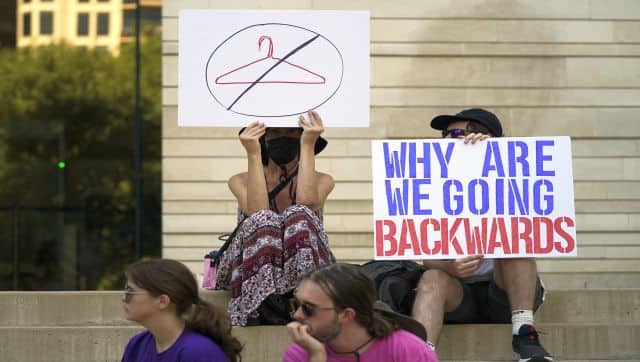 Demonstrators gather in Austin, Texas feeling despair over the historic rollback of the 1973 case Roe V. Wade legalising abortion. AP[/caption]*****US Supreme Court overrules Roe V Wade: What does it mean for the future of abortion rights?As US Supreme Court scraps Roe vs Wade, a look at how abortion laws have evolved in IndiaThe small club of countries that the US joins after overturning the Roe v Wade rulingAbortion triggers great Indian confusion: Who is right wing, who is liberal?India should now help US on reproductive rights laws*****IVF treatmentsOn the face of it, the end of Roe v Wade should not impact the availability or legality of in-vitro fertilisation (IVF).However, activists flag down the far-reaching effects on the ability of women to get medical assistance to conceive a child in a post-Roe America.The debate over whether and at what stage of human development a life begins threatens to restrict doctors’ ability to use IVF to help a woman conceive. The success of IVF depends on fostering a larger number of eggs but typically only use a small number of them.Experts note that states that define life as beginning at conception or fertilisation could put IVF in legal jeopardy.Power, a group that connects women struggling to conceive a child with clinical fertility trials, and the Guttmacher Institute estimate that the overturn of Roe v Wade could result in as many as 30 states banning IVF.Activists also believe that an overturn of Roe v Wade could make access to IVF more expensive by limiting the number of embryos made or implanted, leading to lower chances of successful pregnancy, more IVF cycles and more costs.[caption id="attachment_10842171" align="alignnone" width="640"]
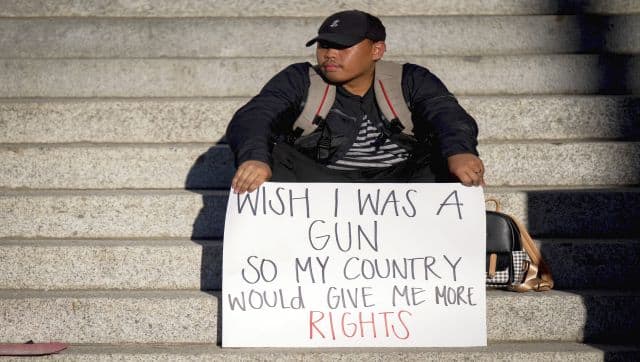 A pro-abortion supporter holds a sign comparing women's right and gun rights during a rally to protest the Supreme Court's decision to overturn Roe v Wade in downtown Riverside, California. AP[/caption]Birth control measuresPro-choice supporters are also wary of the future of birth control in the US following the Roe v Wade reversal.Justice Clarence Thomas’ in his opinion wrote that other cases that protect the right to contraception, to same-sex marriage and to engage in private, consensual sex acts “are not at issue” in this particular decision. But he also writes that “in future cases,” the court “should reconsider” the decisions in the cases that established those rights.“The states that are trying to limit abortion from the moment of conception — not even from the moment of pregnancy, as the medical profession would define it — could well try to challenge Plan B, emergency contraception, potentially even IUDs,” Wendy Parmet, director of the Center for Health Policy and Law at Northeastern University, was quoted as telling NBC News.States, like Oklahoma, for instance, has passed a law that recognised an unborn child’s life as beginning at fertilisation. This means that contraceptives such as an IUD (intrauterine device) and the morning-after pill, that could prevent a fertilised egg from becoming implanted could be under threat.IUDs work by preventing fertilisation: the sperm and the egg never meet in the first place. But they also might prevent implantation under certain circumstances.The morning-after pill prevents fertilisation in the first place, which could be deemed illegal in states that recognise life at fertilisation.While the protests will continue to rage, one thing is certain: the reversal of Roe v Wade will undoubtedly introduce a new era for health care in the US. Whether this is to be celebrated or not, only time will tell.With inputs from agenciesRead all the Latest News, Trending News, Cricket News, Bollywood News,India News and Entertainment News here. Follow us on Facebook, Twitter and Instagram.
First Published:Jun 27, 2022, 16:18:03 IST
Advertisement
Advertisement

US set to sign Saudi nuclear deal; Rubio says pact won't fuel proliferation
The proposed 30-year agreement could pave the way for Saudi Arabia to develop uranium enrichment capabilities for its civilian nuclear programme, even as Washington insists the deal will not increase nuclear proliferation risks.
2 min read
India-US trade deal 'almost complete', says US after Jaishankar-Rubio talks in Manila
External Affairs Minister S Jaishankar met with US Secretary of State Marco Rubio in Manila on Wednesday to discuss priority areas including trade, tariffs, energy, defence, critical minerals, and artificial intelligence.
2 min read
Marco Rubio says he 'would expect India to be concerned' over Trump's pharma tariffs
US Secretary of State Marco Rubio acknowledged India's concerns over Donald Trump's proposed pharmaceutical tariffs, saying Washington is seeking greater domestic manufacturing while remaining engaged with New Delhi.
2 min read
Trump renews China election interference claims, but files point to Russia's larger role
Declassified intelligence records cited by the Trump administration highlight concerns over Chinese election interference, but the same documents indicate Russia carried out broader and more sustained efforts to influence US voters.
2 min read
'See me after class!': UK education secretary Lucy Powell mocked by Tories over grammar gaffe
UK Education Secretary Lucy Powell faced Conservative criticism after a grammar mistake in a social media post went viral, drawing jibes from Tory MPs just days after her appointment to the role.
2 min read
Advertisement
Advertisement