
Advertisement


Sections
Cuba marks six decades under US sanctions: Why JFK imposed blockade, impact on island nation
The economic blockade, which has become harsher over the years, has deeply affected the communist nation's fortunes and shows no signs of being lifted any time soon

"The blockade has evolved to become the most complex, prolonged and inhumane act of economic warfare committed against any country," said the Cuban government, according to news agency Granma, as the country marked 60 years under a US economic blockade.We examine what these sanctions are, why they were imposed and how it has affected the nation’s progress:Embargo imposed in 1962The blockade was first implemented after the Bay of Pigs by United States president John F Kennedy in 1962.The Executive order 3447 signed by John F Kennedy on 3 February, 1962, proclaimed "an embargo upon all trade between the United States and Cuba," citing the island nation's "alignment with the communist powers."[caption id="attachment_10358371" align="alignnone" width="640"]![File image of US president John F Kennedy signing the order of naval blockade of Cuba, in the White House, Washington DC, during the Cuban missiles crisis. AFP]() File image of US president John F Kennedy signing the order of naval blockade of Cuba, in the White House, Washington DC, during the Cuban missiles crisis. AFP[/caption]Interestingly, it has been reported numerous times that on the eve of the embargo's entry into force on 7 February, Kennedy ordered for himself a shipment of 1,200 Cuban cigars — a product since illegal for US citizens.It was initially a response to Fidel Castro’s confiscation of American businesses and properties on the island following the 1959 revolution, which was the largest expropriation of US assets ever.In 1963, after the Cuban Missile Crisis, President Kennedy tightened the blockade further by banning travel, and Congress passed a law to penalise countries that assisted the island nation.Over the years, the US has added more laws on the embargo, making it harsher — while also creating more exceptions.
File image of US president John F Kennedy signing the order of naval blockade of Cuba, in the White House, Washington DC, during the Cuban missiles crisis. AFP[/caption]Interestingly, it has been reported numerous times that on the eve of the embargo's entry into force on 7 February, Kennedy ordered for himself a shipment of 1,200 Cuban cigars — a product since illegal for US citizens.It was initially a response to Fidel Castro’s confiscation of American businesses and properties on the island following the 1959 revolution, which was the largest expropriation of US assets ever.In 1963, after the Cuban Missile Crisis, President Kennedy tightened the blockade further by banning travel, and Congress passed a law to penalise countries that assisted the island nation.Over the years, the US has added more laws on the embargo, making it harsher — while also creating more exceptions.![Motorcyclists with a Cuban flag take part in a caravan against the US embargo against Cuba in Santa Clara, Villa Clara province, Cuba. AFP]() Motorcyclists with a Cuban flag take part in a caravan against the US embargo against Cuba in Santa Clara, Villa Clara province, Cuba. AFP[/caption]Impact on CubaAs one can imagine, the embargo has affected the lives of Cubans drastically. Cuban authorities state that the embargo has damaged the country's economy with losses amounting to some $150 billion.News agency AFP reports that Cuba is experiencing its worst economic crisis in 30 years, with inflation at 70 per cent and a severe shortage of food and medicines as the COVID-19 pandemic dealt a hefty blow to a key source of income: tourism.And amid this, Havana blames the sanctions for all the island's woes.Speaking on the issue, the Cuban government said in a statement, “Its impact has limited the possibilities of economic development, being designed to prevent trade relations with third countries, hinder banking and financial operations as much as possible, limit foreign investment and cut off all sources of income."However, activist Rosa Maria Paya of lobby group Cubadecide, which she directs from exile points a finger at the island nation for their own woes.In an AFP report, she says, "The real blockade was imposed by the Cuban state." The embargo would only be lifted, she believes, through "a transition to representative democracy."Geopolitical effectsThere are some US government officials, who, however, cite that the embargo is 'counterproductive' and should end.They believe that this embargo would push Cuba closer to US rivals such as China and Russia for support. This is worrying when US is trying to limit these countries’ power on the global stage.Moreover, Cuba cosying up to Russia brings back memories of the Cold War and the Cuban missile crisis, which brought the world to the brink of nuclear warfare. And the US should avoid this at all costs in today’s environment.With inputs from agenciesRead all the Latest News, Trending News, Cricket News, Bollywood News,India News and Entertainment News here. Follow us on Facebook, Twitter and Instagram.
Motorcyclists with a Cuban flag take part in a caravan against the US embargo against Cuba in Santa Clara, Villa Clara province, Cuba. AFP[/caption]Impact on CubaAs one can imagine, the embargo has affected the lives of Cubans drastically. Cuban authorities state that the embargo has damaged the country's economy with losses amounting to some $150 billion.News agency AFP reports that Cuba is experiencing its worst economic crisis in 30 years, with inflation at 70 per cent and a severe shortage of food and medicines as the COVID-19 pandemic dealt a hefty blow to a key source of income: tourism.And amid this, Havana blames the sanctions for all the island's woes.Speaking on the issue, the Cuban government said in a statement, “Its impact has limited the possibilities of economic development, being designed to prevent trade relations with third countries, hinder banking and financial operations as much as possible, limit foreign investment and cut off all sources of income."However, activist Rosa Maria Paya of lobby group Cubadecide, which she directs from exile points a finger at the island nation for their own woes.In an AFP report, she says, "The real blockade was imposed by the Cuban state." The embargo would only be lifted, she believes, through "a transition to representative democracy."Geopolitical effectsThere are some US government officials, who, however, cite that the embargo is 'counterproductive' and should end.They believe that this embargo would push Cuba closer to US rivals such as China and Russia for support. This is worrying when US is trying to limit these countries’ power on the global stage.Moreover, Cuba cosying up to Russia brings back memories of the Cold War and the Cuban missile crisis, which brought the world to the brink of nuclear warfare. And the US should avoid this at all costs in today’s environment.With inputs from agenciesRead all the Latest News, Trending News, Cricket News, Bollywood News,India News and Entertainment News here. Follow us on Facebook, Twitter and Instagram.
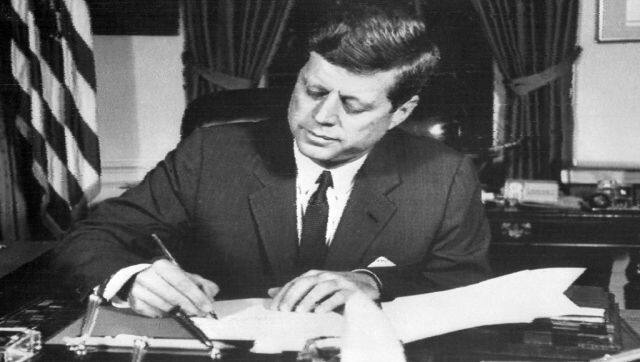 File image of US president John F Kennedy signing the order of naval blockade of Cuba, in the White House, Washington DC, during the Cuban missiles crisis. AFP[/caption]Interestingly, it has been reported numerous times that on the eve of the embargo's entry into force on 7 February, Kennedy ordered for himself a shipment of 1,200 Cuban cigars — a product since illegal for US citizens.It was initially a response to Fidel Castro’s confiscation of American businesses and properties on the island following the 1959 revolution, which was the largest expropriation of US assets ever.In 1963, after the Cuban Missile Crisis, President Kennedy tightened the blockade further by banning travel, and Congress passed a law to penalise countries that assisted the island nation.Over the years, the US has added more laws on the embargo, making it harsher — while also creating more exceptions.
It’s now a complex set of laws with many layers.“The embargo has more holes than Swiss cheese,” Pedro Freyre, chair of Akerman’s International Practice, which provides legal counsel to US-based companies affected by the embargo, was quoted as saying to NBC News.In 2016, in a signal of changing ties US president Barack Obama became the first US president to visit Havana since 1928. During a speech he made at the National Theater in Havana, he described how over his lifetime, the world had “remade itself time, and again, one constant was the conflict between the United States and Cuba.”It was the first step towards normalisation, which President Trump quickly erased after first taking office.What falls under the embargo?While food from the US is available for export to Cuba, those who want to sell to the island requires authorisations or licences from the Treasury and Commerce Departments.Sending medicine and medical supplies from the US to Cuba is trickier because they cannot be exported if there is a “reasonable likelihood” the product could be used for torture, re-export or the production of Cuba's biotechnological industry. It must be verified on-site that the products are being used for their intended purposes.Furthermore, the embargo does not prevent other countries from trading with Cuba, but if a product contains 10 per cent of American-created content, then it must get a licence from the US to be exported to Cuba.[caption id="attachment_10358391" align="alignnone" width="640"]
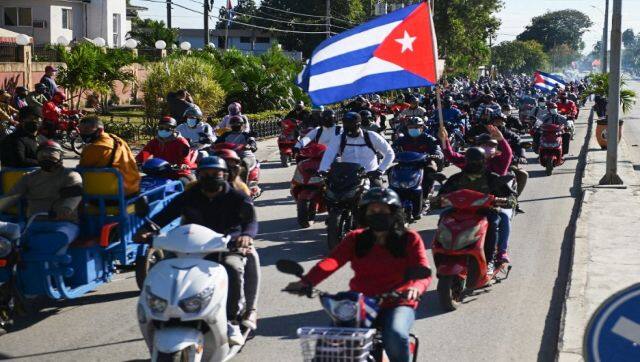 Motorcyclists with a Cuban flag take part in a caravan against the US embargo against Cuba in Santa Clara, Villa Clara province, Cuba. AFP[/caption]Impact on CubaAs one can imagine, the embargo has affected the lives of Cubans drastically. Cuban authorities state that the embargo has damaged the country's economy with losses amounting to some $150 billion.News agency AFP reports that Cuba is experiencing its worst economic crisis in 30 years, with inflation at 70 per cent and a severe shortage of food and medicines as the COVID-19 pandemic dealt a hefty blow to a key source of income: tourism.And amid this, Havana blames the sanctions for all the island's woes.Speaking on the issue, the Cuban government said in a statement, “Its impact has limited the possibilities of economic development, being designed to prevent trade relations with third countries, hinder banking and financial operations as much as possible, limit foreign investment and cut off all sources of income."However, activist Rosa Maria Paya of lobby group Cubadecide, which she directs from exile points a finger at the island nation for their own woes.In an AFP report, she says, "The real blockade was imposed by the Cuban state." The embargo would only be lifted, she believes, through "a transition to representative democracy."Geopolitical effectsThere are some US government officials, who, however, cite that the embargo is 'counterproductive' and should end.They believe that this embargo would push Cuba closer to US rivals such as China and Russia for support. This is worrying when US is trying to limit these countries’ power on the global stage.Moreover, Cuba cosying up to Russia brings back memories of the Cold War and the Cuban missile crisis, which brought the world to the brink of nuclear warfare. And the US should avoid this at all costs in today’s environment.With inputs from agenciesRead all the Latest News, Trending News, Cricket News, Bollywood News,India News and Entertainment News here. Follow us on Facebook, Twitter and Instagram.
First Published:Feb 08, 2022, 17:16:31 IST
Advertisement
Advertisement

US set to sign Saudi nuclear deal; Rubio says pact won't fuel proliferation
The proposed 30-year agreement could pave the way for Saudi Arabia to develop uranium enrichment capabilities for its civilian nuclear programme, even as Washington insists the deal will not increase nuclear proliferation risks.
2 min read
India-US trade deal 'almost complete', says US after Jaishankar-Rubio talks in Manila
External Affairs Minister S Jaishankar met with US Secretary of State Marco Rubio in Manila on Wednesday to discuss priority areas including trade, tariffs, energy, defence, critical minerals, and artificial intelligence.
2 min read
Marco Rubio says he 'would expect India to be concerned' over Trump's pharma tariffs
US Secretary of State Marco Rubio acknowledged India's concerns over Donald Trump's proposed pharmaceutical tariffs, saying Washington is seeking greater domestic manufacturing while remaining engaged with New Delhi.
2 min read
Trump renews China election interference claims, but files point to Russia's larger role
Declassified intelligence records cited by the Trump administration highlight concerns over Chinese election interference, but the same documents indicate Russia carried out broader and more sustained efforts to influence US voters.
2 min read
'See me after class!': UK education secretary Lucy Powell mocked by Tories over grammar gaffe
UK Education Secretary Lucy Powell faced Conservative criticism after a grammar mistake in a social media post went viral, drawing jibes from Tory MPs just days after her appointment to the role.
2 min read
Advertisement
Advertisement