


Close to 75 scientists, staff in US govt labs exposed to anthrax: report
As many as 75 scientists and staff in US government laboratories in Atlanta may have been exposed to live anthrax bacteria.

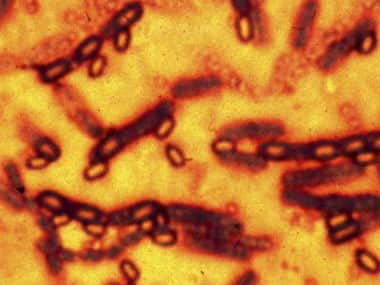
A microscopic picture of spores and vegetative cells of Bacillus anthracis which causes the disease anthrax is pictured in this undated file photograph. Reuters[/caption]“There is no room for error or negligence when it comes to bioterror research and every precaution must be taken to ensure the safety of our scientists," House Energy and Commerce Committee Chairman Fred Upton said in a statement.Meechan said the CDC is conducting an internal investigation and that disciplinary measures would be taken if warranted. He stressed that there is no risk to the general public.INHALATION ANTHRAXThe handling of pathogens inside US government laboratories has been a growing concern since 2008, when the FBI identified Dr. Bruce Ivins, a US Army anthrax researcher, as the prime suspect in a series of anthrax letter attacks in 2001.The threat of insiders having access to lethal bioterror agents led to a crackdown on lab security. The Ivins case touched off fears that “malicious actors” would use the substances to harm humans, according to a 2009 report by the American Association for the Advancement of Science.The CDC said that once the live bacteria were discovered, it immediately began contacting people working in the labs who may have been exposed. Meechan said seven researchers are the most likely to have come into contact with live anthrax, but the agency is casting as wide a net as possible to offer treatment to anyone who may be at risk.The normal incubation period for Bacillus anthracis can take up to five to seven days, though there are documented cases of the illness occurring some 60 days after exposure, Meechan said. Infection can occur through a cut in the skin, breathing in anthrax spores or eating tainted meat.Of the three, the biggest threat is inhalation anthrax, in which bacterial spores enter the lungs. Once they germinate, they release toxins that can cause internal bleeding, swelling and tissue death.Inhalation anthrax occurs in two stages. In the first stage, symptoms resemble a cold or the flu. In the second stage, anthrax causes fever, severe shortness of breath and shock. About 90 percent of people with second-stage inhalation anthrax die, even after antibiotic treatment.Meechan said CDC workers in the lower-security labs were likely not wearing masks. Around 75 people are being offered a 60-day course of treatment with the antibiotic ciprofloxacin and an injection with an anthrax vaccine.SECURITY CHECKMeechan said it was too early to determine whether the transfer of live bacteria was accidental or intentional. All employees who were doing procedures to inactivate the bacteria had passed a security check, he said.The CDC said in a statement it has reported the lab-safety incident to the Federal Select Agent Program, which oversees the use and transfer of biological agents and toxins that pose a severe threat to the public.Dr William Schaffner, an infectious diseases expert at Vanderbilt University Medical Center, said the potential exposures are still "profoundly unfortunate and serious.""What's good about it is the exposures are minimal," he said. "CDC responded appropriately, aggressively and transparently. The risk to the individual is low and to the surrounding community, essentially nil."Schaffner said it is not yet clear exactly what the breach in infection control protocol was, but said, "Whatever it was, it should not have happened."Reuters

Wildfires ravage parts of Italy, Spain and France, prompting thousands of evacuations
US set to sign Saudi nuclear deal; Rubio says pact won't fuel proliferation
India-US trade deal 'almost complete', says US after Jaishankar-Rubio talks in Manila
Marco Rubio says he 'would expect India to be concerned' over Trump's pharma tariffs
Trump renews China election interference claims, but files point to Russia's larger role