


Looking for China economy to collapse? It's not happening!
For all the bear growls over the Chinese economic slowdown, the growth locomotive isn't about to go off the tracks.

China's economy is slowing down - and perhaps even faster than expected; but anyone looking for a collapse of the giant will be "sorely disappointed".
That's the message from Societe Generale economist Glenn Maguire, who heads the China economic analysis team at the French bank.
"The evidence has accumulated sufficiently enough for us to say that, whether causally or coincidentally, the Chinese economy is slowing in response to nine months of policy tightening," notes Maguire.
How quickly the Chinese economy is slowing is, he reckons, the key question. And although it would take more data points to establish a trend, it appears to suggest that, if sustained, "the Chinese economy may be slowing at a faster pace than expected."
But the high-speed China growth locomotive isn't about to derail, adds Maguire. Although policymakers have been "somewhat heavy-handed" in slamming the brakes, "those looking for a spectacular slowing, if not collapse, in the Chinese economy will be sorely disappointed."
 More from World
In fact, a softening China growth trajectory remains consistent with current forecasts, notes Maguire.
This narrative challenges other uber-bearish assessments of China's economy, and should offer some comfort for global asset markets that were unnerved by a particularly low reading of China's Purchasing Managers Index (PMI) on Monday that pointed to a sharper-than-anticipated slowdown.
[caption id="attachment_14804" align="alignleft" width="380" caption="In China, the entire industrial sector - including manufacturing and construction - accounts for less than half of the country's GDP. ChinaFotoPress/Getty Images"]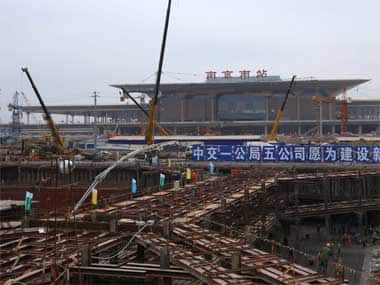 [/caption]
The PMI is a measure of the heartbeat of the manufacturing economy. In China, the manufacturing sector accounts for about a third of the overall economy. Even the entire industrial sector - including manufacturing and construction - accounts for less than half of China's GDP. It's possible, reason the analysts, for China's economy to grow even when the manufacturing sector slows down a tick.
Then again, in China, it is folly to ignore the government's response to the economic situation, the analysts reason. "At the moment, most of the slowdown is due to governments' policy. And a hardlanding is certainly not something that the government would want to see." In their estimation, if growth momentum does become a concern, the government will not choose to keep tightening.
What about China's ghost cities?
The other area of concern about China's economy that's received a lot of attention relates to China's property sector. Media reports speak of ghost cities - that is, enormous construction projects that remain totally uninhabited or barely occupied. [See satellite images of one such here - and two videos here (from November 2009) and here (from more recently).]
Legendary hedge fund investor Jim Chanos pointed to these trends, and flagged the risk that China was a "Dubai times 1,000."
But others are not so convinced.
The first few lines in a new report from the Economist Intelligence Unit (accessible here, with free registration) address this concern head on:
"China is not facing a major housing bubble, although there could be a short-term mild correction.The Economist Intelligence Unit's new models of population and incomes in China's cities point to strong underlying demand for housing throughout the next decade. They indicate that housing demand in China is growing so quickly that a correction in the next couple of years will be short-lived."
It then marshalls some head-spinning statistics to embellish its claim. Indicatively:
At current rates of construction, China can build a city the size of Rome in only two weeks.
In the decade leading up to 2010, China built houses equivalent to roughly twice the total number of houses currently in Spain or the UK, or about the same number as Japan's current total housing stock.
And in the next decade, China's urban population is expected to increase by 26.1% or over 160 million people.
Using the Chinese fixed asset investment measure, EIU expects a total of 75 trillion renminbi (or about $11.5 trillion at today's exchange rates) to be spent on real estate investment over the next decade.
The report also offers an interesting explanation for China's love affair with property, which is rooted in the country's gender imbalance. Check it out...
Venky Vembu attained his first Fifteen Minutes of Fame in 1984, on the threshold of his career, when paparazzi pictures of him with Maneka Gandhi were splashed in the world media under the mischievous tag ‘International Affairs’. But that’s a story he’s saving up for his memoirs… Over 25 years, Venky worked in The Indian Express, Frontline newsmagazine, Outlook Money and DNA, before joining FirstPost ahead of its launch. Additionally, he has been published, at various times, in, among other publications, The Times of India, Hindustan Times, Outlook, and Outlook Traveller.

US set to sign Saudi nuclear deal; Rubio says pact won't fuel proliferation
India-US trade deal 'almost complete', says US after Jaishankar-Rubio talks in Manila
Marco Rubio says he 'would expect India to be concerned' over Trump's pharma tariffs
Trump renews China election interference claims, but files point to Russia's larger role
'See me after class!': UK education secretary Lucy Powell mocked by Tories over grammar gaffe