


Cairo badly needed a detox; COVID-19 lockdown supplied one, but at a steep price to Egypt
Egypt has more than 77,000 known cases, and confirmed infections have grown by about 1,400 cases a day for the past month. Egypt has registered more than 3,400 deaths, the highest toll in the Arab world

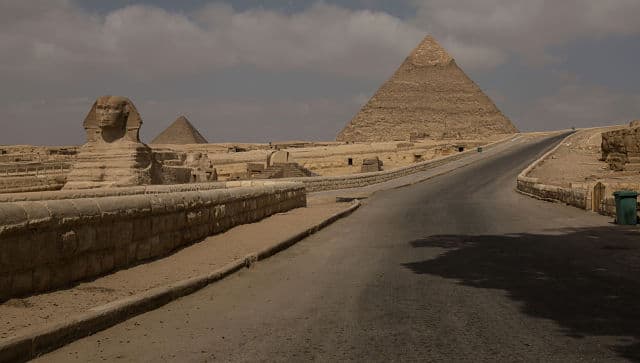
The Great Sphinx and the pyramids stand eerily bereft of tourists amid the coronavirus pandemic. By Sima Diab © 2020 The New York Times[/caption]I chatted with two brothers who held aloft a giant kite emblazoned with photographs of themselves, preening, and the football star Mohammed Salah, who was beaming. Nearby, Samiha Meneim, 62, perched on a rickety plastic chair, surrounded by 15 family members as well as half-eaten platters of koshary, Egypt’s national dish of spiced lentils, rice and macaroni.The picnic was a mercy dash after months cooped up in their cramped, low-rent neighbourhood. “We had to get out,” said Meneim, a retired nurse in a black cloak who continued her treatment for breast cancer throughout the lockdown.She saw the coronavirus as a message from God. “He wants us to look at life differently,” she said.For much of Egypt’s history, its fate has been shaped by the Nile. The bridge of kites led to Roda Island, described in “One Thousand and One Nights” as a place of heavenly gardens, now a tight sprawl of dust-smeared apartment blocks. At its southern tip, though, there survives a Nilometer built in the 9th Century — a structure that measured the river’s seasonal flooding and thus predicted the annual harvest.Now, disease was dictating the pace of life. As night fell and the curfew officially began, I crossed into downtown Cairo, a jumble of old palaces, crumbling elegance and gaudy shop fronts where, in normal times, the traffic is so crazy that guidebooks offer tourists solemn advice on how to survive.“Look for locals and join a group,” advises my edition of National Geographic Traveller. “They cross all together, one lane at a time.”That night it would have taken a miracle to get knocked down. The strays were in charge — skinny cats that strutted down empty boulevards, for once unbothered, and a pair of lordly street dogs that snoozed atop an SUV.The Metro Cinema, with its dust-encrusted Art Deco facade, opened in 1940 with “Gone With the Wind.” Now it had the eerie air of an abandoned film set, advertising the Egyptian movies it had been showing in March: Peep Show and The Thief of Baghdad.In the late 19th century, Egypt’s ruler, Khedive Ismail, modelled this area on the airy elegance of Haussmann’s Paris, but for decades the graceful buildings have gradually crumbled into disrepair. Now, in the desolation of curfew, they seemed to stand proud again, as did the statues lining the way.The giant bronze lions that guard Qasr el Nil, the city’s most scenic bridge, looked more relaxed than ever with no foe in sight.The mix of eerie desolation and faded splendour had a touch of magic, and for an instant I thought of the Egyptian version of the movie “Night at the Museum,” in which the bronze lions come to life under darkness.But I was not entirely alone.Teenagers clustered conspiratorially in doorways. Food-delivery riders clustered around their motorcycles outside a restaurant. Business was brisk.“If it keeps going like this,” remarked Mahmoud Abdel Fattah, leaning over his handlebars. “I’ll be as rich as Naguib Sawiris” — an outspoken billionaire who has been a vociferous critic of the lockdown measures.Still, Fattah noted wryly that, at 28 cents per delivery, that fortune could take a while. “Maybe after one million pizzas,” he quipped.For all their ebullience, the deliverymen also had a downbeat air. Sure, they could zoom to any address in minutes. But Cairo without the grit, the grind, the bustle of people — was it really Cairo at all?
Plagues are nothing new in Cairo. On a visit to Cairo in the 14th Century, when the city’s 500,000 inhabitants made it the world’s largest city outside China, the explorer Ibn Battuta noted that an outbreak of the Bubonic Plague was killing as many as 20,000 people a day. Cholera hit repeatedly in the 19th Century.This time, the human cost is amplified by Egypt’s soaring population, which in February crossed the 100 million threshold, an unnerving milestone in a densely packed country.Outside the city centre, the lockdown has been loosely observed — social distancing is little more than an admirable idea in the city’s cramped slums.Many Egyptians wear masks over their chins or spurn them entirely, much to the chagrin of President Abdel-Fattah el-Sissi, a fitness enthusiastic who has urged Egyptians to stay safe, keep fit and lose weight during the lockdown. “Remember to do sport, it increases immunity levels,” he said in May.Otherwise, it has been business as usual for el-Sissi during the lockdown — with the arrest of rights activists, belly dancers and even young women who post dance videos to social media. The virus, though, cannot be banished so easily.Egypt has more than 77,000 known cases, and confirmed infections have grown by about 1,400 cases a day for the past month. Egypt has registered more than 3,400 deaths, the highest toll in the Arab world. In an ominous portent, el-Sissi last week opened a 4,000-bed field hospital to treat coronavirus patients.And the economic toll is only now becoming apparent. Millions of workers have lost income, and families are cutting back on meat and other items that are now unaffordable. The International Monetary Fund has lent $8 billion to get Egypt through the crisis. More may be needed.The day after the lockdown was lifted, I walked the same route again. The sense of magic had evaporated.Police officers patrolled the bridge where the kites had flown. The familiar rumble of traffic snarled the downtown, where some restaurants had opened. But others remained shut — it’s not worth it yet, the manager of Abou Tarek, the city’s most celebrated koshary emporium, told me — and there was talk that some restrictions could become permanent.Rules obliging restaurants and coffee houses to shut at 10 pm will remain after the virus, a Cabinet spokesman said — an announcement that was consistent with el-Sissi’s desire to “civilize” Egyptians, but that met with muted indignation in a city famous for its vibrant all-night socialising.Egyptian rulers have announced similar detox measures in the past, only to quickly backtrack in the face of popular resistance. For now, what’s certain is that Cairenes are staying home, caught between their desire to get back to normal and their fear of what may be coming next — much like everywhere else.Declan Walsh c.2020 The New York Times Company

US set to sign Saudi nuclear deal; Rubio says pact won't fuel proliferation
India-US trade deal 'almost complete', says US after Jaishankar-Rubio talks in Manila
Marco Rubio says he 'would expect India to be concerned' over Trump's pharma tariffs
Trump renews China election interference claims, but files point to Russia's larger role
'See me after class!': UK education secretary Lucy Powell mocked by Tories over grammar gaffe