


In Pakistan, the lunatics have taken over the asylum
Jihadism, long considered Pakistan military’s “unconventional army”, is now squarely in the general’s seat.

Even the best trained army has its kooks, its rabid nationalist loony fringe, which embarrasses the rest of the disciplined force. In Pakistan, that loony fringe was always the jihadi-minded generals and spy chiefs, who crafted what they felt was a master strategy to spawn an army of terrorist outfits —which could wage “unconventional war” on its neighbours, particularly India, and enemies farther afield.Events of the past month, starting with the killing of Al Qaeda leader Osama bin Laden, show more starkly than ever that in Pakistan, the lunatics have taken over the asylum.Violent jihadism is no longer a fringe force operating on the periphery of the armed forces. It is the primary motivating force that is dictating state and military policy. It is the General Who Must Be Obeyed. Pakistan is today, an army without a country, as Ahmed Rashid noted recently.The jihadi hotheadedness that characterises official Pakistani military thinking manifests itself in many ways. The New York Times reports that Pakistan’s top military spy agency has detained five Pakistani informants, including a Major in the Pakistan Army, who “fed information to the CIA” in the months leading up to the raid that killed bin Laden.”[caption id="attachment_25955" align="alignleft" width="380" caption="Violent jihadism is the primary motivating force that is dictating state and military policy. Reuters"]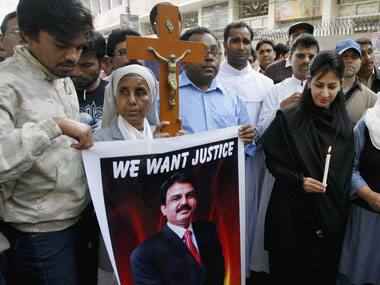 [/caption]Following the May 2 raid, Pakistani military and civilian leaders had reacted with injured innocence, disclaiming any knowledge that bin Laden had been living in Abbottabad for years or had enjoyed Pakistani patronage. They raged and thundered about the perceived slight to Pakistani nationalist sensibilities over the “invasion” by US Marine Seals who came on the bin Laden mission.But the latest detentions show there is no longer any pretence about which side the Pakistani military establishment is on.In fact, the descent into that hell world of jihadi indoctrination has happened for a long while now. Ahmed Rashid recalls a telling incident in this blog post on the New York Review of Books.He notes that the Army did not express regret about the killings earlier this year of two politicians — Shahbaz Bhatti and Salman Taseer — who had been critical of Pakistan’s blasphemy laws, which were an instrument to persecute religious minorities."The army chief General Ashfaq Kayani declined to publicly condemn Taseer’s death or even to issue a public condolence to his family. He told Western ambassadors in January in Islamabad that there were too many soldiers in the ranks who sympathiSe with the killer, and showed them a scrapbook of photographs of Taseer’s killer being hailed as a hero by fellow police officers. Any public statement, he hinted, could endanger the army’s unity.”The Pakistani army top guns have for long been working to indoctrinate this jihadi mindset in its officer corps as well. An officer who had a “Prophet-length beard” was favoured for promotion; likewise, a soldier who prayed five times a day, as orthodox Islam required, was preferred.The consequences for India of a bearded jihadi-minded Pakistani General who has his finger on the nuclear button and an “Allahu Akbar" war cry on his lips are chilling in the extreme.
Venky Vembu attained his first Fifteen Minutes of Fame in 1984, on the threshold of his career, when paparazzi pictures of him with Maneka Gandhi were splashed in the world media under the mischievous tag ‘International Affairs’. But that’s a story he’s saving up for his memoirs… Over 25 years, Venky worked in The Indian Express, Frontline newsmagazine, Outlook Money and DNA, before joining FirstPost ahead of its launch. Additionally, he has been published, at various times, in, among other publications, The Times of India, Hindustan Times, Outlook, and Outlook Traveller.

Trade the hustle for the Shire: Inside the "hobbitmaxxing" trend
Spices, health and the Indian plate: Why chilli can be good for you—but moderation is still key
The right way to break up without feeling groggy
How Spider-Man actor Tom Holland has been on a sobriety journey of 4.5 years after being "addicted to alcohol"
Why Chennai is India's filter coffee capital, one tumbler at a time