
Advertisement


Sections
AAA credit ratings

Washington’s debt impasse officially ended on 2 August. If the Democrats and the Republicans had failed to seal the deal on a revised credit limit, the US would have lost its coveted AAA-ratings. But it didn’t.Why was that crucial? It is because AAA credit ratings are the highest possible ratings of long term and short term credit worthiness of global corporations and governments. A company or state that gets this rating can issue bonds on low interest rates, and therefore secure cheaper debt, because the risk of a default on payment is small. The AAA-rating does not rule out default entirely, however.[caption id="attachment_53411" align="alignleft" width="380" caption="Reuters"] [/caption]AAA-rating and lower on the scale of ratings are determined by financial research and analysis companies. Click here for the scale of investment grades. Standard and Poor's and Fitch Ratings are two of the three most influential credit ratings agencies, apart from Moody's. Because different agencies use different methodologies to arrive at these ratings, the list of nations and corporations under each agency's list differs.The Guardian reports on the history of these ratings:
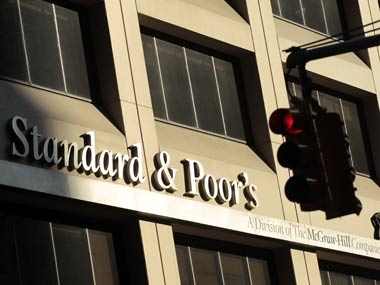 [/caption]AAA-rating and lower on the scale of ratings are determined by financial research and analysis companies. Click here for the scale of investment grades. Standard and Poor's and Fitch Ratings are two of the three most influential credit ratings agencies, apart from Moody's. Because different agencies use different methodologies to arrive at these ratings, the list of nations and corporations under each agency's list differs.The Guardian reports on the history of these ratings:
Rating agencies date back to the 19th century, and the heady early days of the US railways. In the rush to lay track and build railway stations across the American continent, investors craved information to help them profit without losing their shirts. Many railway companies went bankrupt, with some businessmen – among those later dubbed "robber barons" – using borderline-illegal tactics to cripple their rivals. Henry Varnum Poor (one of the "fathers" of Standard & Poor's (S&P) credit-rating agencies) was one of the first analysts to tackle the railway tycoons. He collected and published analyses of the financial health of the various railroad companies that sprang up across the country. John Moody launched a similar venture, called Analyses of Railroad Investments, in the early 20th century. Fitch says it was the first agency to create an alphabetical ranking for bonds issues by countries, called sovereign debt, and corporations in 1924. Fitch, Moody's and S&P, in 1975, became the first three companies to be recognised as "statistical rating agencies". Today, there are 10 rating agencies approved by the US securities and exchange commission.Pointing towards trend of weaker corporate credit, the Business Insider reports that while S&P's AAA ratings were assigned to 60 non-financial US companies, now there are only 4. The number of financial companies is 18. Developed countries are following a similar trend.As quicker market verdicts set the tone for investment decisions, to many companies, these ratings come a little too late and have lost their significance considerably, the New York Times reports.
First Published:Aug 03, 2011, 16:26:34 IST
Advertisement
Advertisement

Holy Cow has become less holy in the Cow Belt
Fresh stats show that the cow belt is abandoning cows in favour of buffaloes faster than the rest of the country.
Djokovic vs Nadal: Who will create history today?
Tough to imagine someone so close to such a historic achievement of winning a grandslam being an underdog, yet that's exactly what Djokovic is.
Muammar Gaddafi
Advertisement
Advertisement