


Two Earth-size planets spotted around distant star
Astronomers have found a pair of Earth-sized planets orbiting a star similar to the sun, though neither are believed to be suitable for life.

Cape Canaveral, Florida: Astronomers have found a pair of Earth-sized planets orbiting a star similar to the sun, though neither are believed to be suitable for life, scientists on NASA's Kepler telescope team said on Tuesday.The discovery follows confirmation earlier this month of a super-Earth sized planet, called Kepler-22b, that circles the right distance from its parent star for liquid water to exist on its surface. Water is believed to be a key ingredient for life."Kepler-22b has the right temperature, but it is too big. (The planets) we're announcing today are just the right size, but too hot," astronomer David Charbonneau with Harvard University, told reporters during a conference call."But you can bet that the hunt is on to find a planet that combines the best of both worlds, a true Earth twin," he said.[caption id="attachment_161462" align="alignleft" width="380" caption="This illustration provided by the Harvard-Smithsonian Center for Astrophysics shows artist's renderings of planets Kepler-20e and Kepler-20f compared with Venus and the Earth.AP"]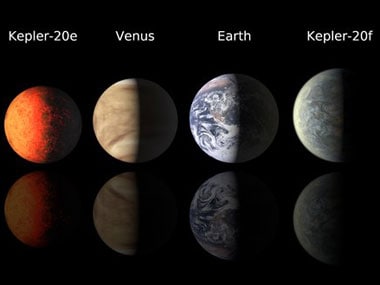 [/caption]The newly discovered planets, called Kepler-20e and 20f, have at least three gas-giant siblings, one of the larger planetary systems found to date.But the family is nothing like our solar system, where rocky worlds like Venus, Earth and Mars are grouped together closer in toward the sun while gas giants like Jupiter and Saturn are segregated in the outer regions.The two Earth-like and three Neptune-sized planets in the Kepler-20 family are interspersed and all orbit closer to the parent star than our solar system's innermost planet, Mercury."Rocky planets and gas giants happily mingle together. This is the first time we've seen anything like this," Charbonneau said.Kepler-20e and 20f, which are believed to be too hot for liquid water, probably are not habitable — at least not today."If Kepler-20f was formed with water, which I think is likely, then it could have held on to its water for several billions of years ," said astronomer Linda Elkins-Tanton with the Carnegie Institute in Washington D.C."And that means that this planet could have been habitable in the past for a long period," she said.The system is located about 1,000 light-years away in the constellation Lyra.Light travels at about 299,337 km per second.Reuters

Google burns cash for first time as AI spending pushes 2026 capex to $205 billion
Tesla sells more cars but makes less money: Why Musk’s AI pivot is squeezing profits
OpenAI launches Presence to bring AI agents into customer support and enterprise workflows
Samsung Galaxy Fold 8 Ultra, Fold 8, Flip 8 launched: Here is how much it costs in India with discounts
Florida pastor sues OpenAI, says ChatGPT's medical advice delayed emergency treatment: Report