


Where did all of Mars' water go? NASA thinks its trapped under its surface
They found that the planet lost most of its water between four to 3.7 billion years ago,

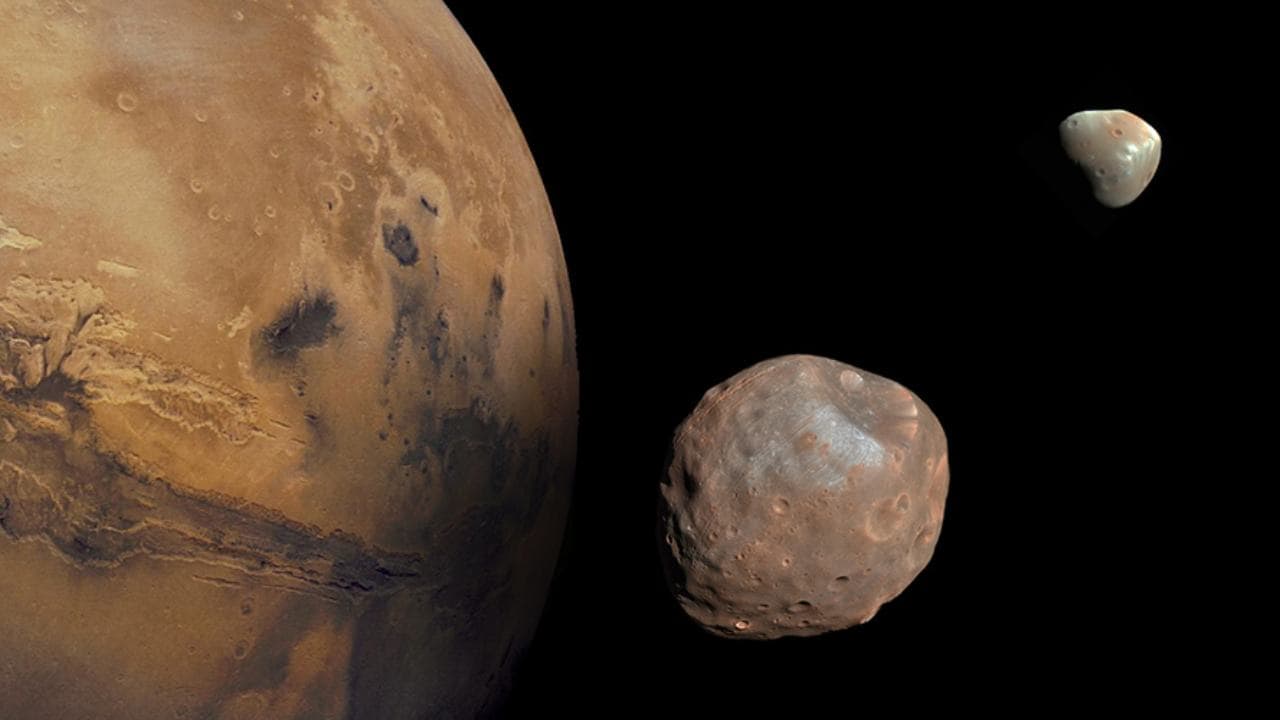
Mars along its moons Phobos and Deimos.[/caption]Early Mars was thought to have enough water to cover the whole planet in roughly 100 to 1,500 meters (330 to 4,4920 feet) of ocean.Because the planet lost its magnetic field early in its history, its atmosphere was progressively stripped away, and it was assumed this was how it lost its water.But the authors of the new study believe that while some of the water did disappear, the majority remained.Using observations made by Mars rovers as well as of meteorites from the planet, the team focused on hydrogen, a key component of water.There are different kinds of hydrogen atoms. Most have just one proton in their nucleus, but a tiny fraction, about 0.02 percent, have both a proton and a neutron, making them heavier. These are known as deuterium, or "heavy" hydrogen.Because the lighter kind escapes the planet's atmosphere at a faster rate, the loss of most of the water to space would leave relatively more deuterium behind.But given how much water the planet is believed to have started with, and the current rate of hydrogen escape observed by spacecraft, the current deuterium-to-hydrogen ratio cannot be explained by atmospheric loss alone.
Permanent loss
The study's authors instead say there was a combination of two mechanisms: the trapping of water in minerals in the planet's crust as well as the loss of water to the atmosphere."Anytime that you have a rock and it's interacting with water, there's a series of very complex reactions that form a hydrated mineral," said Scheller.This process, called "chemical weathering," also takes place on Earth — for example, in clay, also found on Mars.But on our planet volcanoes recycle the water back into the atmosphere. Mars, however, doesn't have tectonic plates, making the changes permanent.According to the teams' simulations, the planet lost most of its water between four to 3.7 billion years ago, which means "Mars was pretty much like we see how it is today for the past three billion years," said Scheller.She added she was excited about what the Perseverance rover, which landed last month for a multiyear science mission on the planet, might be able to contribute to the area of research."The Perseverance rover is actually going to investigate exactly these processes and reactions that cause the sequestration of water in the crust," she said.The team's model contains multiple scenarios, which they to compare to new data acquired by the rover."We can start to say, 'These parts of the model aren't working right and these parts are' and that's going to help us get closer and closer and closer to the answer," said Scheller.

Careless Whispers: Scientists discover that plants can 'talk' to each other using smells
Life on Mars? European Space Agency’s Orbiter discovers ice water deposits at equator
Microsoft briefly overtakes Apple as the most valuable company, Apple back on top again
Even NASA is facing a tough time, starts layoffs following major budget cuts
ISRO, NASA's NISAR satellite to get ready by Jan-end, will monitor Earth's snow-covered regions