


We may finally have an answer to how Mars' long, runout landslides are formed
The landslides and their features have been preserved for millions of years because of reduced erosion, absence of vegetation.


Mars landslide. The blue area represents the landslide debris.[/caption]To explain this conundrum, scientists have suggested that these landslides must have taken place at a time when the area was covered in ice. But in our recent paper, published in Nature Communications, we have come up with another answer. The results could help us protect against harmful landslides – both on Mars and on Earth.Geologists have discussed the odd behaviour of martian landslides since they were first identified nearly half a century ago. These types of landslides have occurred on Earth in its geological history too, but because our planet is active with erosion, atmospheric weathering (wind, rain and so on), vegetation cover and plate tectonics, their evidence can be masked if not completely erased.This is the reason why we study long, runout landslides on other planets in our solar system. There are in fact a number of advantages of doing so. On the red planet, landslides and their morphological features are well preserved for millions of years because of the reduced erosion rate and absence of vegetation and plate tectonics.We now also have available satellite images of the surface of Mars with a resolution that is better than what we have for some regions here on Earth. As a result, we can conduct observations and measurements that are not so granted on our planet.
New findings
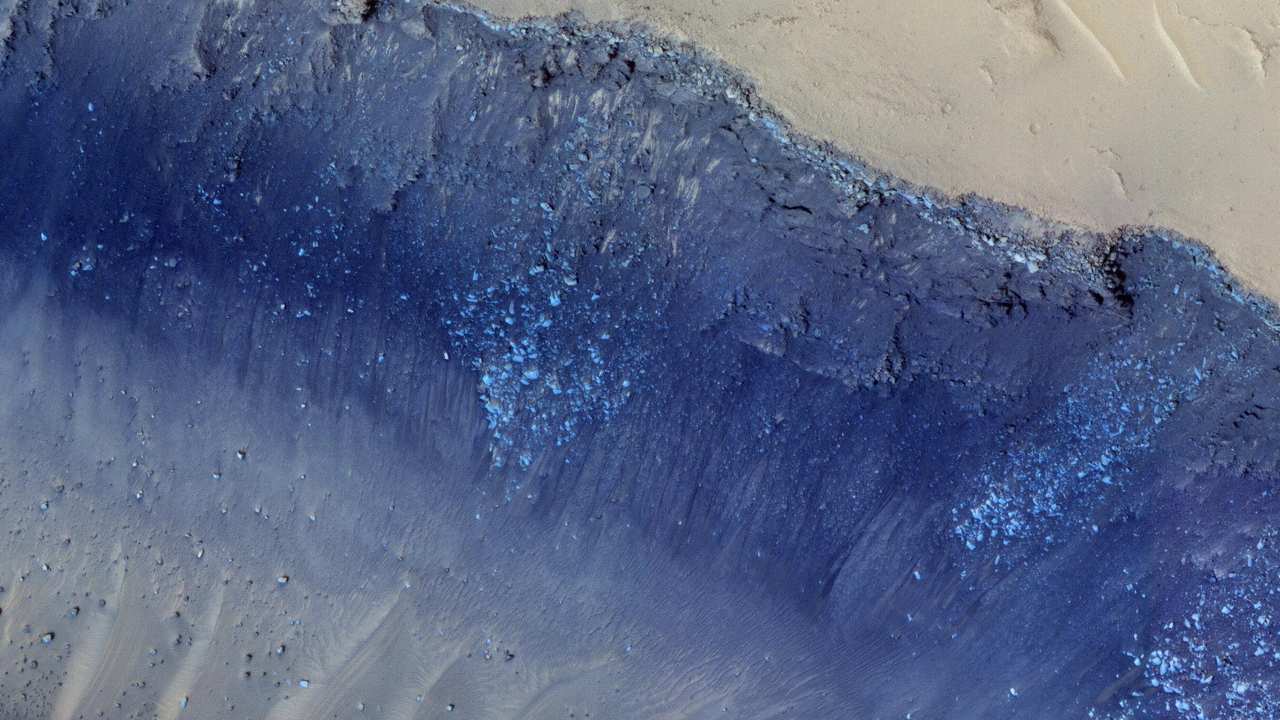 Cerberus Fossae, with steep slopes having active landslides. Image credit: NASA[/caption]This suggests that ice is not a necessary condition for the formation of the long ridges. Instead, we propose that the ridges could have formed at high speeds due to underlying layers of unstable, light rocks. These layers would have been created by vibrations and collisions of rock particles at the bottom of the slide with the rough surface of the valley. This would have initiated a “convection process” – transfer of heat by movement – that caused upper denser and heavier layers of rock to fall and lighter rocks to rise.Once we had accounted for this mechanical instability – and coupled it with the movement at phenomenal high speed of the slide – we could show that vortices extending in the direction of the landslide’s movement were generated, giving rise to the long ridges that we observe on the surface of the landslide.The findings are important. On Earth, the incomplete record of such catastrophic events can lead to misinterpretations and overlooking of the hazard of these landslides. But, as they happened in the past, they will happen in the future, posing great risk to infrastructures and people lives.Turning our look further away to understand what is near us is sometimes a fundamental change of perspective. But, as we know landslides are also still happening on Mars, these studies will set the background knowledge for risk mitigation of human settlements on Mars, no matter how far in the future they are still.
 Giulia Magnarini, Phd Candidate of Earth Sciences, UCL and Tom Mitchell, Associate Professor of Earthquake Geology and Rock Physics, UCLThis article is republished from The Conversation under a Creative Commons license. Read the original article.
Careless Whispers: Scientists discover that plants can 'talk' to each other using smells
Life on Mars? European Space Agency’s Orbiter discovers ice water deposits at equator
Microsoft briefly overtakes Apple as the most valuable company, Apple back on top again
Even NASA is facing a tough time, starts layoffs following major budget cuts
ISRO, NASA's NISAR satellite to get ready by Jan-end, will monitor Earth's snow-covered regions