
Advertisement


Sections
Venus, Mars and crescent moon to align in 'planetary conjunction' during 12-13 July
People can use ordinary binocular to watch this event and those who continue watching the skies will even witness the departure of these planets.

A special week is ahead for sky gazers and astronomy enthusiasts as two of Earth’s immediate neighbours - Venus and Mars will be coming close to one another in the coming days. This celestial event is being termed as ‘planetary conjunction’ because it will be easily visible to the naked eye.Being observable only from Earth, a ‘planetary conjunction’ occurs when two planets come closest to each other on a specific day even though they remain far away from one another.[caption id="attachment_9790451" align="alignnone" width="1280"]![Venus, Mars and moon planetary conjunction. Image credit: Abigail Banerji/Tech2]()
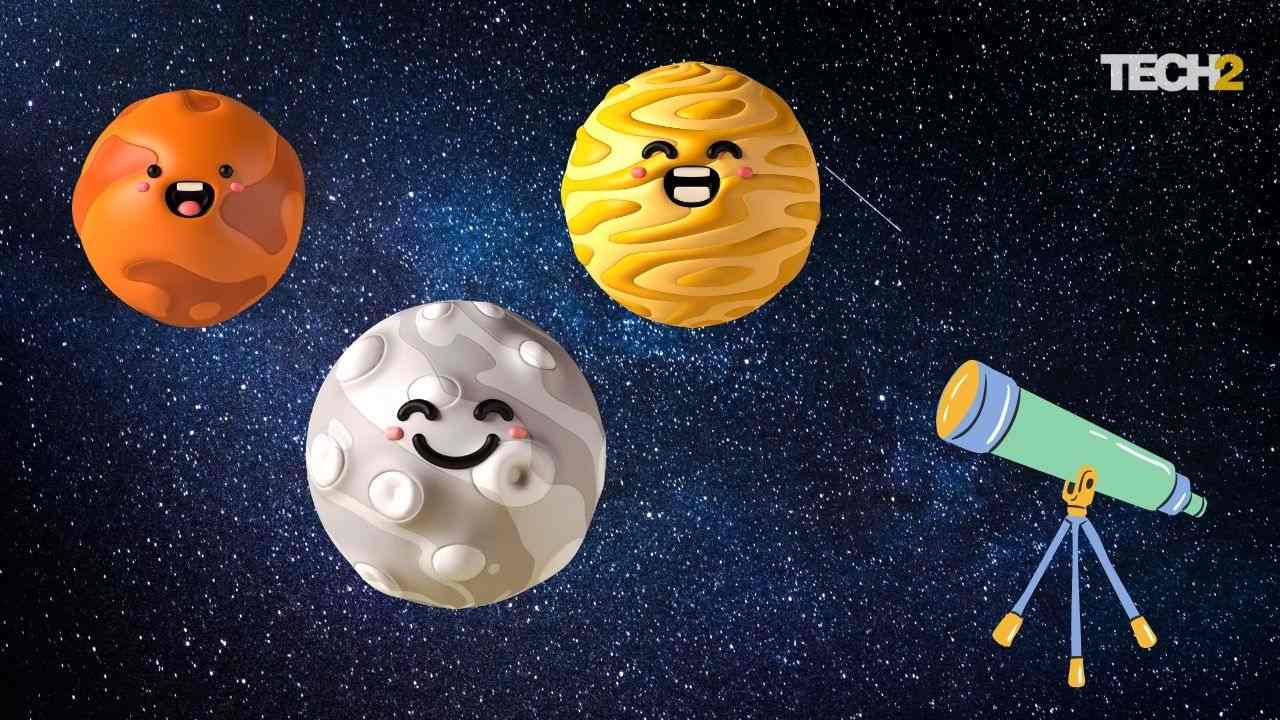
Venus, Mars and moon planetary conjunction. Image credit: Abigail Banerji/Tech2[/caption]Informing people about the event on social media, the Indian Institute of Astrophysics (IIA) shared a post revealing details. “Mars and Venus are passing close to each other in the sky and will be only 0.5 degrees (as wide as the size of the Moon) on 13 July,” a tweet from the official handle reads.Further in the post, the IIA informed that the moon will also be close to Venus and Mars on 12 July. The institute had asked sky gazers to go out and witness the event every evening from today, 8 July.
This amazing sight will be only visible in the western sky or horizon under clear sky conditions after sunset.As the meeting of these celestial objects is a big occurrence in the sky, astronomy enthusiasts can commence observing the sky from Thursday (8 July) and continue till Tuesday (13 July). People who continue watching it after the event will also be able to see the departure of these planets. Any ordinary binoculars will show Venus and Mars at their closest.Meanwhile, the Pune-based Inter-University Centre for Astronomy and Astrophysics (IUCAA) and the IIA, located in Bengaluru have invited photograph entries of the event. Candidates who are interested can send their photos or sketches to outreach@iiap.res.in. The best among them will be published by the institutes online.First Published:Jul 12, 2021, 08:00:07 IST
Advertisement
Advertisement

Careless Whispers: Scientists discover that plants can 'talk' to each other using smells
Japanese scientists have recorded a video that shows plants, in certain conditions, communicate with each other using mists that carry smells. The discovery, reveals that plants release a fine mist of airborne compounds, to warn nearby plants of potential dangers
Life on Mars? European Space Agency’s Orbiter discovers ice water deposits at equator
European Space Agency's Mars Express Orbiter has identified massive ice and ice water deposits beneath the surface of Mars. The Mars Express orbiter was also the first to confirmed the presence of ice on Mars in 2004
Microsoft briefly overtakes Apple as the most valuable company, Apple back on top again
At its peak during the session, Microsoft's value reached $2.903 trillion, with a 2% surge. As of writing this article, Apple closed at $2.89 trillion, whereas Microsoft closed at $2.86 trillion
Even NASA is facing a tough time, starts layoffs following major budget cuts
NASA is facing some massive budget cuts, because of which, it has been forced to postpone some upcoming missions. NASA's Jet Propulsion Laboratory has been hit hard by recent federal budget cuts, resulting in the layoff of 100 contractors last week
ISRO, NASA's NISAR satellite to get ready by Jan-end, will monitor Earth's snow-covered regions
The NISAR satellite which has been developed jointly ISRO and NASA, should be ready for launch by the end of January 2024. The collaboration between NASA and ISRO on NISAR is the first time the two agencies have cooperated on hardware development for an Earth-observing mission
Advertisement
Advertisement