


Time flies on some days, crawls on others: Study locates 'fatigued' neurons that influence our perception of time
The research zeroed in on the region of the brain used to code for time, and responsible for our subjective experience of time.

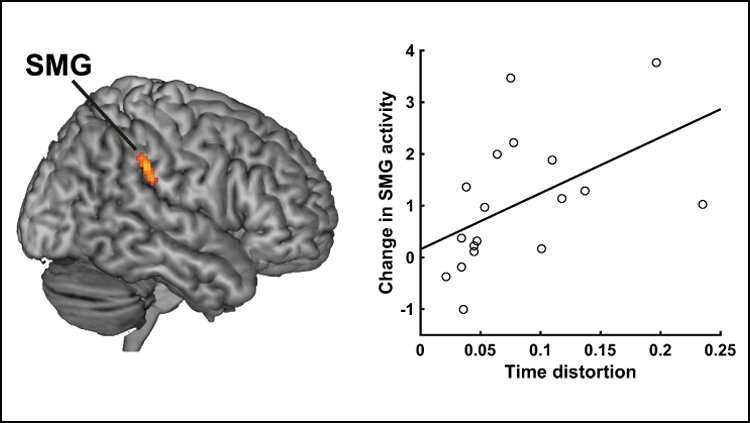
The researchers located the SMG, where neurons exhibited a decrease in activity after a duration of adaptation. Image Credit: Hayashi & Ivry, JNeurosci 2020[/caption]Scientists Masamichi J Hayashi and Richard B Ivry used a functional magnetic resonance imaging (fMRI) study to examine the biological basis for the subjective perception of time in several human participants. These adult participants were told to look at a visual adaptor (a grey circle) for a certain length of time, 30 times in a row. After this, they were shown a test stimulus and told to guess the duration it was shown for. The researchers reported that if the stimulus was shown for longer, the participants underestimated the time it was shown for; conversely, if the adaptor duration was short, they overestimated the time."These results indicate that duration-tuned neural populations in right SMG reflect the subjective experience of time,” the abstract of the study said.The study zeroed in on the right parietal cortex, where the SMG is located in the brain, as the region used to code for time, and responsible for reflecting our subjective experience of time.

Careless Whispers: Scientists discover that plants can 'talk' to each other using smells
Life on Mars? European Space Agency’s Orbiter discovers ice water deposits at equator
Microsoft briefly overtakes Apple as the most valuable company, Apple back on top again
Even NASA is facing a tough time, starts layoffs following major budget cuts
ISRO, NASA's NISAR satellite to get ready by Jan-end, will monitor Earth's snow-covered regions