


Terrestrial microbes could survive briefly on Mars, be a food source for astronauts: Study
The endurance of some microbes to conditions on Mars were tested by launching them into Earth's stratosphere, which closely represents that on Mars.

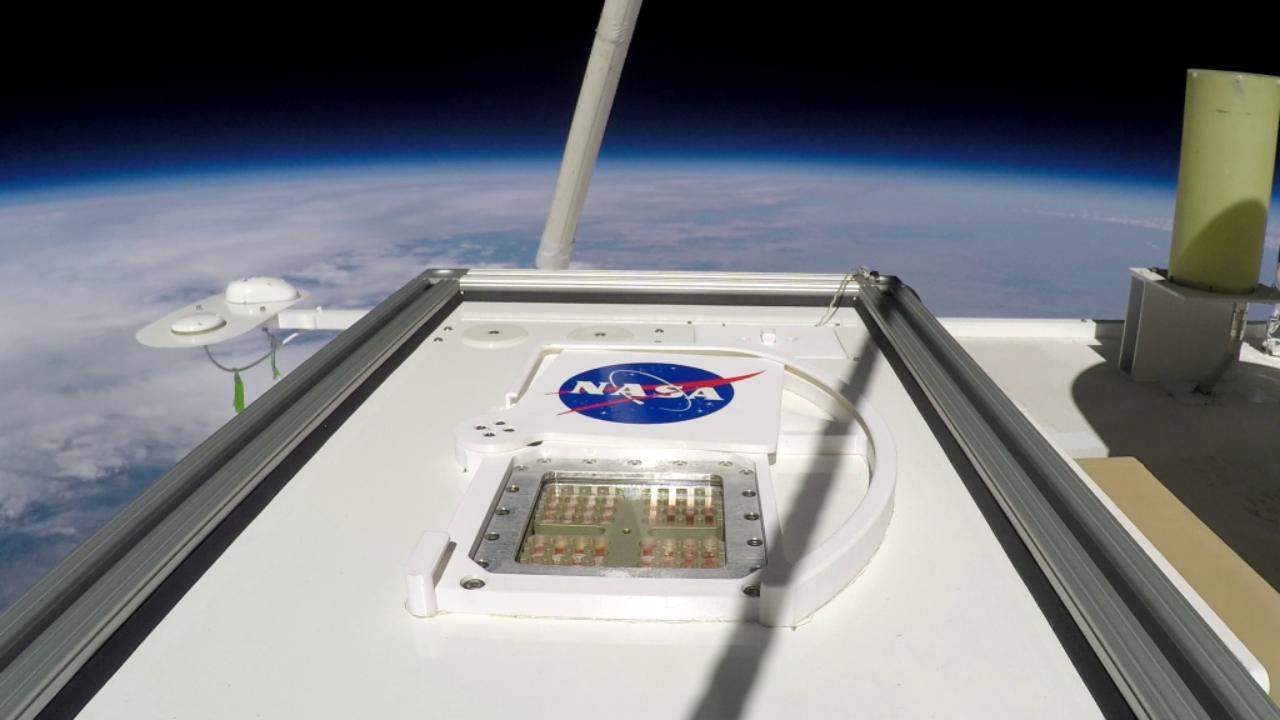
The Microbes in Atmosphere for Radiation, Survival and Biological Outcomes Experiment, or MARSBOx, in flight in September 2019. Its doors are rotated open, exposing samples of nine different types of microorganisms to the extreme environmental conditions of the stratosphere. Image: NASA[/caption]Many key characteristics of the environment at the Martian surface cannot be found or easily replicated at the surface of Earth, however in the middle stratosphere the conditions are remarkably similar."We launched the microbes into the stratosphere inside the MARSBOx (Microbes in Atmosphere for Radiation, Survival and Biological Outcomes experiment) payload, which was kept at Martian pressure and filled with an artificial Martian atmosphere throughout the mission," explained Cortesao. "The box carried two sample layers, with the bottom layer shielded from radiation," she said.This allowed the researchers to separate the effects of radiation from the other tested conditions: desiccation, atmosphere, and temperature fluctuation during the flight.The top layer samples were exposed to more than a thousand times more ultraviolet (UV) radiation than levels that can cause sunburn on our skin, they said."While not all the microbes survived the trip, one previously detected on the International Space Station, the black mould Aspergillus niger, could be revived after it returned home," Siems explained."Microorganisms are closely-connected to us; our body, our food, our environment, so it is impossible to rule them out of space travel," she said.The story was edited sparingly to correct spelling errors and style.

Careless Whispers: Scientists discover that plants can 'talk' to each other using smells
Life on Mars? European Space Agency’s Orbiter discovers ice water deposits at equator
Microsoft briefly overtakes Apple as the most valuable company, Apple back on top again
Even NASA is facing a tough time, starts layoffs following major budget cuts
ISRO, NASA's NISAR satellite to get ready by Jan-end, will monitor Earth's snow-covered regions