


SuperCam on-board NASA's Perseverance rover collected its first samples on Mars
The laser can zap objects smaller than a pencil point as far away as seven metres and observes spots beyond the reach of the rover's arm.

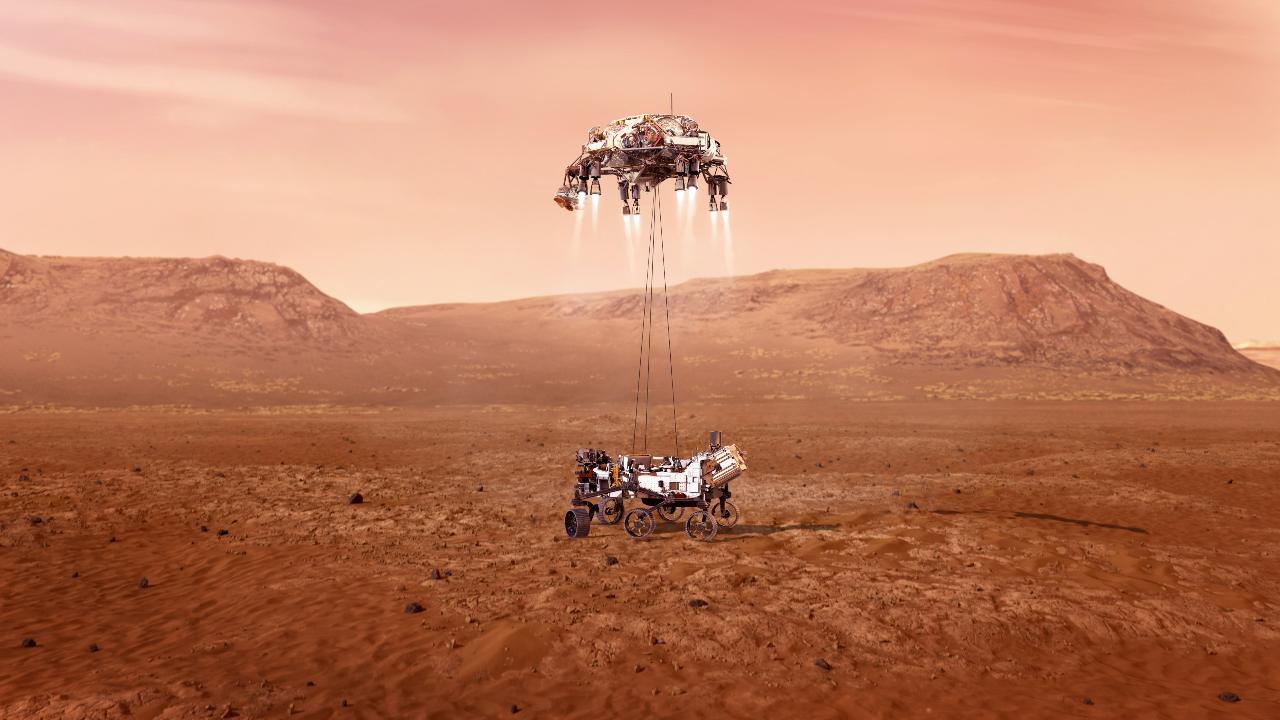
Perseverance rover being placed on Martian soil by the skycrane Image credit: NASA/JPL-Caltech[/caption]After seven months in space, NASA's Perseverance rover gently set down on Martian soil last month and sent back black-and-white images revealing the rocky fields of Jezero Crater, just north of the Mars equator."The critical component of this astrobiology mission is SuperCam," said Thomas Zurbuchen, deputy head of NASA's Science Mission Directorate.Mounted on the rover's mast, the shoebox-sized gizmo is packed with spectrometers, a laser, and an audio recording device to analyse the chemistry, mineralogy and molecular composition of Mars' famously red surface.SuperCam's laser can zap objects smaller than a pencil point from as far away as seven metres (20 feet) and enables the observation of spots beyond the reach of the rover's robotic arm."The laser is uniquely capable of remotely clearing away surface dust, giving all of its instruments a clear view of the targets," said Roger Wiens, an engineer at the Los Alamos National Laboratory (LANL) and SuperCam principal investigator.The mission suffered a serious mishap before liftoff, revealed LANL's Scott Robinson, who said more than 500 engineers and scientists contributed to the project."The mast unit optics were destroyed in a freak accident just four months before delivery," he explained. "The team scambled to pull together spare parts to rebuild the telescope from scratch."The accident turned out to be a blessing in disguise.
A freak accident
In reassembling the unit, engineers discovered what Robinson described as a "Hubble-like" flaw in the original mirror.Shortly after the Hubble Space Telescope's launch in 1990, operators realised that the observatory's primary mirror had an aberration — later corrected — that affected the clarity of images.Scientists believe that around 3.5 billion years ago the crater in which Perseverance landed was home to a river that flowed into a deep lake, depositing sediment in a fan-shaped delta.The rover is tasked with collecting more than two dozen rock and soil samples in sealed tubes, to be sent back to Earth sometime in the 2030s for analysis.About the size and weight of an SUV, Perseverance is equipped with a two-meter (seven-foot) robotic arm, 19 cameras, two microphones as well as other cutting-edge instruments.A small helicopter drone tucked under its belly will attempt the first powered flight on another planet in a few weeks' time.One instrument on board is designed to make oxygen from Mars' primarily carbon dioxide atmosphere, something that would greatly facilitate human habitation.Perseverance is the fifth rover to set wheels down on Mars, all of them from NASA. The feat was first accomplished in 1997.Its core mission lasts just over two years, but the rover could remain operational well beyond that.

Careless Whispers: Scientists discover that plants can 'talk' to each other using smells
Life on Mars? European Space Agency’s Orbiter discovers ice water deposits at equator
Microsoft briefly overtakes Apple as the most valuable company, Apple back on top again
Even NASA is facing a tough time, starts layoffs following major budget cuts
ISRO, NASA's NISAR satellite to get ready by Jan-end, will monitor Earth's snow-covered regions