


Star sisters: Around 500 stars born together in Theia 456 are now moving together
All the stars streams in the Milky Way have been conveniently named Theia for the Greek Titan goddess of sight and heavenly light.

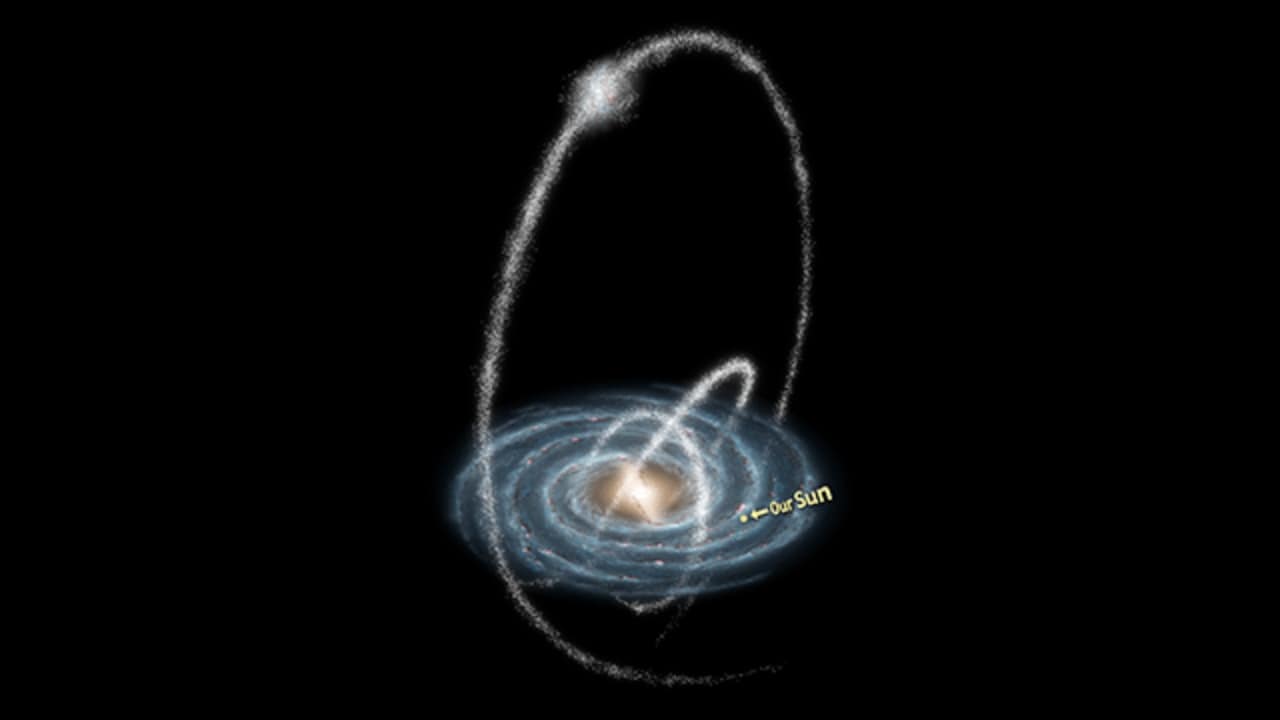
An artistic rendering of generic stellar streams in the Milky Way. Credit: NASA/JPL-Caltech/R. Hurt, SSC & Caltech[/caption]"We’ve found that stars exist in more structures than clumps,” said Jeff Andrews, a Northwestern University astrophysicist and member of the team in a statement. “They often form these streams across the sky. Although we’ve known about these for decades, we’re starting to find hidden ones.”This discovery was made by a team of astrophysicist from the Northwestern University, Columbia University, Pontifica Universidad Catolica, University of Tampa and Western Washington University using the Gaia space telescope and NASA's Transiting Exoplanet Survey Satellite and from the Zwicky Transient Facility. The findings from this study titled — “Theia 456: A New Stellar Association in the Galactic Disk” was presented at the 237th meeting of the American Astronomical Society.All the stars streams in the Milky Way have been conveniently named Theia for the Greek Titan goddess of sight and heavenly light. It is 500 light-years and exists in a hidden stream where it very hard to actually view since it gets lost in the Milky way's 400 billion stars. However, it is distinctive since it is not a small cluster but actually very long and stretched out.The team of astrophysicists found that these stars were born at the same time by studying their iron abundances and found they were similar — 100 million years ago — which meant that the stars likely formed together. They also studied the light curves dataset, which captures how stars’ brightness changes over time and how fast the stars are spinning.“Stars with the same age should show a distinct pattern in their spin rates," added Marcel Agüeros, co-author of the study.“If you know how the stars are moving, then you can backtrack to find where the stars came from,” Andrews said. “As we rolled the clock backwards, the stars became closer and closer together. So, we think all these stars were born together and have a common origin.”

Careless Whispers: Scientists discover that plants can 'talk' to each other using smells
Life on Mars? European Space Agency’s Orbiter discovers ice water deposits at equator
Microsoft briefly overtakes Apple as the most valuable company, Apple back on top again
Even NASA is facing a tough time, starts layoffs following major budget cuts
ISRO, NASA's NISAR satellite to get ready by Jan-end, will monitor Earth's snow-covered regions