
Advertisement


Sections
SpaceX launches its first batch of 60 Starlink satellites for the new year
The landing was crucial as the winds in the landing zone where the recovery ship was stationed exceeded the safety window.

The first batch of Starlink satellites of this year was launched to orbit on 20 January 2021. As per reports, a total of 60 satellites were launched as part of the mission. A Falcon 9 rocket carried the seventeenth batch of satellites at 6.32 pm IST ( 8.02 am EST) from Complex 39 at Kennedy Space Center, Florida and deployed the payload into their intended orbit one hour and four minutes after the launch, as per a UPI report.[caption id="attachment_9228461" align="alignnone" width="1280"]![A Falcon 9 rocket launches SpaceX's Starlink to orbit. Image credit: SpaceX/Twitter]()
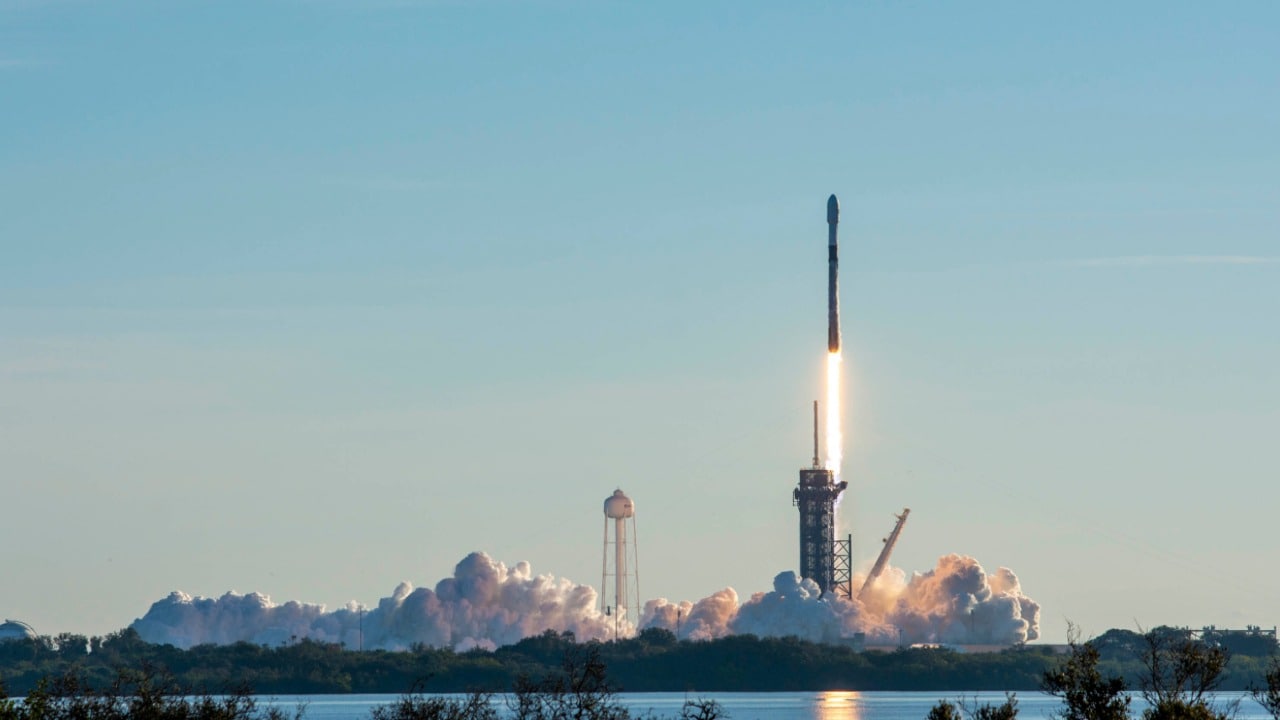
A Falcon 9 rocket launches SpaceX's Starlink to orbit. Image credit: SpaceX/Twitter[/caption]The increasing number of satellites in space as part of the massive man-made constellation envisioned by SpaceX head Elon Musk has added to the worry about increasing space junk. However, the recent mission also bore testament to carriage reusability as Falcon 9 was used to deploy payload and land back safely for the eighth time.
The UPI report quoted Jessie Anderson, a lead manufacturing engineer at SpaceX, celebrating the landing of Falcon 9 after the first stage of the booster was safely collected on a long flat-bottomed boat in the Atlantic Ocean. This time, the landing was crucial as the winds in the landing zone where the recovery ship was stationed at sea exceeded the firm’s expected safety window. Hence the first landing of 2021 took place under ‘envelope expansion’ conditions.With the safe deployment of the recent satellites, the total number of Starlink satellites have reached 955. As per Musk’s plans, SpaceX’s Starlink constellation is going to be a planned network of up to 30,000 satellites.These satellites are being placed in the low orbit of Earth and are going to form a network to provide broadband internet to various remote areas around the world.First Published:Jan 22, 2021, 09:44:34 IST
Advertisement
Advertisement

Careless Whispers: Scientists discover that plants can 'talk' to each other using smells
Japanese scientists have recorded a video that shows plants, in certain conditions, communicate with each other using mists that carry smells. The discovery, reveals that plants release a fine mist of airborne compounds, to warn nearby plants of potential dangers
Life on Mars? European Space Agency’s Orbiter discovers ice water deposits at equator
European Space Agency's Mars Express Orbiter has identified massive ice and ice water deposits beneath the surface of Mars. The Mars Express orbiter was also the first to confirmed the presence of ice on Mars in 2004
Microsoft briefly overtakes Apple as the most valuable company, Apple back on top again
At its peak during the session, Microsoft's value reached $2.903 trillion, with a 2% surge. As of writing this article, Apple closed at $2.89 trillion, whereas Microsoft closed at $2.86 trillion
Even NASA is facing a tough time, starts layoffs following major budget cuts
NASA is facing some massive budget cuts, because of which, it has been forced to postpone some upcoming missions. NASA's Jet Propulsion Laboratory has been hit hard by recent federal budget cuts, resulting in the layoff of 100 contractors last week
ISRO, NASA's NISAR satellite to get ready by Jan-end, will monitor Earth's snow-covered regions
The NISAR satellite which has been developed jointly ISRO and NASA, should be ready for launch by the end of January 2024. The collaboration between NASA and ISRO on NISAR is the first time the two agencies have cooperated on hardware development for an Earth-observing mission
Advertisement
Advertisement