


Space debris weighing 18,000 kgs from a Chinese rocket crashes into the Atlantic Ocean
The core stage of the rocket was launched on 5 May before re-entering Earth’s atmosphere and crashing off the west coast of northwest Africa.

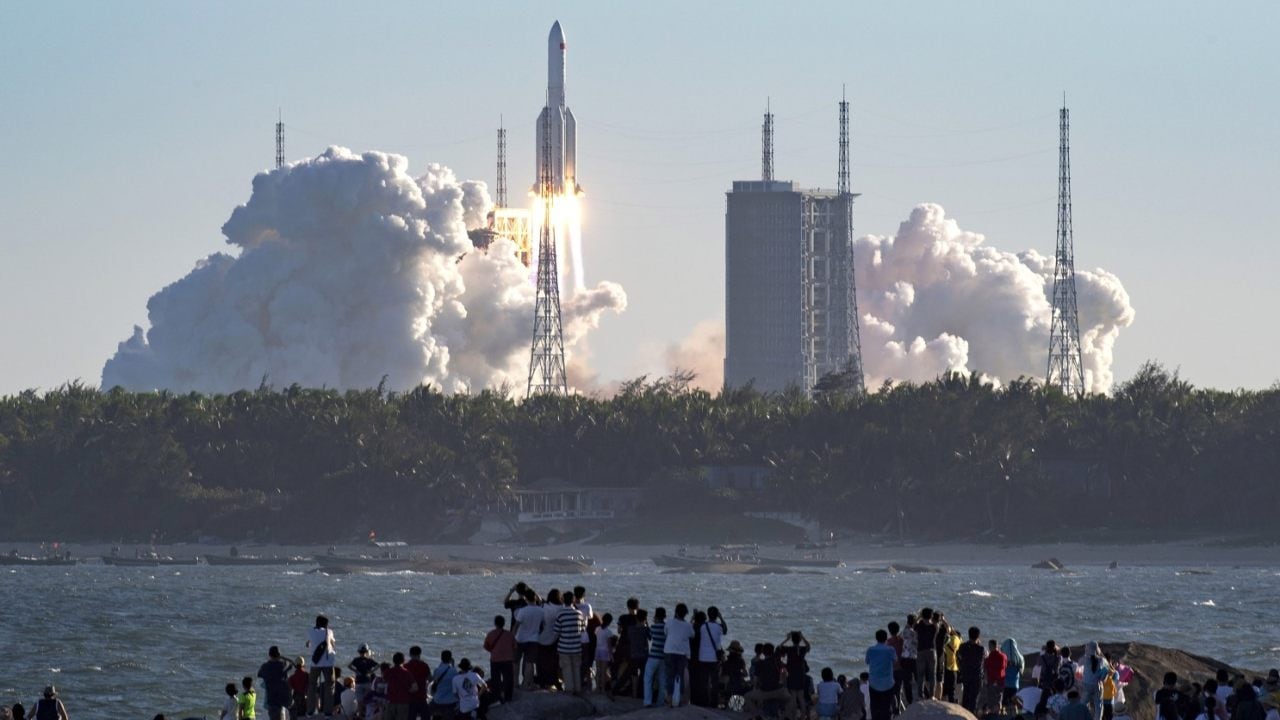
In this photo released by Xinhua News Agency, China's new large carrier rocket Long March-5B blasts off from the Wenchang Space Launch Center in southern China's Hainan Province, May 5, 2020. The Long March-5B made its maiden flight on Tuesday, sending the trial version of China's new-generation manned spaceship and a cargo return capsule for test into space. Image credit: Guo Cheng/Xinhua via AP[/caption]The only larger human-made pieces to ever fall from space were Skylab in 1979, Skylab's rocket stage in 1975 and Salyut 7 in 1991. The report added that the space shuttle Columbia from 2003 could also be added to the list since it became uncontrolled on its descent to Earth.Astronomer Jonathan McDowell from the Harvard-Smithsonian Centre for Astrophysics tweeted about the descent. “At 17.8 tonnes, it is the most massive object to make an uncontrolled re-entry since the 39-tonne Salyut–7 in 1991, unless you count OV–102 Columbia in 2003,” he wrote.
The descent was also confirmed by the 18th Space Control Squadron, a unit of the US Air Force that detects and tracks all artificial objects in Earth’s orbit.Just a day ago, Russia's space agency Roscosmos had confirmed that an old rocket that was used in past launches had broken down in space. The American 18 Space Control Squadron identified 65 associated pieces from the incident.
Careless Whispers: Scientists discover that plants can 'talk' to each other using smells
Life on Mars? European Space Agency’s Orbiter discovers ice water deposits at equator
Microsoft briefly overtakes Apple as the most valuable company, Apple back on top again
Even NASA is facing a tough time, starts layoffs following major budget cuts
ISRO, NASA's NISAR satellite to get ready by Jan-end, will monitor Earth's snow-covered regions