
Advertisement


Sections
Soyuz MS-10 crew survives emergency landing following failure of rocket booster
The two-man crew of a Soyuz MS-10 rocket landed in Kazakhstan without injuries.

A Russian Soyuz MS-10 rocket carrying a Russian cosmonaut and an American astronaut set off for a six-month mission at the International Space Station on 11 October, on a relatively rare two-man launch.The space flight with NASA's Nick Hague and second-time flyer Aleksey Ovchinin of the Russian space agency blasted off from Baikonur Cosmodrome in Kazakhstan for the International Space Station.[caption id="attachment_5360351" align="alignnone" width="1280"]![sss]()
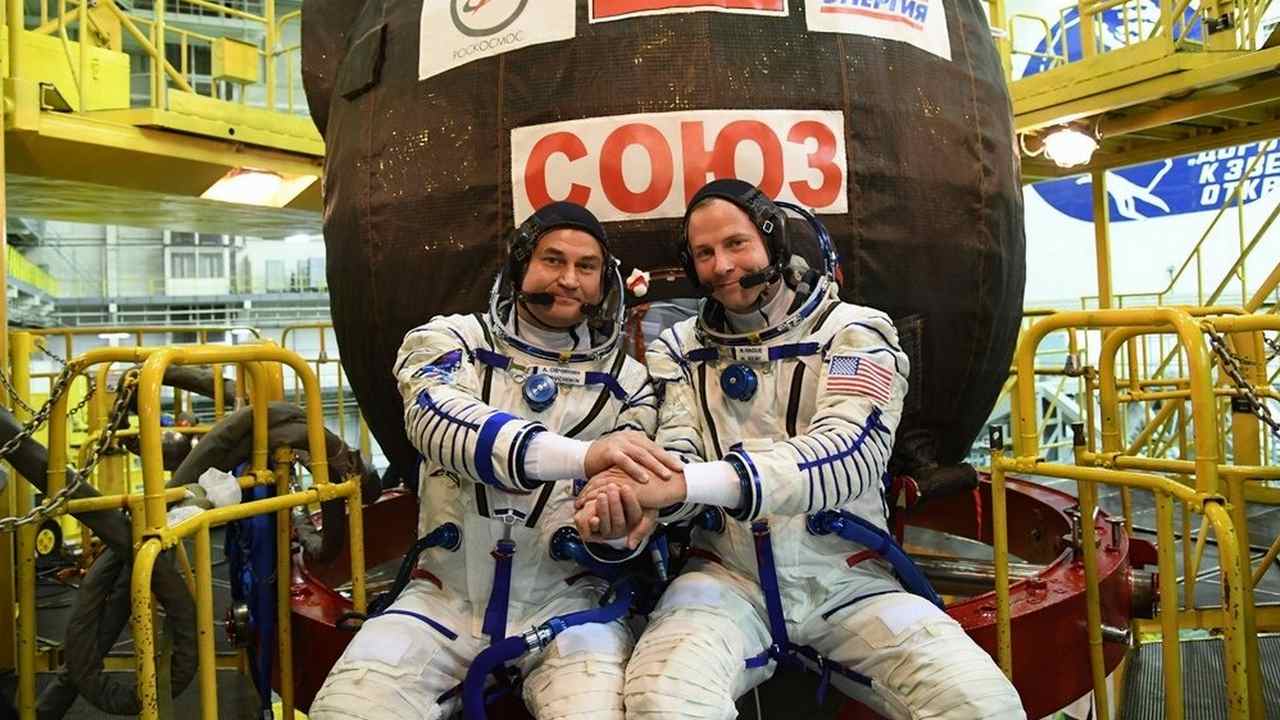
Alexey Ovchinina and Nick Hague. Twitter[/caption]The Soyuz MS-10 mission suffered a booster failure shortly after lift-off, Russian agencies said. The mission began with an on-time lift-off at 4.40 am EDT (GMT-4; 2.40 pm local time).According to NASA, the Soyuz MS-10 to have made a special landing after a "ballistic" descent. The crew-module safely separated from the rocket and returned via spacecraft, landing the two-man crew somewhere in Kazakhistan. A rescue mission was dispatched to recover the crew.
The two crew members were "alive and set to land in Kazakhstan," Russian media reported. The MS-10 mission had to be aborted following the detection of a drop in pressure in one of the rocket boosters powering the MS-10, reported NASA commentator Brandi Dean, from the Johnson Space Center. According to a report in CBS News, there were live television views from inside the cockpit which showed Ovchinin and Hague calmly monitoring the displays as they were completely pushed back into their seats due to the steady acceleration.The report further states that the Russians have routinely practised ascent abort procedures and that the Soyuz is equipped with multiple systems to assure a safe landing at any given point.With inputs from Agence France Presse.First Published:Oct 11, 2018, 17:29:15 IST
Advertisement
Advertisement

Careless Whispers: Scientists discover that plants can 'talk' to each other using smells
Japanese scientists have recorded a video that shows plants, in certain conditions, communicate with each other using mists that carry smells. The discovery, reveals that plants release a fine mist of airborne compounds, to warn nearby plants of potential dangers
Life on Mars? European Space Agency’s Orbiter discovers ice water deposits at equator
European Space Agency's Mars Express Orbiter has identified massive ice and ice water deposits beneath the surface of Mars. The Mars Express orbiter was also the first to confirmed the presence of ice on Mars in 2004
Microsoft briefly overtakes Apple as the most valuable company, Apple back on top again
At its peak during the session, Microsoft's value reached $2.903 trillion, with a 2% surge. As of writing this article, Apple closed at $2.89 trillion, whereas Microsoft closed at $2.86 trillion
Even NASA is facing a tough time, starts layoffs following major budget cuts
NASA is facing some massive budget cuts, because of which, it has been forced to postpone some upcoming missions. NASA's Jet Propulsion Laboratory has been hit hard by recent federal budget cuts, resulting in the layoff of 100 contractors last week
ISRO, NASA's NISAR satellite to get ready by Jan-end, will monitor Earth's snow-covered regions
The NISAR satellite which has been developed jointly ISRO and NASA, should be ready for launch by the end of January 2024. The collaboration between NASA and ISRO on NISAR is the first time the two agencies have cooperated on hardware development for an Earth-observing mission
Advertisement
Advertisement