
Advertisement


Sections
Scientists discover superhighway network which can be used to travel through the Solar System
According to researchers, the most star arch structures are linked to Jupiter and its gravitational force.

Scientists have now discovered a superhigh network to travel through the Solar System much faster than was earlier thought possible. As per study authors, such routes can drive comets and asteroids near Jupiter to Neptune in under a decade and to 100 astronomical units in less than a century. Study authors say that they could be used to send spacecraft to the extreme ends of the planetary system relatively fast and also monitor near-Earth objects.[caption id="attachment_9116511" align="alignnone" width="1280"]![This image is the combination of near-ultraviolet data, shown in yellow, and far-ultraviolet data, shown in blue. Image credit: NASA/JPL-Caltech]() According to researchers, the most star arch structures are linked to Jupiter and its gravitational force. The structures were resolved by gathering numerical data about millions of orbits in the Solar System and computing how they fit within already-known space manifolds.While the results need to be further studied, researchers say both determine how they can be used by spacecraft and how such manifolds behave in the vicinity of Earth, controlling asteroid and meteorite encounters.
According to researchers, the most star arch structures are linked to Jupiter and its gravitational force. The structures were resolved by gathering numerical data about millions of orbits in the Solar System and computing how they fit within already-known space manifolds.While the results need to be further studied, researchers say both determine how they can be used by spacecraft and how such manifolds behave in the vicinity of Earth, controlling asteroid and meteorite encounters.
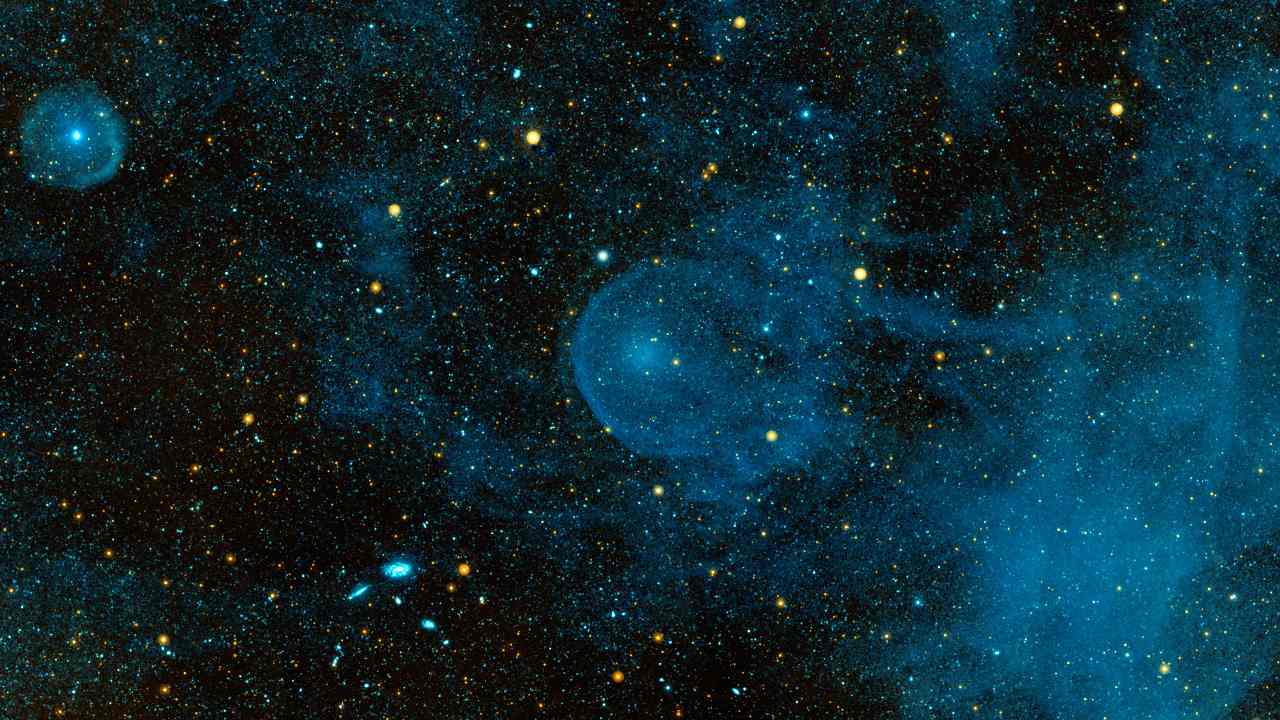
This image is the combination of near-ultraviolet data, shown in yellow, and far-ultraviolet data, shown in blue. Image credit: NASA/JPL-Caltech[/caption]As per a statement by UC San Diego News Centre, in a paper, published on 25 November, researchers observed dynamical structure of these routes, forming connected series of arches inside space manifolds that range all the way from Uranus and beyond.The newly discovered "œcelestial autobahn," or œcelestial highway acts over several decades unlike the millions of years that usually characterise Solar System dynamics.
First Published:Dec 16, 2020, 12:32:07 IST
Advertisement
Advertisement

Careless Whispers: Scientists discover that plants can 'talk' to each other using smells
Japanese scientists have recorded a video that shows plants, in certain conditions, communicate with each other using mists that carry smells. The discovery, reveals that plants release a fine mist of airborne compounds, to warn nearby plants of potential dangers
Life on Mars? European Space Agency’s Orbiter discovers ice water deposits at equator
European Space Agency's Mars Express Orbiter has identified massive ice and ice water deposits beneath the surface of Mars. The Mars Express orbiter was also the first to confirmed the presence of ice on Mars in 2004
Microsoft briefly overtakes Apple as the most valuable company, Apple back on top again
At its peak during the session, Microsoft's value reached $2.903 trillion, with a 2% surge. As of writing this article, Apple closed at $2.89 trillion, whereas Microsoft closed at $2.86 trillion
Even NASA is facing a tough time, starts layoffs following major budget cuts
NASA is facing some massive budget cuts, because of which, it has been forced to postpone some upcoming missions. NASA's Jet Propulsion Laboratory has been hit hard by recent federal budget cuts, resulting in the layoff of 100 contractors last week
ISRO, NASA's NISAR satellite to get ready by Jan-end, will monitor Earth's snow-covered regions
The NISAR satellite which has been developed jointly ISRO and NASA, should be ready for launch by the end of January 2024. The collaboration between NASA and ISRO on NISAR is the first time the two agencies have cooperated on hardware development for an Earth-observing mission
Advertisement
Advertisement