


Scientists detect water vapor rising from geysers on Jupiter's moon Europa
Under Europa's icy surface is a salty ocean that contains twice as much water than that on earth.

One of Jupiter’s 79 moons, Europa has liquid water under its icy surface and from time to time erupts in huge geysers. While scientists have had an inkling of the presence of water, for the longest time, there was no actual evidence of this. Now a team of researchers from NASA's Goddard Space Flight Center have detected water vapour rising out from Europa’s surface.Scientists spotted the vapour after spending 17 (non-consecutive) nights during 2016-2017 peering through a telescope at the W M Keck Observatory in Hawaii. Europa, like Earth’s moon, is gravitationally-locked to its host planet, so the leading hemisphere always faces the direction of the orbit, while the trailing hemisphere always faces in the opposite direction. Water molecules in Europa's leading hemisphere — the side locked forever facing the direction in which Europa goes around Jupiter in its orbit.[caption id="attachment_7685631" align="alignnone" width="1280"]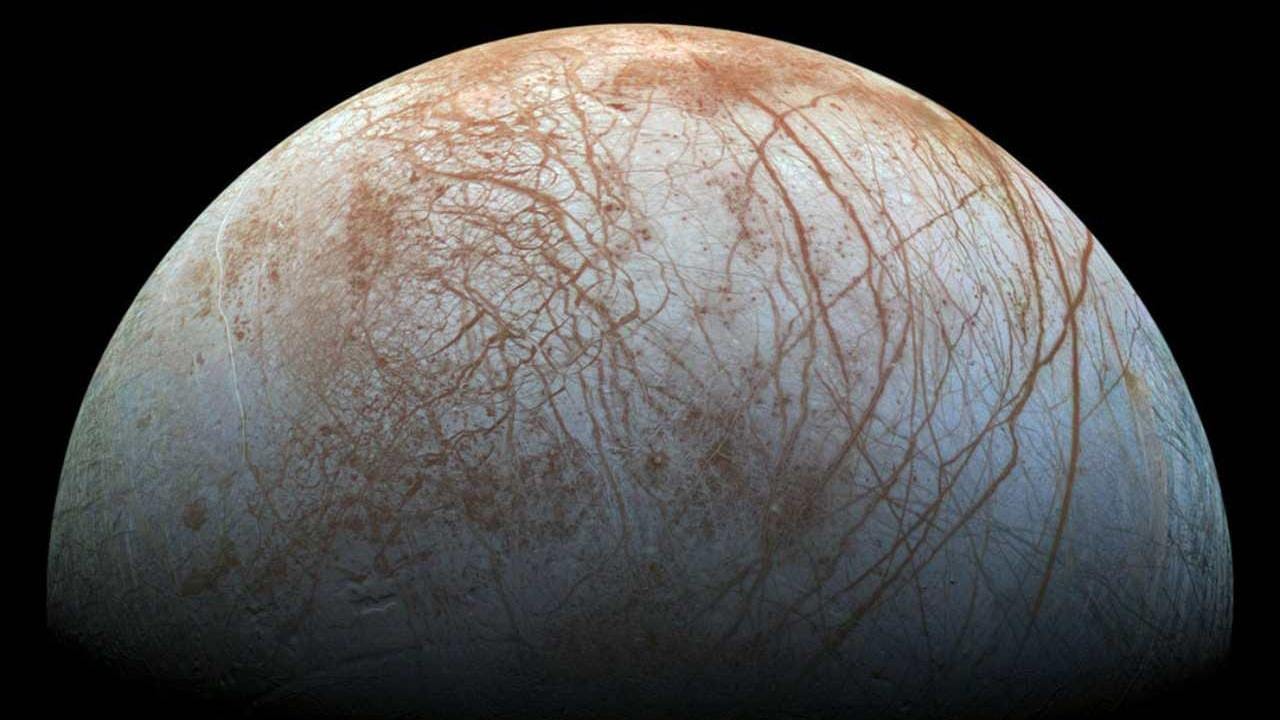 In this image captured during the Galileo mission in the 1990s, Europa's icy surface and the long fissures cutting through them are evident. Image courtesy: NASA[/caption]The observatory also had a spectrograph, which can make measurements of the chemical composition of a planet's atmosphere using infrared light, which molecules either emit or absorb. Compounds like water absorb the infrared energy that finds them and emits a different, unique frequency that can be traced by researchers from light-years (even thousands of light-years, in the case of exoplanet-hunting satellites like TESS) away.
Is water vapour on Europa a big deal?
Finding water vapour on Europa has helped researchers understand it better, and other moons by association. Moreover, water anywhere in space is a promising discovery since it could point to possible extraterrestrial life. Water is essential for any living systems as it has nutrients for them to eat, it can transport chemicals to living cells and allow those cells to get rid of waste.Hidden beneath Europa's icy surface is what scientists think is an expansive, salty ocean containing twice as much water as that on Earth. The water vapour, scientists believe, could be coming out from either the ocean itself or a shallow reservoir of liquid water ice.[caption id="attachment_7686011" align="alignnone" width="1280"]
Could a liquid water ocean beneath the surface of Jupiter’s moon Europa have the ingredients to support life? Image: NASA/JPL[/caption]"Essential chemical elements (carbon, hydrogen, oxygen, nitrogen, phosphorus, and sulfur) and sources of energy, two of three requirements for life, are found all over the solar system," Lucas Paganini, a NASA planetary scientist who led the water detection investigation, said in a statement. "But the third — liquid water — is somewhat hard to find beyond Earth. While scientists have not yet detected liquid water directly, we’ve found the next best thing: water in vapour form.”Water, chemistry and energy make up the three requirements for life on another planet.
What next?
To follow in the footsteps of the Voyager spacecraft, which paid a flyby visit to Europa in 1979, NASA has plans to send the first dedicated mission to Europa in the Clipper mission i. To explore if the moon has conditions favourable for life, the mission won't take a direct approach and look for signatures of life like the Mars 2020 rover or Curiosity. Instead, the Clipper orbiter-only mission will tackle answers around Europa’s ocean and peculiar ice shell, the composition of the atmosphere and surface, and geology.[caption id="attachment_7685611" align="alignnone" width="1280"]
Artist illustration of the Clipper mission to Europa. Image credit: NASA[/caption]The findings from this study have been published in the journal Nature Astronomy.

Careless Whispers: Scientists discover that plants can 'talk' to each other using smells
Life on Mars? European Space Agency’s Orbiter discovers ice water deposits at equator
Microsoft briefly overtakes Apple as the most valuable company, Apple back on top again
Even NASA is facing a tough time, starts layoffs following major budget cuts
ISRO, NASA's NISAR satellite to get ready by Jan-end, will monitor Earth's snow-covered regions