
Advertisement


Sections
SciArt: Teen illustrator brings chemistry in the periodic table alive with graphics
Scrolling through the illustrated elements feels a lot like strolling through Mendeleev's very own garden.

There are a hundred and eighteen elements known, which collectively make up the entire world as we know it. From the books that we read, the phones that we use, to the cars that we drive, the elements are the foundation of chemistry. Yet, as students, the organic, inorganic and most of all, the long, tedious Periodic Table of Elements was quite intimidating.A college-going chemistry illustrator, Julie Hu, has put a cool new spin in this age-old Table, with unique graphics suited to each and every individual element. Beware, though. Once you've seen Hu's version of the Periodic Table, the former version simply won't cut it for you anymore.[caption id="attachment_6578071" align="aligncenter" width="1280"]![Julie Hu's illustrated version of the Periodic Table of Elements. Image: thePeriodicGraphicsOfElements.com]()
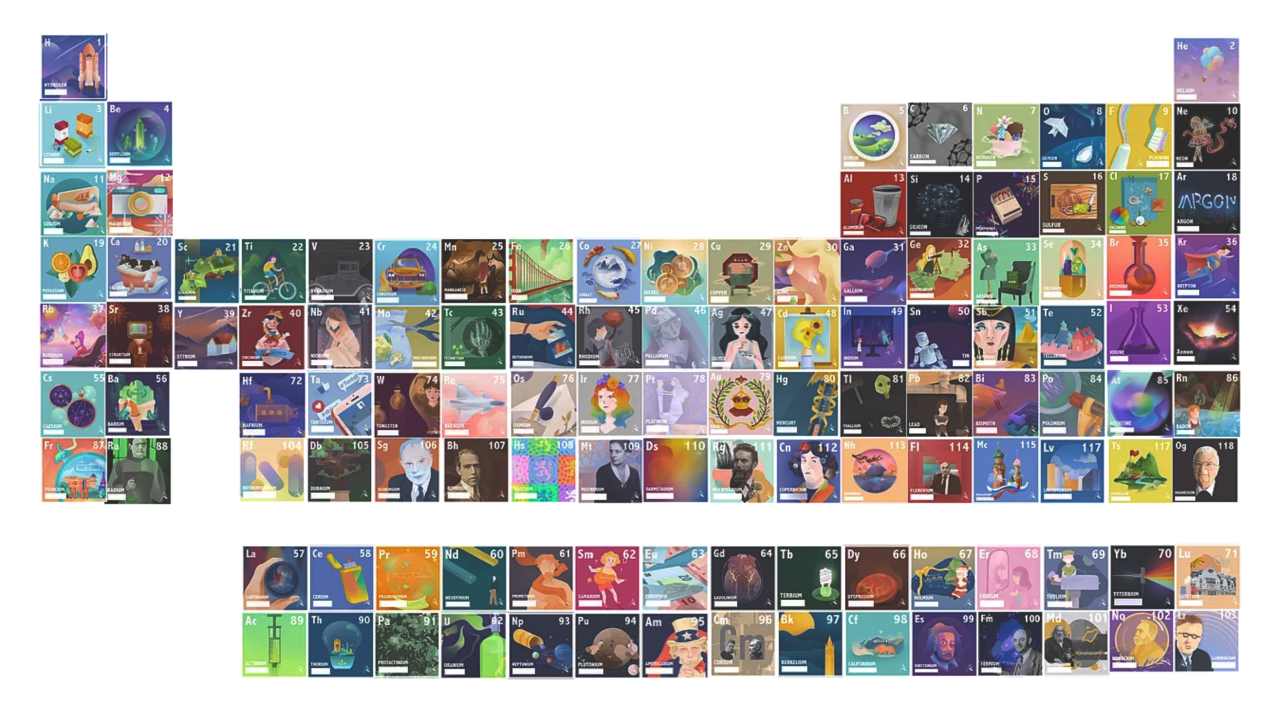
Julie Hu's illustrated version of the Periodic Table of Elements. Image: thePeriodicGraphicsOfElements.com[/caption]"Chemical elements do not only exist as concepts in the chemistry books, but also are relevant to us in our daily lives," the project website reads. Each of the 118 elements has a carefully chosen graphic representing something unique about the element — a significant, use or property that sets it apart. Lithium, for instance, is widely-popular for its use in the lithium-ion batteries, which is used to power most electronics — mobile phones, cars, even satellites.
Nickel is used to make currency coins, and titanium, to build machinery, medical equipment and surgical implants for people with hands or legs impaired.The artist's personal favourite is gallium, illustrated by a melting spoon.Gallium has a very low melting point, of just 85.58 degrees Fahrenheit. This means that a spoon made of gallium would disappear before your eyes if you used it to stir your coffee. Francium is another one of Hu's favourites, a highly radioactive element with an extremely short half-life of just 20 minutes. Part of the illustration for the element Francium is a countdown timer showing "00:20", along with an Eiffel Tower and a chateau to represent France, in honor of which the element was named.Julie Hu's SciArt project, Alchemy, is aiming to boost science communication through visual art.Scroll through the inspired, illustrated version of the periodic table of elements, Hu hopes that it feels like a pleasant stroll through the Father of Chemistry, Mendeleev's very own garden.First Published:May 06, 2019, 12:59:42 IST
Advertisement
Advertisement

Careless Whispers: Scientists discover that plants can 'talk' to each other using smells
Japanese scientists have recorded a video that shows plants, in certain conditions, communicate with each other using mists that carry smells. The discovery, reveals that plants release a fine mist of airborne compounds, to warn nearby plants of potential dangers
Life on Mars? European Space Agency’s Orbiter discovers ice water deposits at equator
European Space Agency's Mars Express Orbiter has identified massive ice and ice water deposits beneath the surface of Mars. The Mars Express orbiter was also the first to confirmed the presence of ice on Mars in 2004
Microsoft briefly overtakes Apple as the most valuable company, Apple back on top again
At its peak during the session, Microsoft's value reached $2.903 trillion, with a 2% surge. As of writing this article, Apple closed at $2.89 trillion, whereas Microsoft closed at $2.86 trillion
Even NASA is facing a tough time, starts layoffs following major budget cuts
NASA is facing some massive budget cuts, because of which, it has been forced to postpone some upcoming missions. NASA's Jet Propulsion Laboratory has been hit hard by recent federal budget cuts, resulting in the layoff of 100 contractors last week
ISRO, NASA's NISAR satellite to get ready by Jan-end, will monitor Earth's snow-covered regions
The NISAR satellite which has been developed jointly ISRO and NASA, should be ready for launch by the end of January 2024. The collaboration between NASA and ISRO on NISAR is the first time the two agencies have cooperated on hardware development for an Earth-observing mission
Advertisement
Advertisement