


Researchers measure and confirm the distance to oldest, farthest galaxy GN-z11 in the universe
The team of researchers measured the redshift of GN-z11, which is the light stretches out, becomes redder, the farther it travels.

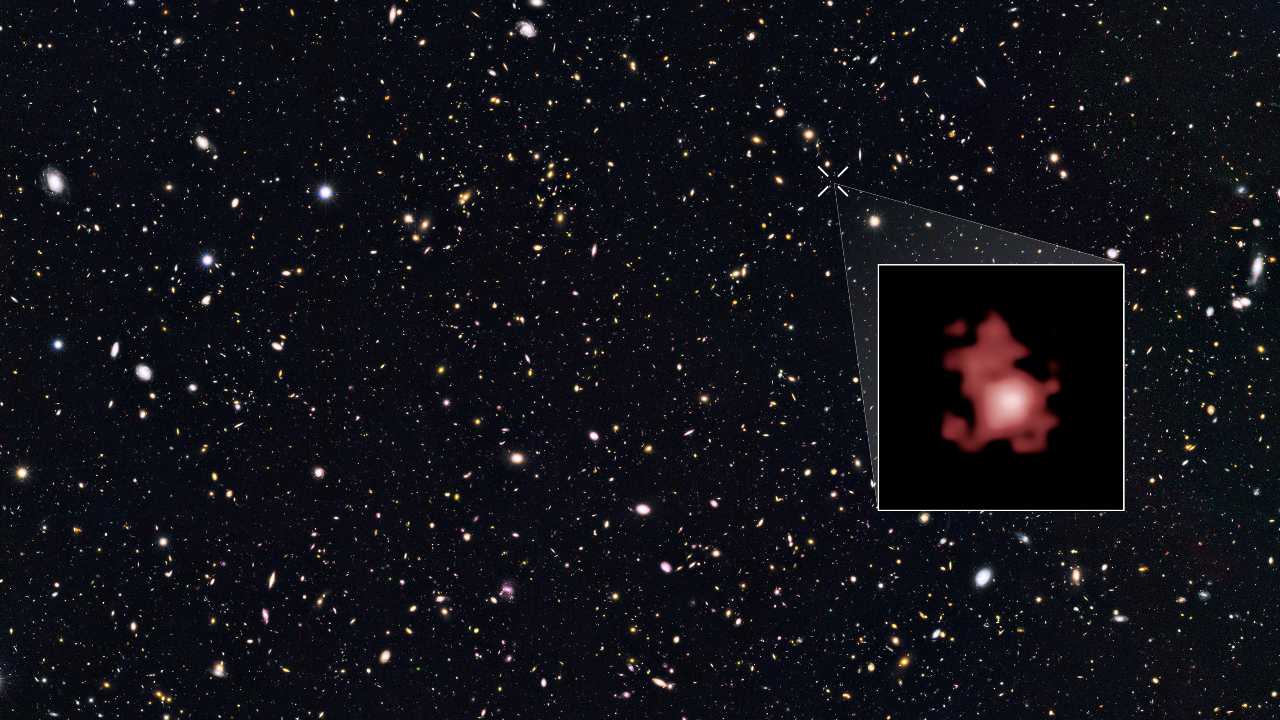
Galaxy GN-z11, shown in the inset, is seen as it was 13.4 billion years in the past, just 400 million years after the big bang, when the universe was only three percent of its current age. The galaxy is ablaze with bright, young, blue stars, but looks red in this image because its light has been stretched to longer spectral wavelengths by the expansion of the universe. Image credit: Wikipedia/NASA, ESA, P. Oesch (Yale University), G. Brammer (STScI), P. van Dokkum (Yale University), and G. Illingworth (University of California, Santa Cruz)[/caption]Kashikawa said that previous studies have estimated that the galaxy GN-z11 is the farthest detectable galaxy at 13.4 billion light-years (approximately 134 nonillion kilometres), but measuring and verifying such a distance is no easy task.The team of researchers measured the redshift of GN-z11, which is the light stretches out, becomes redder, the farther it travels. According to study authors, certain chemical signatures, called emission lines, imprint distinct patters in the light from distant objects. Measuring how stretched the emission lines are, astronomers can figure out how far the light must have travelled and give an idea about the distance between celestial bodies.Kashikawa added that they looked at ultraviolet light as that is the area of the electromagnetic spectrum they expected to find red chemical signatures. According to him, the Hubble Space Telescope detected the signature multiple times in the spectrum of GN-z11, but since the Hubble cannot resolve ultraviolet emission lines to the degree they needed, they turned to MOSFIRE, which is mounted to the Keck I telescope in Hawaii.The MOSFIRE captured the emission lines in detail, allowing the team to make a more concrete estimation on the distance of the GN-z11. As astronomers use a value known as the redshift number denoted by z, Kashikawa and his team increased the galaxy’s z value by a factor of 100.The study has been published in Nature Astronomy.

Careless Whispers: Scientists discover that plants can 'talk' to each other using smells
Life on Mars? European Space Agency’s Orbiter discovers ice water deposits at equator
Microsoft briefly overtakes Apple as the most valuable company, Apple back on top again
Even NASA is facing a tough time, starts layoffs following major budget cuts
ISRO, NASA's NISAR satellite to get ready by Jan-end, will monitor Earth's snow-covered regions