


Red Brittle Star, cousin to Starfish, does not have eyes but uses cells in its body to see
The sea urchin is the only other creature to possess this extraocular vision that uses cells in the body to sense light.

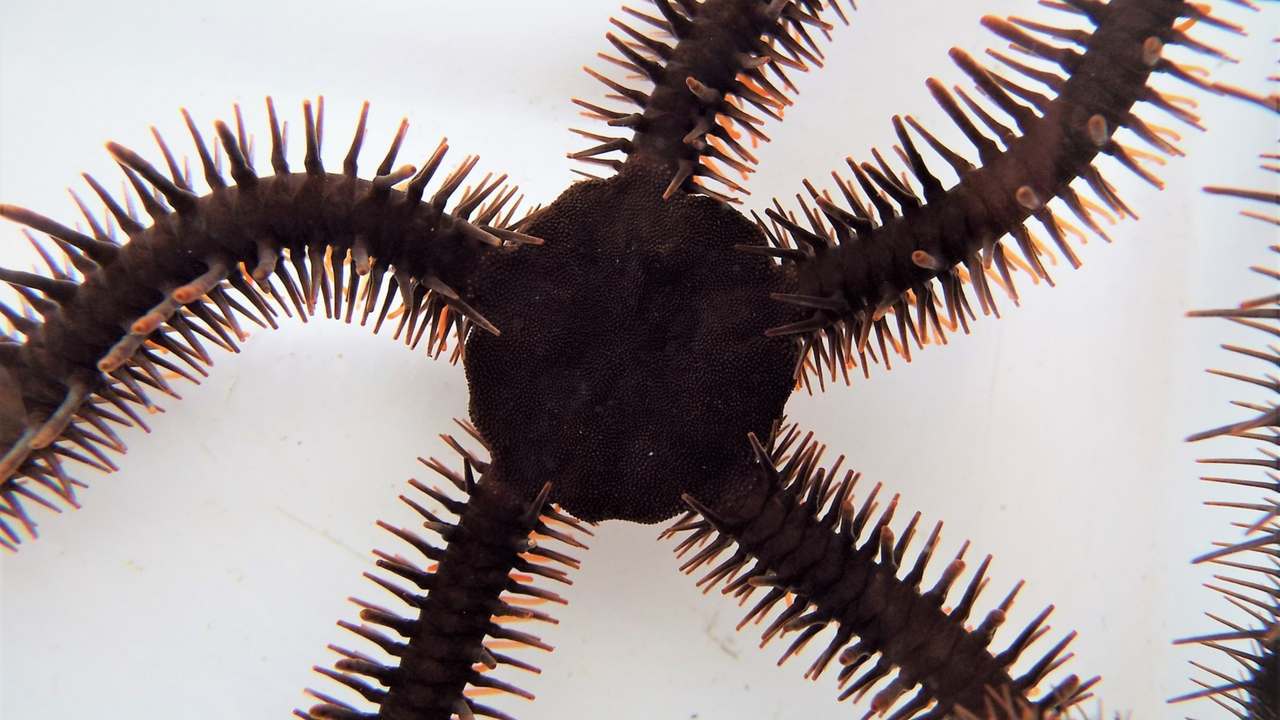
A red brittle star, Ophiocoma wendtii Image credit: Lauren Sumner-Rooney[/caption]Brittle stars, with five radiating arms extending from a central disk, are related to starfish (also called sea stars), sea cucumbers, sea urchins and others in a group of marine invertebrates called echinoderms. They have a nervous system but no brain.The red brittle star - up to about 14 inches (35 cm) from arm tip to arm tip - lives in bright and complex habitats, with high predation threats from reef fish. It stays hidden during daytime - making the ability to spot a safe place to hide critical - and comes out at night to feed on detritus.Its photoreceptors are surrounded during daytime by chromatophores that narrow the field of the light being detected, making each photoreceptor like the pixel of a computer image that, when combined with other pixels, makes a whole image. The visual system does not work at night when the chromatophores contract.“If our conclusions about the chromatophores are correct, this is a beautiful example of innovation in evolution,” said Lauren Sumner-Rooney, a research fellow at Oxford University Museum of Natural History who led the study published in the journal Current Biology.Laboratory experiments indicated the brittle stars have a rudimentary vision. Placed in a circular arena, they moved toward walls that were white with a black bar, suggestive of a daytime hiding place.Another scenario showed they were not simply detecting brightness versus darkness. When they were presented with grey walls making it so no part of the arena was lighter or darker overall, they still moved toward the black stripe, which was centred on a white stripe so as to reflect the same amount of light as the grey.“It’s such an alien concept for us, as very visually driven animals, to conceive of how an animal might see its habitat without eyes, but now we know of two examples,” Sumner-Rooney added.

Careless Whispers: Scientists discover that plants can 'talk' to each other using smells
Life on Mars? European Space Agency’s Orbiter discovers ice water deposits at equator
Microsoft briefly overtakes Apple as the most valuable company, Apple back on top again
Even NASA is facing a tough time, starts layoffs following major budget cuts
ISRO, NASA's NISAR satellite to get ready by Jan-end, will monitor Earth's snow-covered regions