
Advertisement


Sections
Record-setting X-ray burst from a pulsar captured by a 'NICE' telescope on the space station
Turns out researchers caught something extra in this particular pulsar — a signature, in the form of a huge thermonuclear flash

A telescope mounted to the outside of the International Space Station (ISS) picked up on a sudden spike of X-rays coming from a distant neutron star on 20 August 2019. While this kind of signal itself isn't a new discovery, the explosion was powerful enough to release, in 20 seconds, the amount of energy our sun releases in 10 days. These highly-energetic X-ray pulses are called "pulsars", which are rapidly spinning neutron stars that beam jets of charged particles from their magnetic poles.Turns out researchers caught something extra in this particular pulsar — a signature, in the form of a huge thermonuclear flash that astronomers have dubbed 'J1808'. This pulsar, the crushed remains of a star that exploded in a supernova and is 11,400 light-years away and in the same line of sight as the constellations Sagittarius (a.k.a. the Archer) to an observer on Earth.![]() In the past five decades, scientists have studied these compact, mysterious stellar objects from space using different instruments that can see (and capture) different wavelengths of light, especially sensitive to astronomical phenomena like pulsars, which are far more energetic than the radio waves picked up by a variety of space/ground-based telescopes.The Neutron star Interior Composition Explorer mission (NICER, if you'd rather) is the first mission from NASA devoted to the study of pulsars. The mission also famously observed the first recorded pulsar, known today as PSR B1919+21, in November 1967. NICER was launched to the International Space Station in June 2017 and began its science experiments in July the same year.X-ray observations made by NICER are a window into some of the lesser-known fundamental forces in the natural universe that may or may not challenge the laws of physics as we understand it. The inner working of a pulsar simply don't exist anywhere else and can't be reproduced in a laboratory as of today, which makes them interesting subjects for astrophysics researchers.[caption id="attachment_7654711" align="alignnone" width="1280"]
In the past five decades, scientists have studied these compact, mysterious stellar objects from space using different instruments that can see (and capture) different wavelengths of light, especially sensitive to astronomical phenomena like pulsars, which are far more energetic than the radio waves picked up by a variety of space/ground-based telescopes.The Neutron star Interior Composition Explorer mission (NICER, if you'd rather) is the first mission from NASA devoted to the study of pulsars. The mission also famously observed the first recorded pulsar, known today as PSR B1919+21, in November 1967. NICER was launched to the International Space Station in June 2017 and began its science experiments in July the same year.X-ray observations made by NICER are a window into some of the lesser-known fundamental forces in the natural universe that may or may not challenge the laws of physics as we understand it. The inner working of a pulsar simply don't exist anywhere else and can't be reproduced in a laboratory as of today, which makes them interesting subjects for astrophysics researchers.[caption id="attachment_7654711" align="alignnone" width="1280"]![NICER has captured a record setting X-ray burst in November. Image: NASA]() NICER has captured a record setting X-ray burst in November. Image: NASA[/caption]"What's inside a pulsar?" is one of many long-standing astrophysics questions about these ultra-dense, fast-spinning, powerfully magnetic objects, according to a NASA press release.Today, scientists know of over 2,000 pulsars. These rotating “lighthouse” neutron stars begin their lives as stars between about seven and 20 times the mass of our sun. Some are found to spin hundreds of times per second, faster than the blades of a household blender, and they possess enormously strong magnetic fields.The newly-observed rarity offered some interesting insight about pulsars – there was a brief expansion of its many layers as the intensity was built up and the energy of the blast built up enough to blow the pulsar’s hydrogen layer into space. The flickering of these “burst oscillations” is also interesting to scientists since it appears to rise and fall at the pulsar’s spinning frequency, just like its X-ray signals do. Yet, these happen at different locations on the pulsar's surface than the hotspots associated with its normal X-ray pulses.A paper describing the findings has been published by The Astrophysical Journal Letters.
NICER has captured a record setting X-ray burst in November. Image: NASA[/caption]"What's inside a pulsar?" is one of many long-standing astrophysics questions about these ultra-dense, fast-spinning, powerfully magnetic objects, according to a NASA press release.Today, scientists know of over 2,000 pulsars. These rotating “lighthouse” neutron stars begin their lives as stars between about seven and 20 times the mass of our sun. Some are found to spin hundreds of times per second, faster than the blades of a household blender, and they possess enormously strong magnetic fields.The newly-observed rarity offered some interesting insight about pulsars – there was a brief expansion of its many layers as the intensity was built up and the energy of the blast built up enough to blow the pulsar’s hydrogen layer into space. The flickering of these “burst oscillations” is also interesting to scientists since it appears to rise and fall at the pulsar’s spinning frequency, just like its X-ray signals do. Yet, these happen at different locations on the pulsar's surface than the hotspots associated with its normal X-ray pulses.A paper describing the findings has been published by The Astrophysical Journal Letters.
 In the past five decades, scientists have studied these compact, mysterious stellar objects from space using different instruments that can see (and capture) different wavelengths of light, especially sensitive to astronomical phenomena like pulsars, which are far more energetic than the radio waves picked up by a variety of space/ground-based telescopes.The Neutron star Interior Composition Explorer mission (NICER, if you'd rather) is the first mission from NASA devoted to the study of pulsars. The mission also famously observed the first recorded pulsar, known today as PSR B1919+21, in November 1967. NICER was launched to the International Space Station in June 2017 and began its science experiments in July the same year.X-ray observations made by NICER are a window into some of the lesser-known fundamental forces in the natural universe that may or may not challenge the laws of physics as we understand it. The inner working of a pulsar simply don't exist anywhere else and can't be reproduced in a laboratory as of today, which makes them interesting subjects for astrophysics researchers.[caption id="attachment_7654711" align="alignnone" width="1280"]
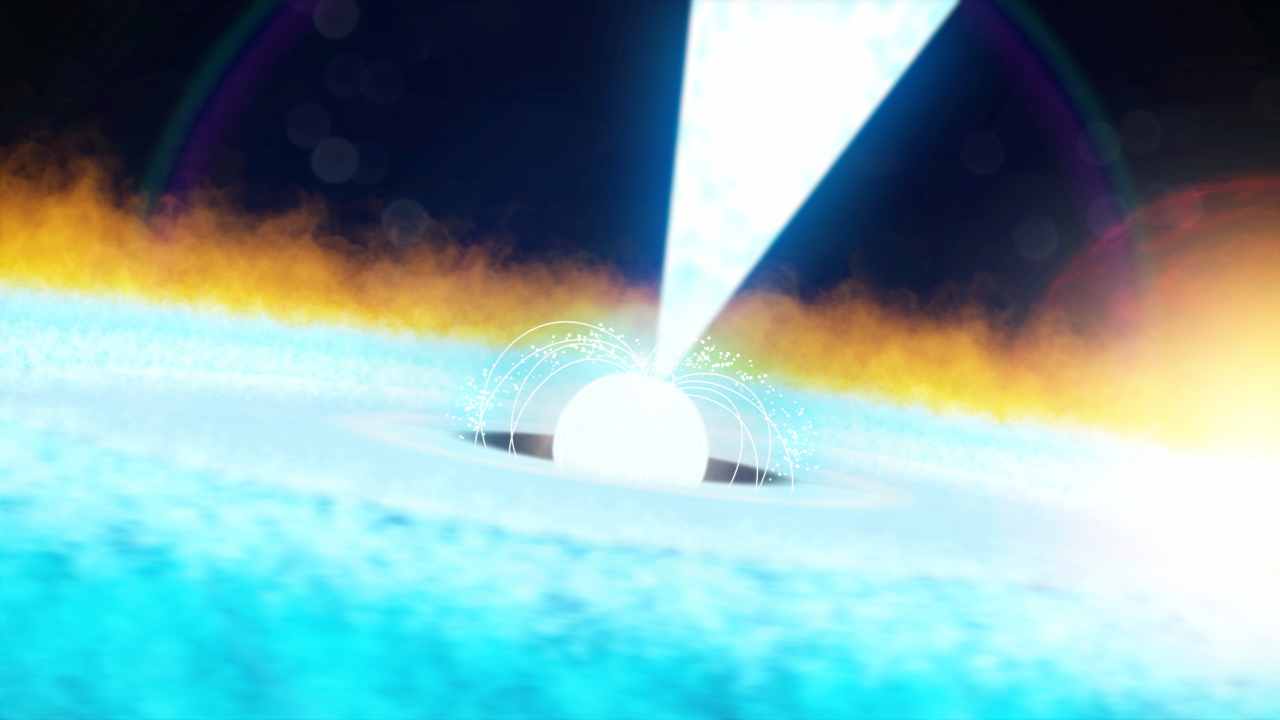 NICER has captured a record setting X-ray burst in November. Image: NASA[/caption]"What's inside a pulsar?" is one of many long-standing astrophysics questions about these ultra-dense, fast-spinning, powerfully magnetic objects, according to a NASA press release.Today, scientists know of over 2,000 pulsars. These rotating “lighthouse” neutron stars begin their lives as stars between about seven and 20 times the mass of our sun. Some are found to spin hundreds of times per second, faster than the blades of a household blender, and they possess enormously strong magnetic fields.The newly-observed rarity offered some interesting insight about pulsars – there was a brief expansion of its many layers as the intensity was built up and the energy of the blast built up enough to blow the pulsar’s hydrogen layer into space. The flickering of these “burst oscillations” is also interesting to scientists since it appears to rise and fall at the pulsar’s spinning frequency, just like its X-ray signals do. Yet, these happen at different locations on the pulsar's surface than the hotspots associated with its normal X-ray pulses.A paper describing the findings has been published by The Astrophysical Journal Letters.
First Published:Nov 15, 2019, 08:45:52 IST
Advertisement
Advertisement

Careless Whispers: Scientists discover that plants can 'talk' to each other using smells
Japanese scientists have recorded a video that shows plants, in certain conditions, communicate with each other using mists that carry smells. The discovery, reveals that plants release a fine mist of airborne compounds, to warn nearby plants of potential dangers
Life on Mars? European Space Agency’s Orbiter discovers ice water deposits at equator
European Space Agency's Mars Express Orbiter has identified massive ice and ice water deposits beneath the surface of Mars. The Mars Express orbiter was also the first to confirmed the presence of ice on Mars in 2004
Microsoft briefly overtakes Apple as the most valuable company, Apple back on top again
At its peak during the session, Microsoft's value reached $2.903 trillion, with a 2% surge. As of writing this article, Apple closed at $2.89 trillion, whereas Microsoft closed at $2.86 trillion
Even NASA is facing a tough time, starts layoffs following major budget cuts
NASA is facing some massive budget cuts, because of which, it has been forced to postpone some upcoming missions. NASA's Jet Propulsion Laboratory has been hit hard by recent federal budget cuts, resulting in the layoff of 100 contractors last week
ISRO, NASA's NISAR satellite to get ready by Jan-end, will monitor Earth's snow-covered regions
The NISAR satellite which has been developed jointly ISRO and NASA, should be ready for launch by the end of January 2024. The collaboration between NASA and ISRO on NISAR is the first time the two agencies have cooperated on hardware development for an Earth-observing mission
Advertisement
Advertisement